


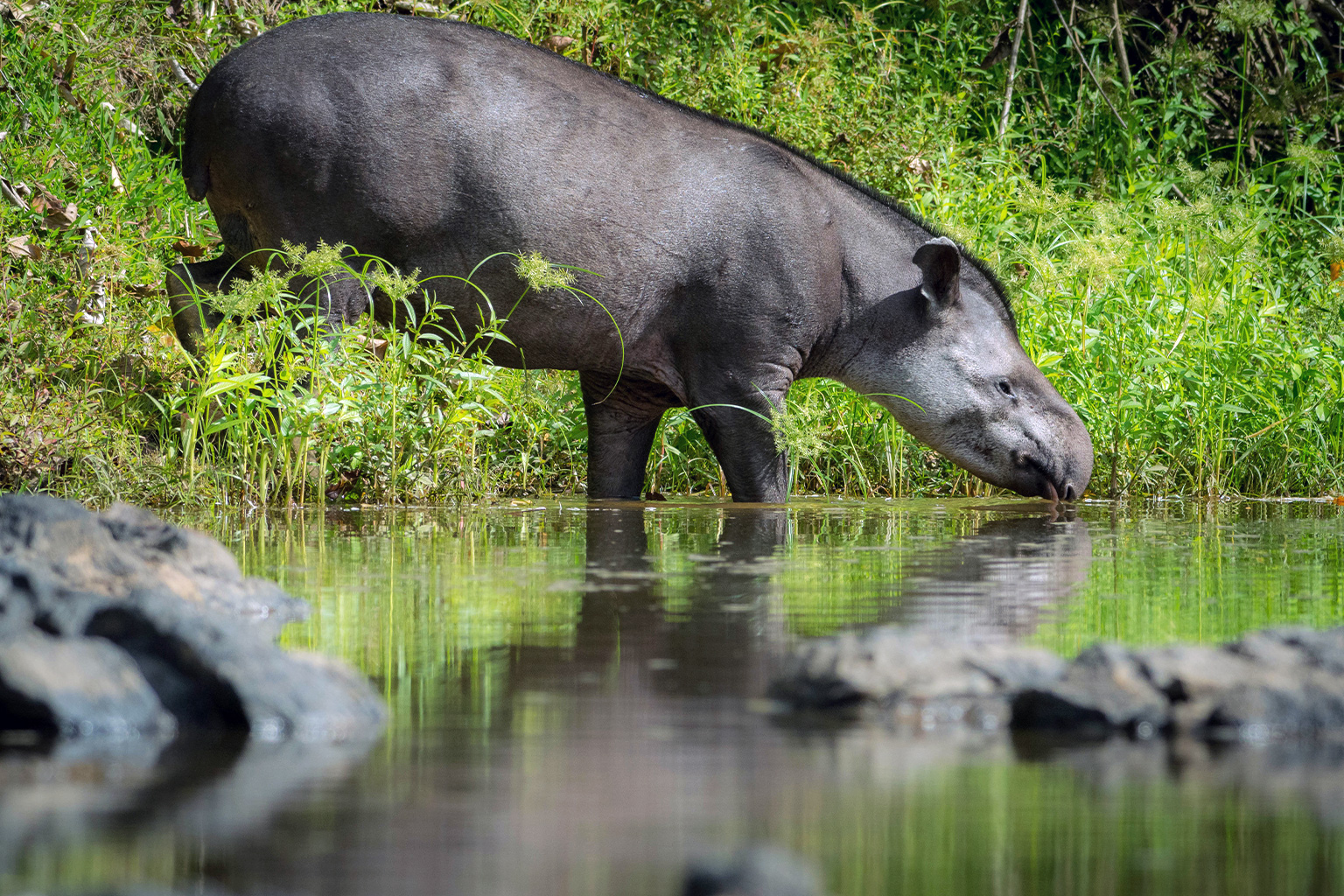
- Studies have found microplastics in various species of Amazonian wildlife, including fish, tapirs, crabs and bats, even within protected areas far from major urban centers.
- Contamination spreads through multiple routes, traveling from small forest streams known as igarapés to the mouth of the Amazon River, where birds are building “blue nests” out of plastic debris.
- Although the toxic effects on animals remain poorly understood, data show that microplastics cross between aquatic and terrestrial ecosystems, potentially impacting the entire food chain.
This is the third and final article in a special series on microplastics in the Amazon. Read the first story here and the second story here.
MANAUS, Brazil — Traveling by boat up the Negro River from Amazonas state capital Manaus, it takes eight to nine hours to cover the 100 kilometers (62 miles) to Anavilhanas National Park. This protected area preserves one of the world’s largest freshwater archipelagos, comprising more than 400 islands and 60 lakes.
They include Prato Lake, which is about 3.5 kilometers (about 2 miles) long and 1.5 kilometers (nearly 1 mile) wide. Yet, even here, in a protected area far from urban pressures, microplastics were found in the digestive tracts of fish.
A recent study found an average concentration of 0.25 particles per liter of microplastics in the waters of Prato Lake. The particles were also present in the fish analyzed, regardless of their feeding habits, averaging 3.3 particles per individual. In total, about eight out of every 10 fish contained microplastics, despite living in a preserved area far from urban centers.
“As a result of the entire connectivity dynamic that exists between aquatic environments in the Amazon, plastic is found even in the most remote places,” said co-author of the study Adalberto Val, a biologist from the National Institute of Amazonian Research (INPA).
Plastic’s likely journey begins long before it reaches the lake. Most of the particles found in the fish consisted of filaments of polyamide, also known as nylon, alongside fragments of materials like PET. Synthetic clothing fibers, abandoned fishing nets, packaging and bottles enter the environment after being used in cities and local communities and on boats. Over time, part of this material is broken down into fragments by sun, heat and friction and carried into other water bodies by rain, small forest streams known as igarapés, and rivers.
During seasonal floods, rising waters connect riverbanks, forests, channels and lakes. During low-water periods, some of this plastic is trapped in the soil, caught in vegetation or deposited on the riverbed. Even when an area’s immediate surroundings are free from direct urban influence, as with Prato Lake, it remains connected to a vast water network that transports and distributes these particles.
In a separate study, Spanish researcher Andreu Rico also found microplastics in Anavilhanas, at concentrations of 5-8 particles per cubic meter. “These concentrations are much lower than those found in Amazonian cities and do not pose a risk of poisoning to animals,” Rico said. “But they show how plastics travel through water or air and how there is microplastic in any sample you take.”
In igarapés, invisible impacts at the foundation of life
Microplastics’ journey through the Amazon likely begins in the igarapés. They receive untreated sewage and uncollected garbage directly, especially in large cities like Manaus and Belém. As a result, microplastic concentrations in these streams are hundreds of times higher than in the main channel of the Amazon River.
In these aquatic environments that are much smaller than rivers and lakes, microplastics are severe stressors for organisms at the base of ecosystems. It is the case with aquatic insects that shred leaves, accelerating the decomposition of organic matter and serving as a vital food source for fish and other wildlife.
An experiment conducted on Amazonian Trichoptera found high mortality rates for aquatic insects or caddisflies locally known as moscas-d’água (Phylloicus elektoros) after 15 days of exposure to microplastics. At one of the concentrations tested, which is higher than environmental conditions currently considered common, 96% of the insects died. “Mortality increases by about seven times compared to the pollution-free environment. In a longer experiment, they all might die,” said one of the study’s authors Renato Tavares Martins, a researcher at the Adapta National Institute of Science and Technology.
The contamination mechanism is directly connected to how these insects live. As shredders, they feed on organic debris like leaves that fall on igarapés. When microplastics accumulate on these leaves, the insects ingest them along with their food. Many species also breathe through external gills. As contaminated water passes over these structures, plastic particles may clog them, reducing the surface area available for respiration.
Once ingested, microplastics may physically block the digestive tract and accumulate in excretory organs. But the damage does not stop there. Because they are the foundation of the food chain and nutrient cycle in Amazonian streams, contaminated caddisflies and other aquatic insects can transfer microplastics to terrestrial environments and other animals. “If a predator, such as a fish, eats a shredder insect, it will also be eating the microplastics inside that insect,” Tavares said.
A key part of these insects’ diet also depends on conidial fungi, named for their reproduction via spores called conidia. These even tinier organisms colonize fallen leaves in the streams and perform “microbial conditioning,” which softens the leaves and makes them more nutritious for insects. However, in an experiment combining microplastics with warming induced by climate change, these fungi showed a drop in spore production and a slower decomposition rate.
Looking at this small world affected by the presence of microplastics, Tavares sees a broader impact on the entire ecosystem. “These organisms consume coarse organic matter like leaves and logs, and basically transform it into food for others,” he said. When microplastics disrupt this pathway, he explained, they interfere with the delicate ecological work that keeps the streams functioning.

From water to dry land: Microplastics in tapirs and bats
From Amazonian streams, the journey of microplastics extends beyond the water. While some particles remain in water, others cross into the surrounding forest. Aquatic insects are one of these bridges; they spend their first stage in the water but emerge as adults, circulate in the forest and serve as food for other animals. Airborne particles also settle easily on leaves and fruits and might become contamination pathways for other animals.
Research on plastic contamination in terrestrial environments remains scarce, particularly in the Amazon. Therefore, it came as a surprise when Danielle Regina Ribeiro-Brasil, a researcher at the Federal University of Mato Grosso (UFMT), found microplastics in an unexpected subject: Amazonian bats.
Ribeiro-Brasil had co-authored studies identifying plastic contamination in small stream fish and aquatic insects, but she did not expect to find it in bats. “We thought: there shouldn’t be any microplastics; it will be the only case without them. And we were wrong,” she said.
In a study co-authored by Ribeiro-Brasil, researchers found microplastics in 95% of the bats analyzed. Particles were present in the digestive tract, liver and even the respiratory tract, suggesting the animals had inhaled them from the air. In specific species such as hematophagous, that is, blood-feeding bats (Desmodus rotundus, Diaemus youngii and Diphylla ecaudata), the contamination rate reached 100%. “Microplastics get stuck in the animal’s fur, where the bat goes to feed. In doing so, it ingests microplastics and fibers that adhere to the fur,” Ribeiro-Brasil said.
Most of the particles found were synthetic fibers. The findings reflect the bats’ habitat: The study took place in the Arc of Deforestation, in municipalities like Altamira and Vitória do Xingu in Pará state, an area heavily impacted by environmental degradation and human activity.

Elsewhere in Pará, particularly in areas affected by bauxite mining in Paragominas, another land mammal is showing signs of contamination: The lowland tapir (Tapirus terrestris). For his master’s thesis, still unpublished, David Silva Sousa analyzed tapir feces across the Amazon, Cerrado and Pantanal wetlands. He found microplastics in about 77% of the samples. The highest average contamination occurred in the Amazon, with 2.6 particles per gram of dry feces.
“Regardless of the environment, the tapirs were contaminated,” said Ana Cristina Mendes de Oliveira, a zoologist at the Federal University of Pará (UFPA) who advised the study. “We found out that the tapir is an extremely vulnerable animal because it is an herbivore and eats large amounts of food every day, and it ends up ingesting microplastics that are stuck to the leaves.”
Because the study only analyzed feces, it does not prove that the microplastics were absorbed into the tapirs’ organs. However, the results show that these particles are being ingested by a wide-ranging animal that consumes large amounts of vegetation and interacts with water. Oliveira said this makes the species an excellent indicator of an area’s contamination. “We are studying tapirs, but every animal in that same territory is probably contaminated too,” she said.
In river plumes: Contaminated crabs and ‘blue nests’
Whether drifting through the air to remote forests or flowing down streams into major rivers, microplastics travel across the entire biome until they reach the estuary near Belém. There, where river waters meet the ocean tide, particles from cities, urban canals, fisheries and upstream waters all converge. This final stretch of the river’s journey is where some of the most visible signs of pollution emerge.
UFPA professor José Eduardo Martinelli Filho was one of the first researchers to study microplastic contamination in the Amazon. He noted that the first paper on the subject in that biome was published in 2018. Since then, research has expanded, revealing a widespread problem. “In most of the places we can sample, we’ll find them,” he said.
In river plumes, tides play a key role in trapping plastic. “When it rises, these particles return to the channels; when the tide goes down, they leave. So, the pollutant enters and leaves,” Martinelli said. Once, while collecting sediment, he said his team had to cast their dredge 10 times just to clear away plastic bags before they could reach the channel bed.

Perhaps, that is why he was part of teams that have documented what they call “blue nests.” Crested oropendolas (Psarocolius decumanus) are weaving plastic debris into their nests that hang from trees. The study, conducted in a mangrove clearing near a fishing village on Maiandeua Island off the coast of Pará, found plastic in 67% of the 36 nests analyzed. In the mangrove forest itself, every single nest contained plastic.
The researchers called the phenomenon “blue nests,” because of the plastic woven into the structures. The color points to the type of material that is at the origin of the pollution: Discarded fishing gear such as nets and ropes, which accumulate in mangroves and their surroundings.
Laboratory analysis confirmed that 97.5% of the fibers were polyethylene, a common plastic used in flexible packaging, cable coatings and fishing gear. The blue hue comes from cobalt phthalocyanine, a chemical additive that is insoluble in water but can be toxic through inhalation, repeated exposure or prolonged contact.
“Plastic itself is not toxic, but these chemical additives and dyes are. Some are linked to cancer cases,” Martinelli said. He added that the next phase of the research will investigate whether this toxicity is affecting chicks and eggs. Another ongoing study is looking into whether nests made with plastic retain more heat than those without it, potentially altering birds’ development conditions.

“When I was a child, I used to go to swimming areas a lot to enjoy rivers or beaches. Over the years, I saw that environment getting dirtier and dirtier, full of plastic,” said Nicole Aleixo, who holds a master’s degree in oceanography. She studied microplastic contamination in biting fiddler crabs (Minuca mordax) locally known as sararás or chama-marés, which are common in the estuaries around Belém. These small crabs are one of the final links in the Amazonian microplastic pathway before the river empties into the ocean.
The crabs spend most of their lives burrowing and feeding on microalgae, bacteria and organic debris in the tidal mud. As they sift through the sediment, they ingest microplastics, which Aleixo found in their stomachs, gills and hepatopancreas. These crabs are, in turn, a primary food source for local birds.
The same pattern emerged in the crabs: Most of the plastics found were blue fibers and fragments. Researchers collected the specimens from six sites across the Greater Belém area, including Guajará Bay and other parts of the Pará River estuary, which are heavily impacted by urban growth, fishing, waste circulation and lack proper sewage treatment.
For Aleixo, finding microplastics in the crabs does not answer the question; it only shifts the focus. “We know microplastics are there, but what do they cause?” she said.
In river plumes, this question follows the particles to the end of their journey through the Amazon: From urban channels to hanging nests and from the mud into the bodies of the small crabs that feed other animals.
Banner image: Lowland tapir (Tapirus terrestris) in a river in the Surinamese Amazon. Image by Panning Out via Flickr (CC BY-NC-SA 2.0).
This story was reported by Mongabay Brasil and first published here on our Portuguese site on Aug. 11, 2026.
Citations:
Alencastre-Santos, A. B., Silva, D. M. e., Ribeiro-Brasil, D. R. G., Correia, L. L., Garcia, M. G. … Vieira, T. B. (2025). Microplastic contamination in Amazon vampire bats (Desmodontinae: Phyllostomidae). Diversity, 17(1), 31. doi:10.3390/d17010031
Firmino, V. C., Martins, R. T., Brasil, L. S., Cunha, E. J., Pinedo-Garcia, R. B., Hamada, N. … Juen, L. (2023). Do microplastics and climate change negatively affect shredder invertebrates from an Amazon stream? An ecosystem functioning perspective. Environmental Pollution, 321, 121184. doi:10.1016/j.envpol.2023.121184
Firmino, V. C., Martins, R. T., Brasil, L. S., Medeiros, A. O., Bastos, R. C., Mandarino, N. N. B., Barreto, G. G., Pinedo-Garcia, R. B., Hamada, N. … Juen, L. (2025). Climate change and microplastic effects on conidial fungal assemblages associated with leaf litter in an Amazonian stream. Science of the Total Environment, 992, 179968. doi:10.1016/j.scitotenv.2025.179968
Lopes, A. C., Kuznetsova, M., Ferreira, A. T. S., Wetter, N. U., Giarrizzo, T. … Martinelli Filho, J. E. (2024). Blue nests: The use of plastics in the nests of the crested oropendola (Psarocolius decumanus) on the Brazilian Amazon coast. Marine Pollution Bulletin, 205, 116695. doi:10.1016/j.marpolbul.2024.116695
Rico, A., Redondo-Hasselerharm, P. E., Vighi, M., Waichman, A. V., Nunes, G. S. S., Oliveira, R., Singdahl-Larsen, C., Hurley, R., Nizzetto, L. … Schell, T. (2023). Large-scale monitoring and risk assessment of microplastics in the Amazon River. Water Research, 232, 119707. doi:10.1016/j.watres.2023.119707
Tuvikene, A., Agasild, H., Val, A. L., Haldna, M. … Zingel, P. (2026). Plastic contamination in fish digestive tracts in Amazonian rivers during a period of extreme low water. Journal of Fish Biology, 108(3), 963–975. doi:10.1111/jfb.70021

