


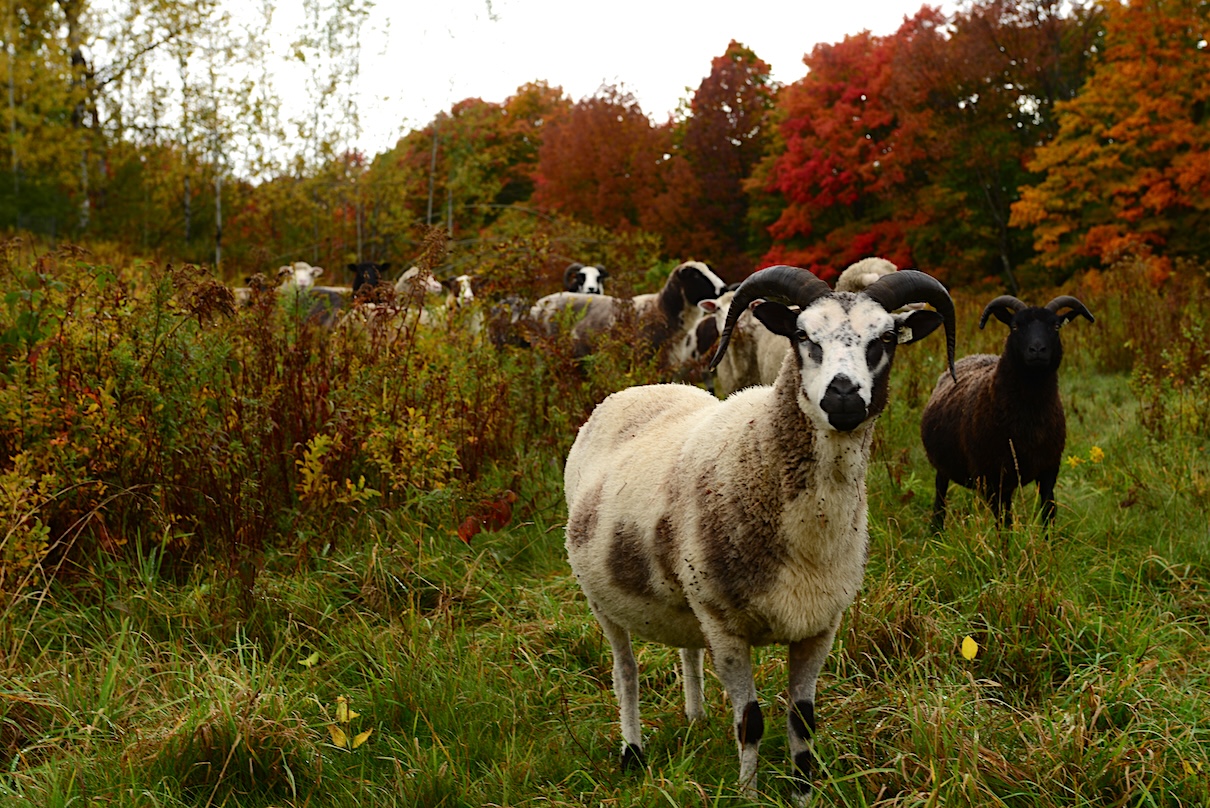
- A recent survey of American farmers revealed that many are practicing an ecological form of agriculture that incorporates woody perennials like trees and shrubs — agroforestry — including a livestock-centric brand of this called silvopasture.
- Grazing animals on pasture with trees has many advantages for them and their keepers, and many U.S. farms are working to implement these systems despite waning federal support for such highly climate- and biodiversity-positive methods.
- Silvopasture seems to be growing in popularity across Vermont that Mongabay recently visited, and nationally too, since it increases the quality of forage while providing shade to animals during the hotter and drier conditions that are increasingly prevalent due to climate change.
VERSHIRE, Vermont – When Sabra Ewing and Sebastian Lousada bought a tired dairy farm with pastures featuring old apple trees alongside sprouting maples, it was obvious that the grass below these trees’ crowns was a lot lusher than in the open. Then they noticed their sheep began to prefer those shady spots, and their manure added to the richness of the grass and of the other annual plants growing underneath.
“You do a lot of observation when you’re a farmer, and when we put the heritage sheep in the orchard, we quickly noticed,” Ewing said in a phone interview after Mongabay’s recent visit. Then the couple discovered a grant program offered by the American Farmland Trust that would help them incorporate more kinds of trees into the 30 acres (just over 12 hectares) of pasture on their overall 250 acres (nearly 102 hectares).
“I pounced on it, because I was already excited about this,” Ewing said.
That grant and other financial supports like one from the U.S. Department of Agriculture (USDA)’s Natural Resources Conservation Service (NRCS) helped turn their Flag Hill Farm – which now grazes heritage breeds of sheep under 80 varieties of apples plus other useful trees, to produce high quality wool, hard cider and brandy created in an on-farm distillery – into an idyllic, savanna-like scene surrounded by the vibrant hues of hardwoods changing colors during the New England autumn.
About 23 miles (37 km) west in Randolph, VT, Jenn Colby at Howling Wolf Farm similarly noticed the benefit that trees provided to her 23 acres (just over 9 hectares) of pasture, and has also relied on grants and payments from programs of the NRCS like the Conservation Stewardship Program (CSP), to make improvements to her pastures where Katahdin sheep are rotationally grazed. But such supports are waning under the current U.S. government, one of which’s first moves was to freeze previous President Joe Biden’s USDA funding program called the Partnership for Climate-Smart Commodities (CSC) program, which had begun investing up to $2.8 billion in 70 projects across the nation. This has left many farmers and programs to figure out how to pay for work they’d started without the funds they were promised, and the current leadership at USDA has also since changed other longstanding supports for sustainable agriculture in a way that de-emphasizes climate change-related methods.
Despite these setbacks, practices like silvopasture appear to be growing in popularity, as everyone Mongabay spoke with attested, and not just in the eco-conscious state of Vermont. A branch of agroforestry – the ancient and ecological method of growing crops, herbs, fruits and trees together in systems like shade-grown coffee, for example – silvopasture also integrates livestock such as cattle, sheep, or poultry with woody perennials. USDA’s own agroforestry office published a study this year illustrating the popularity of this method that, until recently, was not well known: almost a third of the respondents to their most recent survey of American growers practicing agroforestry placed their farms in this animal-centric category.

Faltering funds and frameworks
Although both farms Mongabay visited are already well advanced in implementing silvopasture systems, the funding they’ve gotten across the years helped their operations in important ways, which is key because of all the kinds of agriculture, agroforestry and silvopasture take a long time before profitability (7-12 years according to one study) due to the years required for perennial plants and trees to become mature. Once established, though, these systems produce sustained and increasing yields, and are ranked high among the most effective farming methods for bolstering biodiversity in the landscape while sequestering carbon from the atmosphere.
Reducing the time until profitability is key since most farms operate on an annual basis, growing crops like grains or vegetables. So without supports, new agroforestry systems have a tough time competing, especially when the cost of sapling trees and equipment like fencing is much greater than seeds for annual crops, so the U.S. government’s clawing back of CSC funding, alongside other cuts to climate-friendly programs, has become a challenge.
Meghan Giroux, director of Vermont-based nonprofit Interlace Commons, which boosts regional training capacity to help farms implement agroforestry systems, said during a phone interview that adding to the uncertainty is that the NRCS recently consolidated practice scenarios for silvopasture and agroforestry in ways which aren’t practical for the Northeast, and also pointed out that neither of these methods are listed under the new Regenerative Pilot Program.

Further, the former CSC agroforestry program which is now called Advancing Markets for Producers duplicates some of what NRCS does, Giroux said. While NRCS conservation planning and support will continue to be available, she emphasized the need for a new farm bill that can clarify and strengthen these programs.
Like agroforestry, farm business diversity is key
Given the uncertainties and longer horizon toward profitability for agroforestry systems, farms like these often must develop multiple income streams or products to keep their sheep in the trees. In Flag Hill’s case, the couple often drives in opposite directions during the weekend, with one selling wool at craft markets while the other is providing fermented apple products at other venues.
Howling Wolf Farm takes two other but increasingly common routes, that of working off the farm part time – Colby manages the farm at the heart of Food Systems Research Station, a University of Vermont partnership with USDA’s Agricultural Research Service – and agritourism. When Mongabay visited she had just finished making guest accommodations ready for a couple arriving from New Jersey keen to enjoy a late fall stay in that pastoral setting, and noted while driving this reporter out to view the pastures that these short rentals managed via AirBnB have evolved to become the biggest income line in the farm’s budget. She now has plans to expand this side of her business to welcome more guests seeking rural rejuvenation.

Stacking businesses like this just makes sense to her, saying that expecting farmers to make a living from a single project or product is unrealistic. Colby’s mission also goes beyond profits, having seen the destruction wrought on her town during Hurricane Irene, when heavy rains poured off the steep hillsides and destroyed much infrastructure there and across the state. Her land management goals now include providing flood management services to downstream neighbors by boosting perennial plant cover, which is slow and costly to establish, but important: “I’m creating a benefit, and feel like federal funds should be rewarding people who are managing their land for public benefit,” she said.
While it won’t be known whether silvopasture’s popularity with American farmers will continue growing until the USDA’s next survey years from now, everyone Mongabay spoke with, including various agency and university program staffers, felt that awareness and uptake will just keep growing. Colby shared that view and said that when invited to speak at conferences focused on raising livestock recently as part of her off-farm role, attendees kept bringing up the topic of silvopasture, and not just at events in Vermont.
“It is a topic because of shade. As temperatures increase, and as weather becomes more variable with many places in drought, it’s just becoming increasingly important. When trees are there to provide shade and keep the soil a little bit cooler, that creates a much more promising environment for the animals,” she said.

That sentiment was echoed by Ewing, who called silvopasture a win-win scenario because farms like hers save money on fuel by not having to mow pasture while the animals fertilize the trees that provide fruit for their business. The added benefit to her is enjoying an “incredible biodiversity of native plants, flowering shrubs, and smaller, flowering plants beside just clover.”
Yet when asked if her farm would operate this way without federal or other financial support, she agreed with Colby that farmers need support, and a prior lack of such programs would have slowed the growth of her business in this sector, in which costs are so heavily externalized.
So despite the national popularity of agroforestry and silvopasture, a continued lack of new or renewed incentives in the U.S. for implementing these most environmentally beneficial of methods for producing food and fiber will grow more slowly – yet steadily – like young trees planted in a pasture.
Erik Hoffner is a photojournalist and senior editor at Mongabay, view his latest projects and reporting via Instagram, Bluesky or LinkedIn.
Banner image: Heritage breeds of sheep in silvopasture at Flag Hill Farm, Vershire, VT. Image by Erik Hoffner for Mongabay.
See related coverage:
Agroforestry offers market-based way to boost Amazon rains & farmer incomes (analysis)
Agroforestry offers Thai rubber farmers a pathway to profit and sustainability
Citations:
Smith, M.M., Floress, K., Batcheler, M. et al. Silvopasture in the United States: Results from the National Agroforestry Producer Survey. Agroforest Syst 100, 142 (2026). https://doi.org/10.1007/s10457-026-01514-7
Economics of agroforestry. (2014). Handbook of Forest Resource Economics, 204-225. doi:10.4324/9780203105290-19
Cite this article
Erik Hoffner (2026). Sustainable silvopasture is popular with US farmers despite waning financial supports. Mongabay Conservation news. DOI: https://doi.org/10.66709/news-333104

