


- A new report finds that more than 61.5 million hectares of protected areas analyzed across tropical countries overlap with oil and gas blocks, while another 42.7 million hectares overlap with mining concessions.
- It identifies major gaps in protection for key biodiversity areas, with more than 40% in the Amazon, 29% in the Congo Basin and more than half in Southeast Asia and Central America still unprotected.
- Ahead of the United Nations Biodiversity Conference (COP17) in Armenia, the report authors call on governments to restrict extractive activities in high-biodiversity areas and strengthen Indigenous peoples and other local communities’ land rights and role in conservation.
- The report says that meeting the 30×30 target requires more than expanding protected areas, arguing that governments should ensure that conservation protects the right ecosystems, is effectively enforced and prevents large-scale extractive and industrial activities from undermining biodiversity.
A new report by Earth Insight finds more than 61.5 million hectares (151.9 million acres) of protected and conserved areas — an area roughly 2.5 times the size of the United Kingdom — overlap with ongoing and planned oil and gas blocks across the tropical countries. Another 42.7 million hectares (105.5 million acres) of protected lands overlap with mining blocks or concessions.
“[The] analysis reveals a major gap between conservation commitments and the industrial pressures facing areas already counted as protected and conserved,” Florencia Librizzi, deputy director at Earth Insight and author of the report, told Mongabay over email.
Released on Oct. 8, the report arrived less than two weeks before delegates from around the world gather in Yerevan, Armenia, for the United Nations Biodiversity Conference (COP17) from Oct. 19 – 30.
The findings show that expanding protected areas is not enough, according to the report.
At COP15 in 2022, 196 nations pledged to conserve at least 30% of the world’s land, inland waters and coastal and marine areas by 2030 (known as “30×30”) under Target 3 of the Kunming-Montreal Global Biodiversity Framework. This year, delegates will assess global progress toward the 30×30 goal.
But instead, the report says governments should evaluate which ecosystems are being preserved, ensure enforcement is effective and prevent industrial activities from undermining conservation efforts.
A coalition of NGOs, including Earth Insight, the World Commission on Protected Areas, the KBA Secretariat, the International Indigenous Forum on Biodiversity (IIFB) and others analyzed extractive pressures from a host of industries and how they overlap with areas under various levels of protection.
Areas under no conservation management face additional extractive pressures researchers found. The report identified that more than 36 million hectares (89 million acres), or 19%, of unprotected Key Biodiversity Areas (KBAs) are threatened by oil and gas blocks and 28 million hectares (69.1 million acres), or “15%, are threatened by mining concessions.” For marine KBAs, 91 million hectares (224.9 million acres) remain unprotected, 19% of which are threatened by oil and gas blocks.
More than 40% of identified terrestrial KBAs in the Amazon remain unprotected, as well as 29% in the Congo Basin and more than 50% in both Southeast Asia and Central America.
Norman Jiwan, a Kerambai Dayak Indigenous leader from Borneo, West Kalimantan, Indonesia, told Mongabay over email that extractive activities can lead to damaging impacts for Indigenous people and their territories. These include restrictions on livelihoods, the denial of rights and justice, increased disease and infectious viruses, conflict and other social and cultural impacts and increased pollution and chemical exposure.
In the Amazon, 15.6 million hectares (38.5 million acres), or 3.9%, of protected lands overlap with oil and gas blocks, along with 21% of unprotected lands and 43% of unprotected marine areas.
In Southeast Asia, oil and gas concessions cover 17% of protected lands, along with 19% of unprotected land KBAs and 12% of unprotected marine KBAs. In addition, the researchers found that mining blocks or concessions threatened 12% of unprotected marine KBAs.
The Congo Basin faces the heaviest threat, with 31% of protected lands designated for oil and gas and 5% for mining. For unprotected KBAs, 33% overlap with oil and gas blocks and 16% with mining areas.
The report raised concerns about the Democratic Republic of Congo’s Kivu-Kinshasa Green Corridor, a proposed 54-million-hectare (133.4-million-acre) conservation landscape, of which 39.2 million hectares (96.9 million acres), or 72%, will overlap with oil and gas blocks, as well as 2.6 million hectares (6.4 million acres) with mining blocks or concessions and 6.4 million hectares (15.8 million acres) with logging concessions.


Quality over quantity
According to Chris Sandbrook, a professor of conservation and society at the University of Cambridge in the United Kingdom who did not contribute to the report, “for the 30×30 target to be met, we can’t just think about the area covered by protected and conserved areas.”
An article published in Nature Communications by Sandbrook and colleagues in May 2026 argues that achieving the global 30×30 conservation target must account for its social as well as ecological impacts, as the effects on people, whether positive or negative, will depend on the social context of newly protected areas and how they are governed and managed. Meeting the 30×30 target must go hand in hand with respecting Indigenous peoples’ and other local communities’ rights and providing support for their livelihoods, according to the authors.
Sandbrook also said the findings of the Earth Insight report raise concerns around the credibility of the 30×30 target, “as it suggests that a lot of places which are currently designated for nature conservation could be lost at a later stage.”
“Governments must meet quantitative and qualitative commitments together and safeguard protected and conserved areas from extractive and large-scale industrial expansion,” Librizzi said. “That is high-integrity 30×30: Conserving at least 30% through healthy, connected ecosystems, effective management, equitable governance and Indigenous Peoples’ and local communities’ rights upheld, with no place for extractive or large-scale industrial activities.”
The report argues that governments should establish and enforce rules prohibiting large-scale extractive activities in protected and conserved areas. In addition, conservation commitments should also align with economic and development policies, government spending and financial incentives.
Another recommendation is for governments to recognize, secure and adequately fund Indigenous peoples’ land rights, governance and stewardship. Recognition should be Indigenous-led, it said, and free, prior and informed consent must be respected.
Failing to do so “undermines and violates the human rights and intergenerational rights of Indigenous peoples’ over traditional and customary forest, land and soil, river streams, lakes and other water body areas,” Jiwan said.
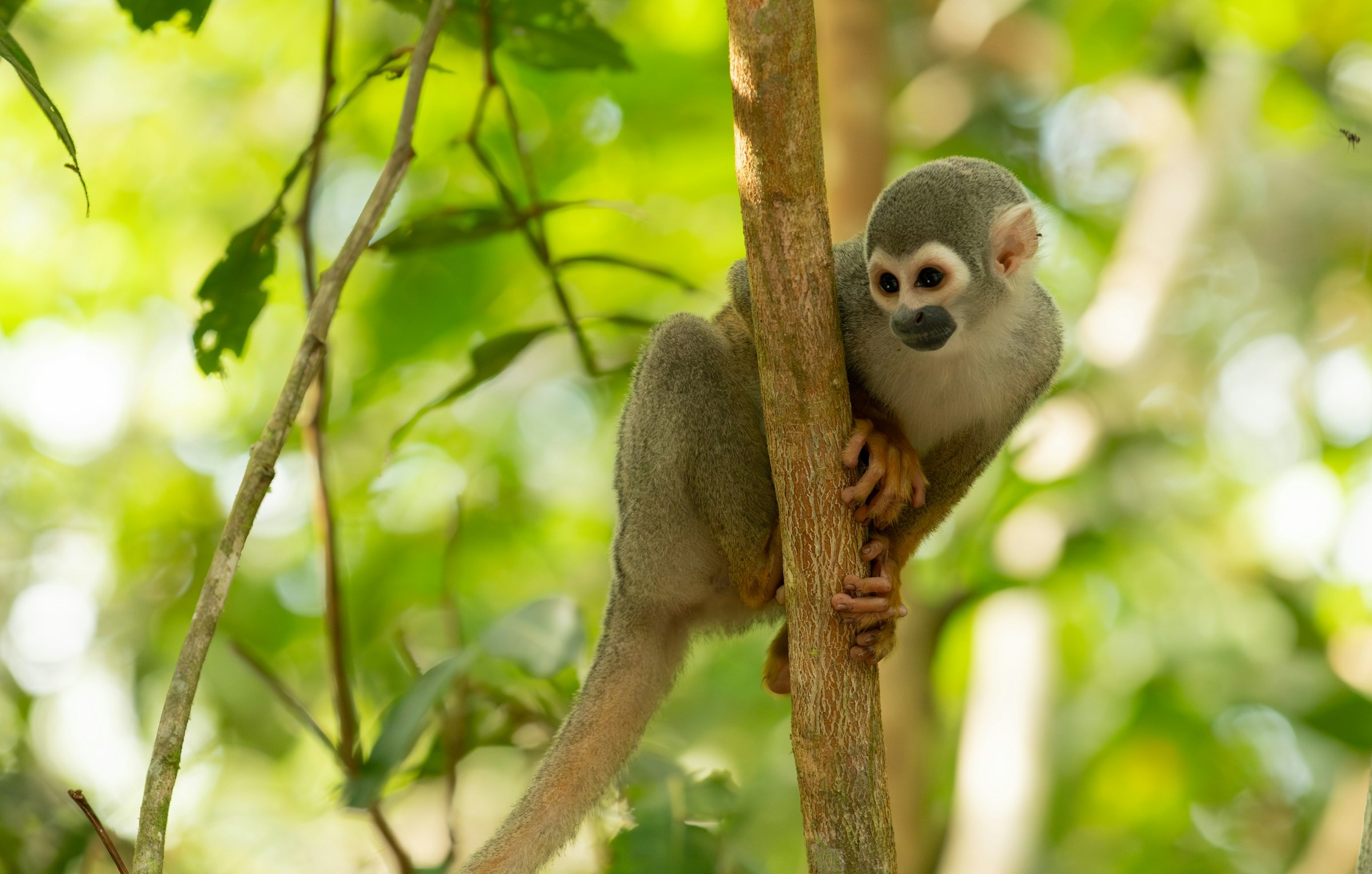
Banner image: A squirrel monkey in the Amazon. Image by Alain Bonnardeaux via Unsplash.
Delegates at biodiversity COP17 should follow the lead of Global South women (commentary)
Citation:
Fajardo, J., Bingham, H. C., Brockington, D., Chaplin-Kramer, R., Fitzsimons, J. A., Fleischman, F., … Sandbrook, C. (2026). Social implications of the 30×30 global conservation target. Nature Communications, 17 (1), 4067. doi:10.1038/s41467-026-71860-8
Cite this article
Aimee Gabay (2026). Extractive industries threaten global goal to protect 30% of nature by 2030, report finds. Mongabay Conservation news. DOI: https://doi.org/10.66709/news-333467

