


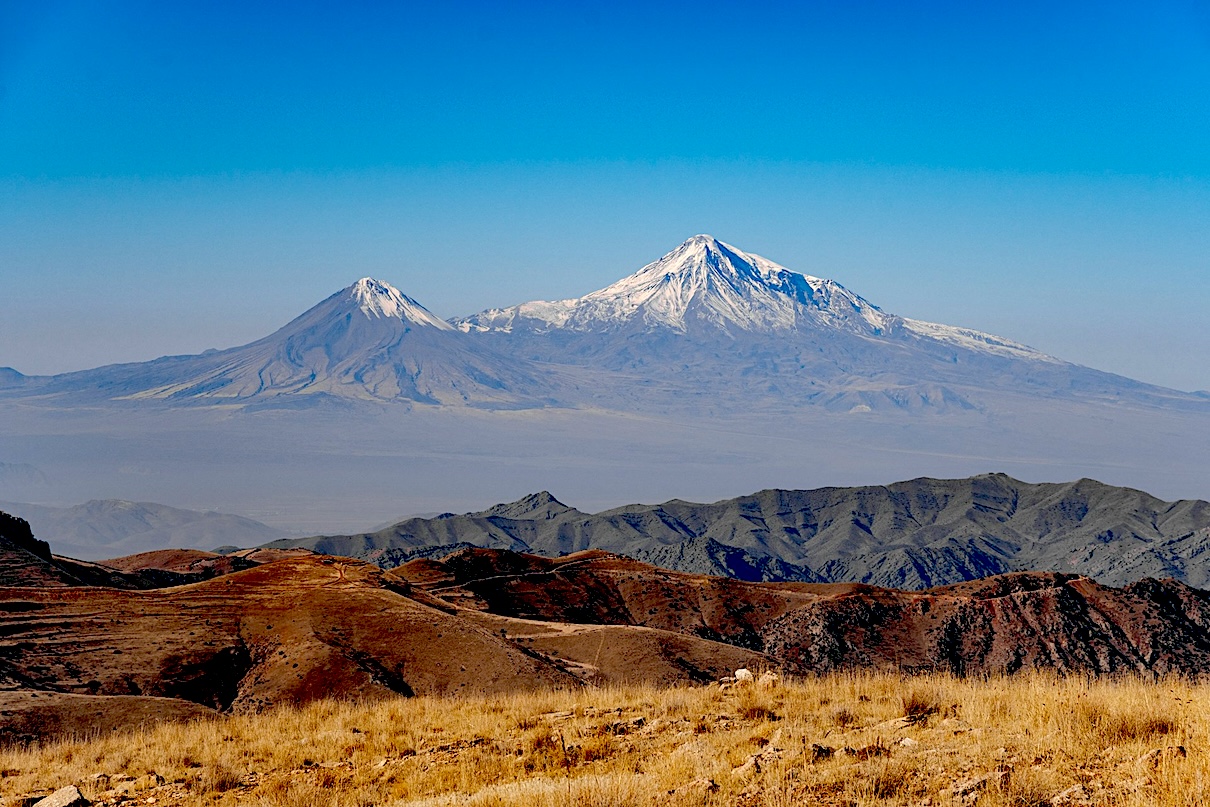
- As delegates assemble this week in Yerevan, Armenia, for a summit on the Convention on Biological Diversity (CBD COP17), an environmental leader argues in a new op-ed that it’s a moment of seemingly Biblical importance and resonance.
- Set in view of Mount Ararat, where Noah’s Ark is said to have found dry land and wildlife species rescued from the Biblical flood disembarked, it’s an opportunity for world leaders to chart a new course for biodiversity conservation, which lately appears to be faltering.
- “Thousands of years later, our fellow creatures need another rescue in the shadow of Mount Ararat, via this summit,” he writes.
- This article is a commentary. The views expressed are those of the author, not necessarily of Mongabay.
Delegates from most of the world’s governments are assembling this week in Yerevan, Armenia for the latest summit of the Convention on Biological Diversity (CBD COP17), whose aim is to prevent the extinction of our fellow creatures, and promote sustainable and just land use.
There could be no more fitting location: in the Bible, Mount Ararat is where Noah’s Ark found dry land after the great flood – and where the animals he had rescued, two by two – finally disembarked:
“But God remembered Noah and all the wild animals and the livestock that were with him in the ark, and he sent a wind over the earth, and the waters receded. Then God said to Noah, ‘Bring out every kind of living creature that is with you — the birds, the animals, and all the creatures that move along the ground — so they can multiply on the earth and be fruitful and increase in number on it.’” (Genesis 8).
Thousands of years later, our fellow creatures need another rescue in the shadow of Mount Ararat, via this summit. That is fitting, because, as a lifelong environmentalist, I have personally never seen a time where politicians around the world seem to care less about nature than they do right now.
A leading edge of this political assault on nature is the U.S. Government, even though America was in many ways the cradle of the modern conservation movement. For instance, the Trump Administration recently eliminated a longstanding interpretation of the Endangered Species Act that prohibited habitat destruction when an activity killed or injured endangered wildlife. This change could allow developers and logging companies to destroy habitat critical to endangered species with impunity.
The administration has also gutted the Roadless Rule that has protected over 50 million acres (about 20.2 million hectares) of mature forest, including much old-growth, and dramatically weakened marine protected areas.
Perhaps it’s good, then, that the U.S. is the only UN member that is not a party to the CBD treaty which provides the framework for this summit, as their presence could result in a lack of progress.
While the Trump Administration has pursued an ideological attack on the very idea of conservation, other governments are letting our fellow creatures perish from neglect. Of course, there are excuses: economics and wars are big distractions. But these daily pressures, though they feel acute in the moment, are temporary, whereas extinction is forever.

One area where this neglect is most felt is in the egregious lack of funding for nature, even though we depend on thriving forests and oceans for the oxygen we breathe, and the joy of beholding natural wonder inspires this generation and every previous one.
The last biodiversity summit set a noble goal of protecting 30% of the Earth’s land and waters by 2030. Some countries have undertaken that goal with seriousness, while most are lagging.
But almost none have provided anything close to even a modicum of funding that would be required to achieve it. Indeed, while the world spends a few tens of billions of dollars on nature internationally, it is also investing $2.67 trillion on artificial intelligence, with all the energy use and pollution that entails, on top of more than $1 trillion invested annually on fossil fuels. The result of these and other imbalances are that monitored populations of vertebrate wildlife declined by an average of 73% between 1970 and 2022, according to one recent estimate.
We should consider humanity’s abuse and neglect of nature as an act of evil on the scale of those that the Bible cites as the cause of the flood during Noah’s time. Of course, there are still righteous men and women walking the Earth, and a few governments still muster the will to act on the sacred trust they hold for all the creatures in their territories.

Australia recently passed stronger environmental protection laws, and just announced enforcement actions so it can better protect its Great Barrier Reef. Indonesia just announced the cancellation of the world’s largest deforestation project, and has dramatically reduced commercial deforestation, though it is struggling once again with terrible fires that are the legacy of past destruction. Chile and Argentina have recently created a giant new network of national parks that will protect and restore rare animals like jaguars, guanacos, and Andean condors, while Brazil has reduced its deforestation to the lowest level on record.
But for most of our hotter planet, humanity is forgetting that in the Bible, God established a covenant not just with living humans, but with “your descendants after you and with every living creature that was with you — the birds, the livestock and all the wild animals, all those that came out of the ark with you — every living creature on earth.” (Genesis 9)
Restoring our relationship with the divine means renewing such a covenant with our fellow creatures, upon whom we depend in a single community of life.
There is no better place to start once again than in the shadow of Mount Ararat.
Glenn Hurowitz is founder and CEO of Mighty Earth, an international nature advocacy organization.
Banner image: Mount Ararat. Image courtesy of Ani Adigyozalyan via Unsplash.
See related coverage:
Delegates at biodiversity COP17 should follow the lead of Global South women (commentary)
Mozambique’s Maputo National Park showcases biodiversity and shelters migratory birds
Navigating crisis and opportunity in conservation funding (commentary)

