


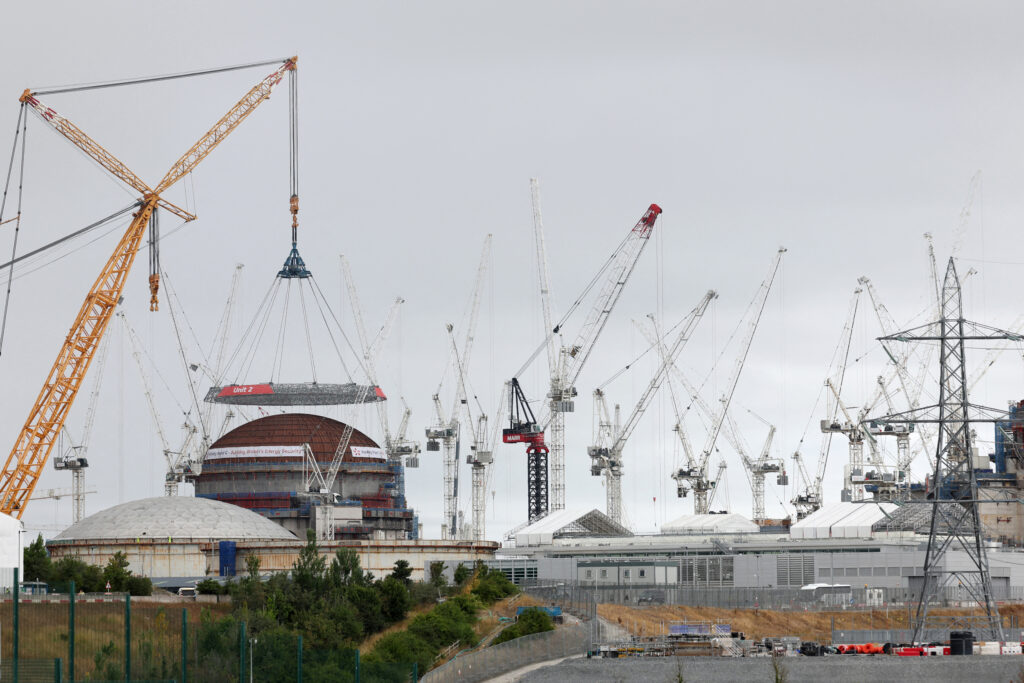
Over the past year, boats have plied the waters around Hinkley Point C, a nuclear power plant under construction along England’s Somerset coast, laying and testing a network of ultrasonic speakers across the seabed.
This technology, set to drive fish away from the plant’s deadly cooling pipes, is expected to save fewer than one salmon, fewer than one sea trout, six river lamprey, 18 Allis shad and between approximately 100 and 528 twaite shad each year.
This is one of three protections for fish in the nearby Severn estuary, built into the plant’s original planning and environmental approvals, set to cost French-owned EDF Energy, which leads the project, more than $926 million.
For some of nuclear’s proponents, the price tag reflects an exacting regulatory system that has slowed nuclear development and channeled huge sums toward site-specific mitigation where it could be better used to deliver broader benefits for nature. This argument was put forth in the 2025 Fingleton Review, a government-commissioned examination of the regulatory barriers facing nuclear projects, which called for “radical reforms.”
Embracing the premise, the government is now pursuing an innovative funding strategy to usher in a “golden age” of nuclear power to strengthen energy security, meet its 2050 net-zero target and supply the growing electricity demands of data centers. Britain is betting over $22 billion through 2030 on what it calls its “most ambitious nuclear new-build programme for a generation.”
Based upon so-called Environmental Delivery Plans, the new approach would anticipate projects’ environmental impacts, set out conservation measures deemed sufficient to address them, and calculate costs aimed at securing “environmental uplift.”
Developers would make single payments into a Nature Restoration Fund managed by Natural England, the government’s environmental regulator, discharging their relevant obligations without the need for project-specific environmental surveys and old-school mitigation efforts. The Nature Restoration Fund was first introduced in the 2025 Planning and Infrastructure Act to help unblock housing development.
The government says Natural England could pool those payments to deliver “conservation measures at scale” and maximize the outcome for the environment, with ministers calling it a “win-win” for nature and development.
Much of this work will be contracted to private-sector organizations, such as habitat banks and ecological consultancies, or environmental non-governmental organizations.
Not everyone is impressed. Alexa Culver, an environmental law and policy specialist, calls the approach “ecologically illiterate,” echoing a sentiment expressed by many others in the broader environmental community, who say traditional regulation is being scapegoated for nuclear’s time and cost overruns, with selective examples used to make the case for rolling back environmental protections.
The Case for Conservation at Scale
Natural England’s new chief executive began his tenure Oct. 1 by endorsing the shift from “site-by-site mitigation to work at scale.” Still, the push toward landscape-scale conservation, which the Environmental Delivery Plans could advance, is not new.
In 2010, the Department for Environment, Food and Rural Affairs commissioned a review led by ecologist Sir John Lawton to assess whether England’s wildlife sites were capable of responding to climate change and growing demands on land.
Its conclusion: “The essence of what needs to be done to enhance the resilience and coherence of England’s ecological network can be summarised in four words: more, bigger, better and joined.”
The idea helped give rise to England’s Nature Improvement Areas, which offer an example of what landscape-scale conservation can look like in practice.
The Birmingham & Black Country Nature Improvement Area, a partnership of more than 50 organizations, covers some 60,000 hectares across one of England’s most heavily urbanized regions.
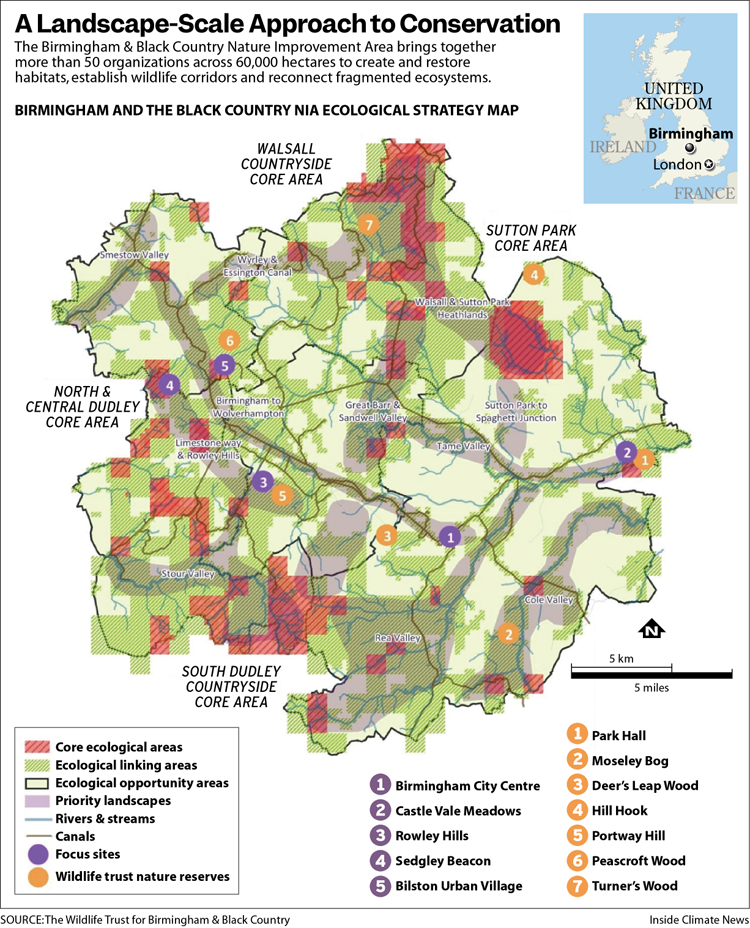
Its work spans creating more habitat, new woodland and species-rich grassland and meadows, on sites such as capped landfills, linking them to existing core ecological areas. These efforts improved the quality of existing habitat by reintroducing appropriate land-management techniques, clearing invasive plant species and introducing those sourced from remaining old woodland or ancient meadows. Wildlife corridors, or “linking areas,” were also improved where they had been degraded, narrowed or broken by development. In one project, a heavily engineered stretch of river was freed from pipes and widened to allow it to flow more naturally.
Jeff Ollerton, an ecologist and environmental consultant, sees an opportunity for EDPs to advance landscape-scale restoration if done well. “The devil will be in the details,” he said.
Richard Cowell, a professor of environmental policy and planning at Cardiff University, also acknowledged potential benefits of the approach.
“You could do more strategic, large-scale mitigation, where the problems in conservation are that a lot of pepper-potting and small areas may not help achieve greater nature reversal in the ways we might want.”
But he cautioned that the approach would require both institutional capacity and land that can realistically be restored.
“Natural England needs to have the time and capacity to do it,” Cowell said. “Plus, we are a full country. The idea that there’s space enough to easily recreate large areas of habitat where existing interests exist is problematic.”
Despite Natural England’s public support for the Natural Restoration Fund and EDPs, internal emails obtained by Greenshank Environmental through a Freedom of Information request show that staff at the agency and the Department for Environment, Food and Rural Affairs have raised concerns that developer payments may not “come in fast enough to take forward sufficient conservation measures.”
The Risk to Britain’s Nature
The reforms are still in their early stages and remain vague. Environmentalists, however, have raised concerns about whether damage to nature in one place can be adequately compensated for elsewhere, and whether pressure to accelerate nuclear development could come at the expense of protections for nature.
“If the Fingleton pressure continues, I can imagine there could be a strong push to deploy EDPs, and they could end up being fast-tracked,” said Culver, who works for the environmental consultant RSK Wilding.
There remain questions about how the system would work in practice. It remains unclear when a developer would qualify for an EDP, how early in the planning process one would become available, or how Natural England would decide which projects receive one.
Culver worries that the system could create “backchannel routes” for developers to seek intervention when environmental requirements become more costly or time-consuming than expected.
She argues that the problem is not a lack of new mechanisms, but regulators who are already under-resourced and have struggled to keep the process moving. Adding a new system could further strain their capacity.
This story is funded by readers like you.
Our nonprofit newsroom provides award-winning climate coverage free of charge and advertising. We rely on donations from readers like you to keep going. Please donate now to support our work.
There is also a fundamental debate about whether conservation is better achieved at a development site or through larger, strategic interventions elsewhere.
“Whether you regard more strategic mitigation away from the site as better than what is being done on-site throws up all sorts of questions about what’s lost, what’s equivalent and so on,” Cowell said.
He believes that focusing on planning and regulation as barriers to the development of nuclear overlooks the underlying issues: nuclear power has come to coexist with some of Britain’s most valuable landscapes and habitats.
Where Britain Built Its Nuclear Plants
A solution to public distrust of nuclear power after World War II was to put plants in less-populated areas, often along coasts or river estuaries, where they could draw on large quantities of cooling water, in some cases, up to 1 billion gallons a day. Siting plants away from population centers also helped address radiological and safety concerns.
In a crowded country like Britain, those sites often carry one or more of Britain’s top conservation designations: Areas of Outstanding Natural Beauty, Sites of Special Scientific Interest, Ramsar wetlands, Special Protection Areas, or Special Areas of Conservation.

The U.K. has five nuclear power sites in operation, and all live alongside some of Britain’s most valuable landscapes and habitats. Cowell said that nuclear gravitates toward special multiply-protected sites. A review of nuclear sites, using a mapping tool created by the Department for Environment, Food and Rural Affairs, or Defra, which highlights protected landscapes, illustrates this.
In Suffolk, for example, the operational Sizewell B and developing Sizewell C sit inside the Suffolk Coast & Heritage Coast Area of Outstanding Natural Beauty, and border Minsmere, a designated Special Protection Area, a Special Area of Conservation, a Site of Special Scientific Interest, and a Ramsar wetlands site. Nuclear power could, thus, present a different test for EDPs than housing, given where Britain’s nuclear plants are located and the potential scale of their environmental impacts.
What’s Next?
The first EDPs will provide an early test of how the system works in practice, including how effectively Natural England can translate developer payments into conservation measures.
Defra has provided Natural England with just over $15 million for 2026–27 financial year to cover costs incurred before developer payments are received. FOI documents show that part of this funding will not need to be repaid. That raises a broader question about who ultimately pays for the system: taxpayers could be funding conservation measures that would otherwise have been paid for by private landowners.
Then there is the question of what kind of conservation the money will buy. The challenge, said Ollerton, the independent environmental consultant who is also a visiting professor of biodiversity at the University of Northampton, will be balancing local protections, which safeguard species dependent on specific habitats and draw on Britain’s long tradition of local conservation expertise, with landscape-scale conservation, which creates the larger, connected habitats without which some species may not persist.
The test of the new approach may come quickly. As Britain moves to fast-track a new generation of nuclear projects, it will become clearer whether Environmental Delivery Plans are used to help move them through the planning system, and whether they can deliver on conservation at the scale their proponents promise.
The government has committed more than $3.3 billion to build three Rolls-Royce small modular reactors at Wylfa, a former nuclear power station in Wales, while over $1 billion in contracts have already been awarded across the supply chain, with more than 70 percent of them to U.K.-registered companies.
Britain is also deepening nuclear ties with the U.S. British energy company Centrica is partnering with Maryland-based X-energy to develop up to 12 advanced modular reactors at Hartlepool. At the former Cottam coal-fired power station in Nottinghamshire, U.S.-based Holtec International is working with EDF and U.K.-based Tritax on plans for small modular reactors.
Whether the all-out push for nuclear development is driving a rethink of British conservation or accelerating one already underway, it has raised a practical question: Can the government effectively deliver the new age nature recovery it promises with the resources at hand?
About This Story
Perhaps you noticed: This story, like all the news we publish, is free to read. That’s because Inside Climate News is a 501c3 nonprofit organization. We do not charge a subscription fee, lock our news behind a paywall, or clutter our website with ads. We make our news on climate and the environment freely available to you and anyone who wants it.
That’s not all. We also share our news for free with scores of other media organizations around the country. Many of them can’t afford to do environmental journalism of their own. We’ve built bureaus from coast to coast to report local stories, collaborate with local newsrooms and co-publish articles so that this vital work is shared as widely as possible.
Two of us launched ICN in 2007. Six years later we earned a Pulitzer Prize for National Reporting, and now we run the oldest and largest dedicated climate newsroom in the nation. We tell the story in all its complexity. We hold polluters accountable. We expose environmental injustice. We debunk misinformation. We scrutinize solutions and inspire action.
Donations from readers like you fund every aspect of what we do. If you don’t already, will you support our ongoing work, our reporting on the biggest crisis facing our planet, and help us reach even more readers in more places?
Please take a moment to make a tax-deductible donation. Every one of them makes a difference.
Thank you,

Fellow
Leana Carbonez is a fellow at Inside Climate News. Born in London, she studied History at the University of Cambridge, and recently graduated from Columbia’s Graduate School of Journalism. She is interested in exploring Americans’ manifold understandings of ‘nature’ and the ways these perceptions are shaped by, and serve, political ideologies. She hopes to continue pursuing investigative projects while working across a variety of journalistic mediums.
