


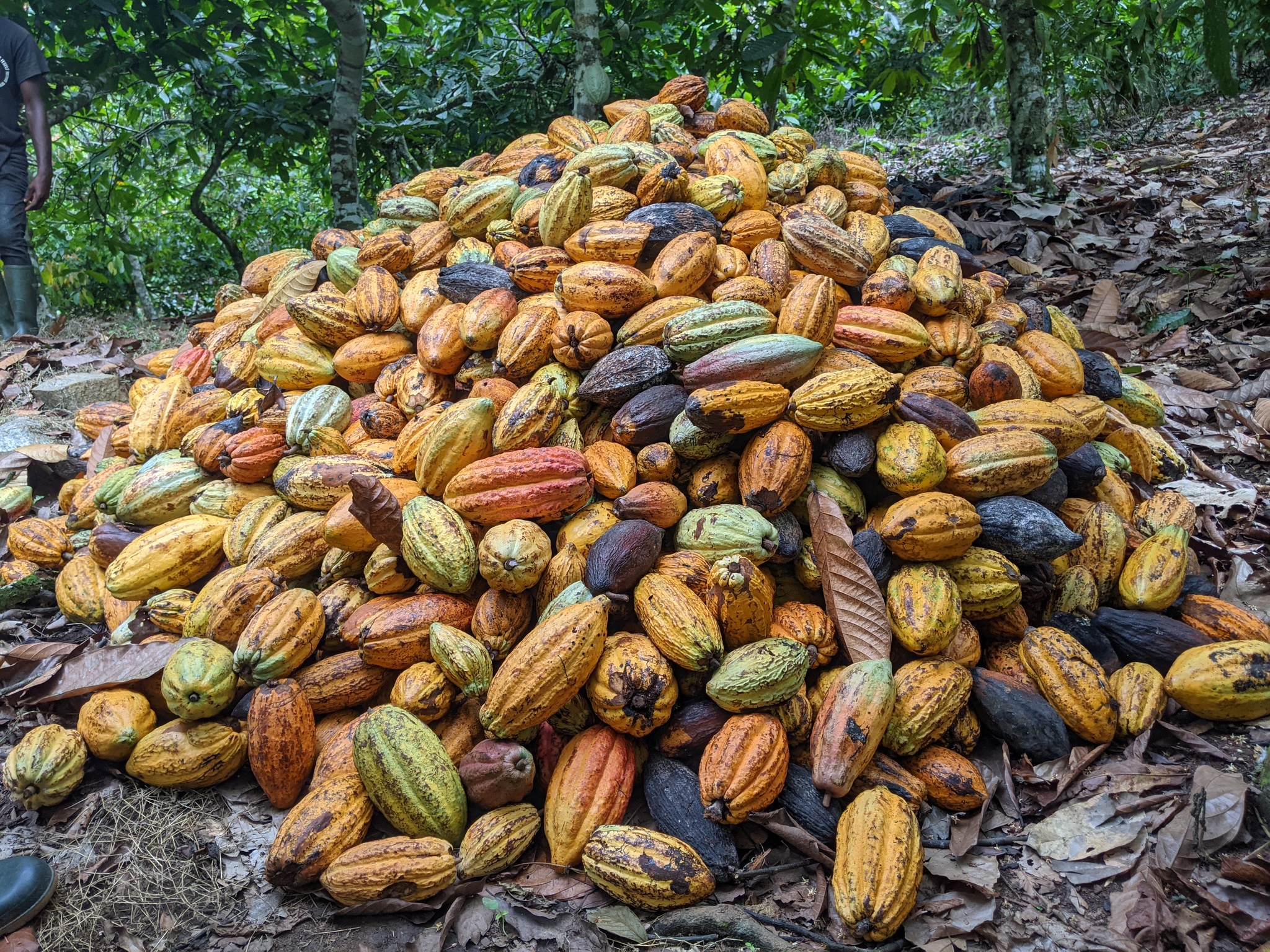
- A new study describes how short periods of heavy rainfall play a key role in low cacao harvest yields in Ghana.
- Using newly available data on daily temperatures and precipitation in Ghana, the authors found that rains occurring during the flowering season damage the plants, leading to poorer harvests.
- The findings build on previous research which has found that heat and drought impact cacao harvests, ultimately pushing up global chocolate prices and presenting new challenges to farmers.
Heavy rainfall during the cacao flowering season is a major driver of Ghana’s recent harvest fluctuations, new research finds.
A study published in September by researchers at the Harvard University Center for the Environment in the U.S. found that heavy rainfall during cacao’s flowering and early pod development is linked to significant yield decreases. The researchers described how short, untypical rains during the flowering season, together with dry-season drought, is a major reason for recent fluctuations in Ghana’s cacao production.
Ghana and Côte d’Ivoire together account for about 60% of global cocoa production, making West Africa central to the world’s chocolate supply. Cacao seeds are the primary ingredient in chocolate.
The authors raised concerns about how these changing rainfall patterns could affect Ghana’s cacao industry, which is one of the West African country’s most important agricultural sectors.
“Along with dry-season drought, [heavy rainfall during flowering and early pod development], those two factors alone explain about two-thirds of the year-to-year variability in Ghana’s production,” lead researcher Anna Lea Albright from Harvard told Mongabay via email.
Albright and her colleagues began looking into the issue in 2024, when global cacao prices surged after several poor harvests in West Africa. They considered several possible explanations for the trend, including aging trees, pests and diseases, gold mining, smuggling and weather.
Analyzing daily rainfall and temperature records, the researchers noticed a pattern. Losses or gains during years of low and high production were experienced by farmers across Ghana, rather than just by some farmers in some districts. That suggested the influence of a broader trend, not localized factors like gold mining, soil conditions or access to agricultural inputs.
“When did the rain fall, how intense was it, and where did that sit in the growing cycle? Heavy rainfall during flowering is what stood out, first in Ghana and then elsewhere,” said Albright, who cross tested the results from Ghana in two other major cacao producing countries, Indonesia and Ecuador. The vulnerability doesn’t appear to be unique to Ghana, they found.
Across those three countries, heavy rainfall was found to be a stronger climatic constraint on yields than temperature during the relevant periods.
The cacao plant (Theobroma cacao), native to Latin America, is especially sensitive to changing conditions during flowering and early pod development. Albright said intense rainfall and wind can physically damage flowers and young pods and may interfere with the insects that pollinate cacao flowers.

Other downfalls of heavy rain on cacao
Heavy rainfall can also create conditions that lead to fungal diseases such as black pod, whose spores can be spread by rain, said Eric Opoku Mensah, a research scientist at Ghana’s Plant Genetic Resources Research Institute who was not part of the study, in an email.
The cacao plant generally grows best when there are steady levels of rainfall and a short dry season. However, too little water can also damage crops, said Mensah, who has studied the effects of drought and heat on cacao in Ghana.
He added that Ghanaian farmers are already struggling with increasingly unpredictable rainfall. “Rainfall is variable and farmers are not able to predict what the pattern could be in the following years,” he told Mongabay. “For the times they expect the rains, it will fail them while the times they don’t expect the rains, they get them in abundance making it difficult to plan for agronomic activities.”
Ghana’s average temperatures in cacao-growing areas have increased from about 26° Celsius (78.8° Fahrenheit) between 1960-1980s to 27-28° C (80.6-82.4 °F) now, added Mensah, who has researched cacao production and climate-related stresses in Ghana for years.
The new study’s findings are consistent with what researchers already know about the crop: “Severe rainfall especially coupled with high wind also damage the fragile flowers and the cherelles [unmatured cacao pods],” Mensah said. This ultimately reduces the number of pods that eventually develop into harvestable cacao.
For Albright, the results raise questions about how climate change could affect the frequency or intensity of the rainfall extremes identified by the study. However, she said that weather variability and longer-term climate change are not the same thing.
Using the example of El Niño, the weather phenomenon that shifts rainfall patterns across the tropics from one year to another, Albright explained that year-to-year variability is not to be confused with longer-term trends. In West Africa, Albright said, El Niño years have historically tended to reduce the risk of the heaviest rainfall while increasing the risk of dry-season drought later in the year.

As a recommendation, the researchers say that improved weather and climate forecasts could be useful for cacao farmers to anticipate high-risk periods and better disease control. “There are certainly actions that could help reduce these risks: better access to seasonal weather forecasts and early-warning systems; facilitating access to fungicides; planting more climate-resilient cacao varieties; improving drainage and reducing rain splash where heavy rainfall is becoming more frequent,” Albright said. However, she said that all of these require coordination and investments.
Mongabay contacted the Ghana Cocoa Board, the government body overseeing the cocoa sector in the country, but hadn’t received a response by the time of publication.
How farmers can adapt
Some adaptation measures are already available, according to Mensah. He said agroforestry systems, in which cacao is grown alongside shade trees, could help protect plants from high temperatures and strong winds.
Farmers could also harvest and store water during periods of heavy rain for use during drier periods, he said.
Albright said that for farmers, their study revealed that the major challenge is not whether a season is wetter or drier than usual, but when the rains arrive and how intense they are.
“The climate risks are not random, which can help for improving forecasts of those risks and improving adaptation,” Albright said.
Banner image: Cacao (Theobroma cacao). Image courtesy of mwintirew via iNaturalist (CC BY-SA 4.0).
Citations:
Albright, A.L., Berkoh-Oforiwaa, R., … Huybers, P. (2026). Rainfall extremes drive cocoa yield losses across the tropics. Proceedings of the National Academy of Sciences, 123(39), e2606123123. doi:10.1073/pnas.2606123123
Opoku Mensah, E., Vaast, P., Asare, R., Amoatey, C. A., Owusu, K., Asitoakor, B. K., … Ræbild, A. (2023). Cocoa under heat and drought stress. doi: 10.1007/978-3-031-45635-0_2
Asare-Nuamah, P., … Botchway, E. (2019). Understanding climate variability and change: analysis of temperature and rainfall across agroecological zones in Ghana. Heliyon, 5(10). doi: 10.1016/j.heliyon.2019.e02654
Feedback: Use this form to send a message to the author of this post. If you want to post a public comment, you can do that at the bottom of the page.
Cite this article
Victoria Schneider (2026). Heavy rains during critical period of cacao cultivation hit Ghana’s yields. Mongabay Conservation news. DOI: https://doi.org/10.66709/news-333406

