


- Kenya has made significant progress in climate legislation and policy, but a gap remains between its commitments to a just transition and women’s lived realities, particularly the unequal burden of unpaid care work.
- Experts say women’s experiences of climate stress, from collecting firewood and water to navigating floods and losing income, constitute critical expertise that must inform climate financing, policy decisions and adaptation strategies.
- The researchers say a just transition needs three things: The costs and benefits of environmental action must be fairly distributed, people affected by environmental decisions must have a say in those decisions, and historical inequalities leaving some communities exposed to environmental harm cannot be carried forward into a changing climate.
Anna Fatuma is a 31-year-old woman who runs a kibandaski in Tumboni village, Kitui county in eastern Kenya.
Kibandaski is Kenyan urban slang for an affordable, open-air urban eatery, often a small shack made of iron sheets, 3-ply wood or canvas. They are popular with low-income customers. Inside, smoke from firewood beneath simmering pots hangs in the air, while dark stains from settled soot mark the walls around cooking areas. The heat from the food, the smoke and the cramped space make the kibandaski humid and uncomfortable.
Fatuma’s kibandaski is one of these small roadside eateries. She opens every day at 6 a.m., cooking and serving meals until about 8:30 p.m. The most expensive meal on her menu costs 250 Kenyan shillings, about $2. She started the business in 2024, hoping it would improve her financial situation and that of her husband, Sam.
“Cooking gas is expensive. I can’t afford to buy and use it here,” she says. “Kuni, firewood is easier to find and cheaper to use. Charcoal is my preferred option, though it is expensive.”
Fatuma often collects the firewood herself. The work leaves her with a persistent backache. On some days, she pays someone to collect it so she can arrive early enough to open the “hotel,” as she calls it.
“Kamgongo kanauma. My back aches,” she says. “Paying someone to collect firewood isn’t ideal, but sometimes I am forced to. It’s also to make sure I open the hotel early.”
Her routine might seem far removed from the language of climate policy. But it sits at the center of a question raised by a recent paper published in the Environmental Law Review by University of Nairobi researcher Nkatha Kabira and Patricia Kameri-Mbote, who works at the U.N. Environment Programme. Examining Kenya’s environmental transition through the rights of women, children and nature, the paper argues that Kenya has developed a relatively strong legal and policy framework for climate action, but that the law in the books remains at variance with the laws in action and the lived realities of people on the ground.
For a transition to be just, the researchers argue, three things must hold. The costs and benefits of environmental action must be fairly distributed. People affected by environmental decisions must have a meaningful say in those decisions. And the inequalities that have historically left some communities more exposed to environmental harm cannot simply be carried forward into a changing climate.
Kenya has laws. The Climate Change Act provides for gender equity and social inclusion in climate responses. In the country’s second Nationally Determined Contribution for 2031–2035, submitted in April 2025, Kenya commits to reducing greenhouse gas emissions by 35% by 2035 against its business-as-usual scenario, with 20% of the required emissions reductions to be met through domestic resources and the remaining 80% dependent on international support. The commitment also includes increasing renewable electricity generation towards 100% by 2035 and implementing climate action in a gender-responsive manner. The National Gender and Climate Change Action Plan 2025–2027 complements these commitments by prioritizing gender-responsive climate finance, women’s participation in climate decision-making and access to technologies that support adaptation and mitigation. Yet, for women like Fatuma, the distance between these national commitments and the realities of daily life remains wide.
Malkia John, executive director of Sauti Salama, a survivor-led feminist nonprofit that advocates for women’s rights, has spent years working with women in Kitui on the relationship between climate stress and care work.
“Gender roles are so deeply entrenched in our societies, so much so that anything about care of the home is automatically a woman’s issue,” she says.
In Kitui, women walk long distances to collect water and firewood, sometimes in extreme heat, sometimes before dawn or after dark. Those journeys carry risks beyond physical exhaustion. Gender-based violence is one of them. Lost income is another. Every hour spent looking for fuel and water is an hour that cannot be spent running a business or earning a living.
Through her work, Malkia uses a framework of five actions she says any serious climate response must take when it comes to care work: recognizing that the burden exists, reducing it, redistributing it across households instead of concentrating it on women, representing women’s care labor in trade unions and policy spaces, and rewarding it as the economic contribution it is.
“Who counts and compensates the time women spend out in the scorching sun looking for firewood?” she asks.

Women in Kitui are not alone. In Isiolo county, 257 kilometers (160 miles) from Kitui, women walk hours to fetch water, making daily calculations between what amount they use for bathing, what goes to cooking and what remains for farming. That lived experience, Malkia argues, is itself a form of research — detailed, specific and largely absent from the data that shape climate policy.
Fatuma is one of the beneficiaries of Sauti Salama’s Climate and Care project, which distributed over 190 solar lanterns across Kitui and Isiolo counties. The lanterns help families reduce lighting costs, allow children to study after dark and give women more time to run their businesses.
“It has made my work a little bit easier because it has expanded my working time and customers can see their food clearly,” she says. Cleaning at night is easier. She feels safer.
For Fatuma, the lantern responds to a problem she faces every day. But Malkia is careful about what the intervention represents.
“The challenges are layered,” she says. “Most of the time, one intervention cannot completely address all the challenges, all at once.”
Terry Owino is a climate adaptation and financing expert and co-convener of Africa’s Coalition of Young Women for Climate. She agrees that Kenya has made progress in climate governance — stronger laws, more action plans, climate committees with broader mandates.
But she says many women, particularly young women living in informal settlements like Kibera, the largest slum dwelling in Africa, have not experienced that progress as greater safety or power. For a woman in Kibera, climate change can mean waking up after heavy rain and worrying about whether the house will flood. It can mean impassable roads, rising water costs, overflowing sanitation and a lost day’s income. Owino is uncomfortable with calling women in these situations simply “vulnerable.”
“Women are not vulnerable by nature,” she says. “Women are put in vulnerable situations by systems.”
Housing, sanitation, the security of work and how much unpaid care a woman is expected to carry when a crisis happens — these are the determining factors. She traces the roots of that unequal care burden to colonialism when colonial taxation recognized only men’s paid labor, systematically devaluing women’s work and entrenching the divide between paid and unpaid labor that climate policy still hasn’t reckoned with.


The Environmental Law Review paper places participation at the center of environmental justice. Women should not only be consulted after decisions are made, the researchers argue. They need meaningful opportunities to influence decisions about the environments in which they live.
Owino asks a simple question, “Who is at the table before the decisions are made?”
She has watched women be brought into high-level climate spaces such as the Africa Climate Summit and COP side events to share their experiences and watched that sharing stop short of influence. The real work, she says, happens earlier and elsewhere. At the UNFCCC subsidiary body meetings in Bonn, technical language is drafted, indicators are negotiated, and the groundwork for COP outcomes is laid. Conservative blocs have blocked gender-mainstreaming language at those meetings. By the time the summit arrives, significant decisions have already been made.
Women in communities like Kibera carry detailed knowledge of their environments, where flooding starts, which routes become dangerous, how a climate shock moves through a household budget.
“That is not just a sad story to be collected,” Owino says. “It is expertise.”
When Owino talks about what a just transition must not look like, she is equally specific.
A just transition, she argues, cannot look the same in Kibera as it does in the wealthy Nairobi suburb of Karen, in Germany or across the Global South. Industrial workers in Kibera risk losing their livelihoods if industries decarbonize without adequate social protection and alternative employment. The financial constraints are equally stark.
According to AFRODAD’s Debt Service Watch report, African countries spent 54% of their government revenue servicing debt in 2023, while debt payments exceeded combined spending on education, health, social protection and climate by 50%. These competing demands leave governments with less fiscal space to invest in climate adaptation and a transition that protects workers and communities. For Owino, applying climate frameworks designed elsewhere without accounting for Africa’s economic realities risks shifting the costs of decarbonization onto the very communities least equipped to bear them.
She is particularly sharp on carbon markets. Companies using large tracts of land across the Global South to offset their emissions while continuing to pollute are not solving the climate crisis, she says. They are purchasing cover for it.

The Coalition of Young Women for Climate Justice is currently preparing a set of demands ahead of November’s COP31 in Türkiye, grounded in a desk review of policy gaps and a Google form collecting lived-experience demands from young women across the continent. Badge quotas and funding barriers have significantly reduced young African women’s access to the negotiations, but the coalition is building its presence in the spaces where language is still open to change.
“Adding women into an already unjust system,” Owino says, “does not make it just.”
Kenya’s National Gender and Climate Change Action Plan sets specific targets for the period 2025-27: building the capacity of 1,000 people on climate finance, reaching another 1,000 through community-based education on gendered climate impacts and ensuring that 470 women and special interest groups participate in the design and implementation of gender-responsive financing mechanisms. It monitors compliance with the two-thirds gender principle in climate change committees, with a budget of 80 million shillings ($616,000) in the first year alone. However, those targets cannot guarantee that women arrive early enough in the process to shape decisions, not simply fill seats after the agenda has already been written.
But those targets don’t mean Fatuma’s situation will improve right away. While the solar lantern makes something easier, the backache is still there. Other women in the distribution of solar lanterns have found that their children can study late into the night with ease. A small but real shift. Still, they are walking the same distances for water. Still exhausted at the end of the day, with no formal recognition of the labor that exhausted them.
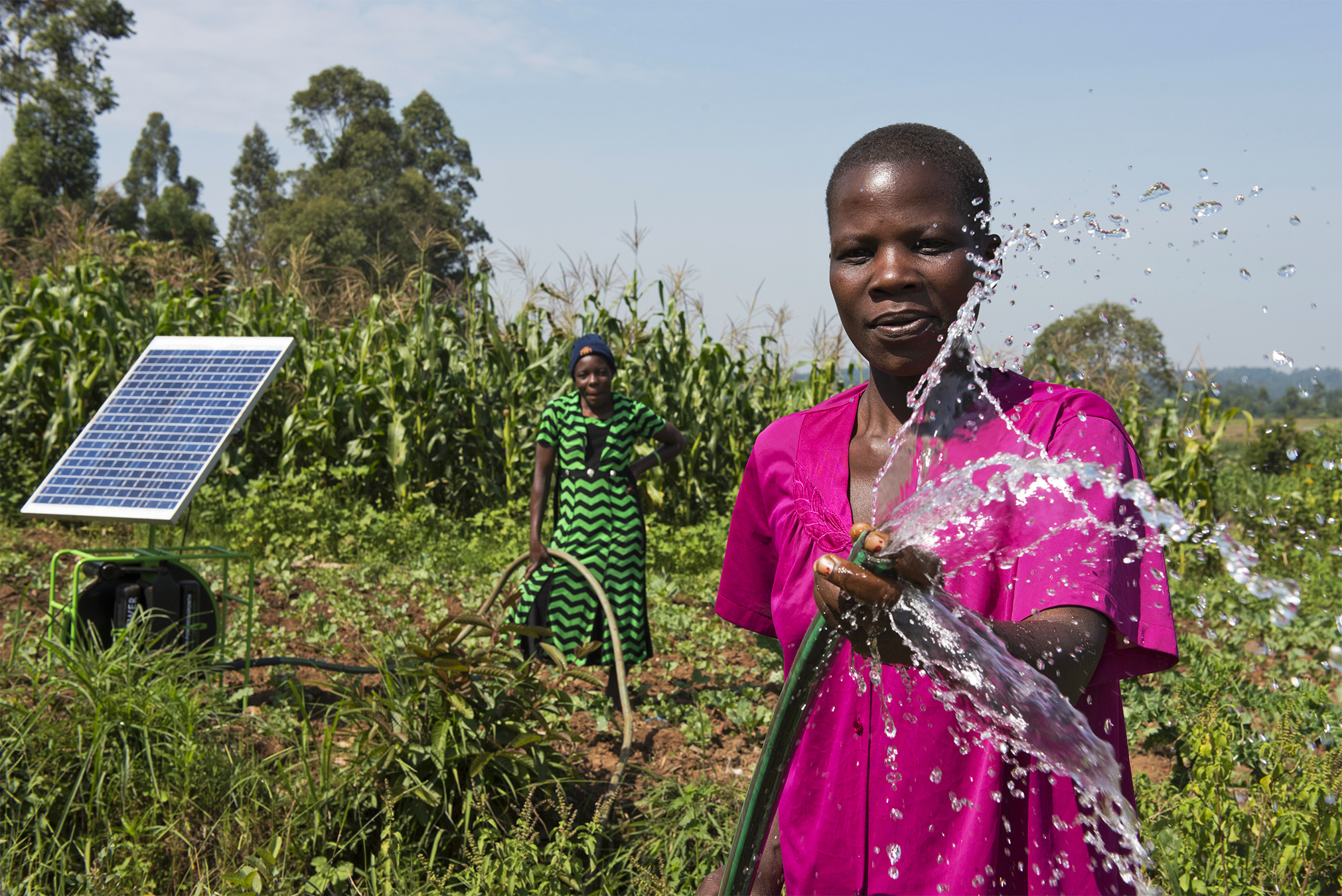
Banner image: Irrigating a farm using solar-powered water pump, Kenya. Image by IWMI/Jeffery M Walcott/IWMI via Flickr (CC BY-NC 2.0).
Citation:
Kabira, N., & Kameri-Mbote, P. (2026). Just transition through the lens of women, children and nature rights in Kenya. Environmental Law Review. doi:10.1177/14614529261419314
Cite this article
Ouma Elvine Tina (2026). Just transition remains elusive for Kenyan women despite robust policies. Mongabay Conservation news. DOI: https://doi.org/10.66709/news-333396

