


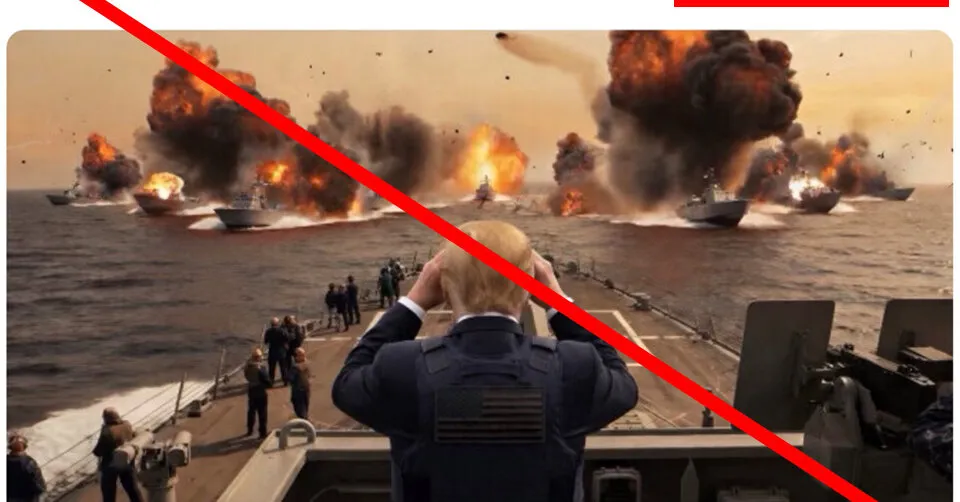
The internet is awash in A.I.-generated video and images — think President Trump appearing to tame a tiger or unbelievable fitness transformations.
But it’s rare for The New York Times to report on specific pieces of A.I. slop, even on days when a viral clip seems to be all anyone is talking about. Why is that? How do we decide to report on certain images? And how do we know where to draw the line?
For answers, we turned to three colleagues who seek clarity in a bewildering media world: Stuart A. Thompson, who reports on online influence; Aisha Khan, the deputy Standards editor; and Mark Scheffler, who leads the Visual Investigations team.
These are edited excerpts from our conversation.
How do we decide when A.I. images and memes are newsworthy?
STUART THOMPSON: This is a tricky question! It’s one we’ve been debating since long before A.I. came along. Remember QAnon? It was this massive online conspiracy theory, but there was a lot of debate about when, why and how mainstream media should weigh in.
My golden rule is that readers need to benefit from learning about it in some way. We don’t usually just debunk. We try to explain — usually focused on the causes and consequences. Who made it, why and how do they benefit? Who is harmed? The article needs to reflect something deeper about society, technology or regulations, I think. But it’s rarely obvious when to dive in.
AISHA KHAN: As Stuart says, figuring out when to report on these can be tricky. Is it the president, or a major political candidate, sharing an A.I.-generated video or image of himself or a rival to make a political point? Are film studios turning to A.I., or are propaganda operations churning out A.I. content? What about those strange videos on YouTube Kids? Those are things we’d want to and have covered. But we also want to help our audience understand how the technology is evolving, and how to spot when someone is using A.I. to try to influence them or to sell them something.
MARK SCHEFFLER: We typically jump in when the imagery is purporting to show an incident or event with high stakes. A bombing of a building, someone appearing to perpetrate violence, attempts to deceive as part of a scam of some kind, whether it’s hawking a dubious product or trying to influence minors or other vulnerable populations. If there’s an accountability dimension, that’s when, from our perspective, it’s important for our team to cover it.
We’ve reported on how A.I. imagery is changing elections like the Los Angeles mayoral race and global affairs like the Iran war. Where’s the line between showing our audience what we’re talking about and amplifying misinformation or disinformation?
AISHA: This is a really difficult question, and one we wrestle with nearly every day. So much misinformation and disinformation is visual, now that it is easy to pump out A.I.-generated content. We don’t want to contribute to the circulation of dubious content created to mislead and sow confusion. So we take steps to choose clips and images with great care and restraint, limit what we show, and also label and mark content that is false. We also put a lot of effort into explaining and contextualizing anything we do show. And in some cases, we may decide it is better to explain the content rather than show it, for example if it is very offensive.
STUART: I prefer showing readers the content as much as possible, except for content that is vulgar or deeply offensive. The imagery and videos I see on social media are sometimes shocking, and we risk sanitizing the reality of what people are doing with A.I. tools if we write about it only obliquely. Once you see it, you understand how far things have gone. But that leads to some tough conversations inside the newsroom, since we’re also wary of amplifying something false or doing a liar’s work for them by spreading the message further.
A politician publishing an A.I. fake would have been unthinkable a few years ago. Now there are hundreds of ads floating around the midterms that are A.I.-made. We probably need to find some broader significance to an A.I. fake to consider reporting on it. There was an A.I.-generated photo of President Trump seemingly embracing an aide on a golf course. It was nothing spectacular as far as A.I. fakes go, but people started to share it as though it was real. It fed into larger speculation among critics about the aide’s relationship to Mr. Trump. It was also apparently manipulated to remove the invisible watermarks that companies insert to identify A.I. imagery. So those methods, and the power of that particular image to fit within existing narratives, were all worthy of an article.
MARK: The world is becoming awash in this material, and it’s getting more and more sophisticated. We are in a situation where objective reality is constantly being put into question and in some cases, wholly undermined. It’s important that we stay vigilant for synthetic content in our own reporting, but also continue to help people understand what it looks like and how it’s getting better and better at mimicking real-world scenes, locations, actions and people. Stuart’s work in this space is invaluable.
How do our considerations change when a world leader like President Trump posts an A.I. video?
AISHA: The president posts a lot of videos, and not all are newsworthy. But he is the head of government, and some of his posts are definitely important to cover: when they are part of a campaign or promoting a policy platform, or might be misleading on an important issue. Our readers rely on us to report on these in a straightforward and responsible way, and to make it clear why they are newsworthy and to include any information they need to understand them.
MARK: To Aisha’s point, some of these posts have more serious consequences than others, but Mr. Trump has put A.I. slop into the public discourse at the highest levels now, and we should be persistent in calling out what it is, what it might reveal and what the downstream ramifications could be.
STUART: He’s the leader of the free world. What he is doing matters. We also risk becoming desensitized to his behavior. In some ways we already are. The first A.I.-generated video he posted was national news. Now people barely blink.
A.I. videos generated for propaganda purposes may be outrageous, but many are clearly fake to a reasonable viewer — think Trump bombing protesters with excrement. How do our decisions about covering that type of video differ from reporting on deepfakes?
STUART: At the beginning of this new A.I. age, watchdogs worried that A.I. deepfakes would flood the internet. What we got instead were a lot of memes, and relatively fewer deceptive deepfakes. But memes still have a lot of power. It’s less about debunking them than understanding what they’re being used for, and why.
MARK: I agree with Stuart that things that are more reflections of what people want to believe — whether they’re ludicrously presented or obviously fake — can still get a lot of traction. With the more sophisticated efforts to deceive, you start to add motive or suspected motive to the mix. Why is this person or entity doing this? Do they have an active stake in an outcome? That’s harder to determine and report out, but it’s key.
Are there best practices for displaying manipulated images that make news?
AISHA: We have come up with a system for how we show A.I. videos. We try to label any such content with a prominent “Generated by A.I.” label. When the videos or photos feature false or misleading content, we also overlay a red slash on them to make it clear these are disinformation.
It sounds like all this work takes time. How do we build that in while still being fast to a story?
MARK: Everyone at The Times works in a highly competitive news world. That’s a given. On Visual Investigations, we abide by the longstanding adage that it’s better to be right than to be first. It’s nice when you can be both obviously. But if things aren’t adding up, we keep reporting and trying to shore up the facts.
Have we ever gone too far, or not far enough, in showing manipulated imagery?
STUART: There was a lot of debate about my most recent piece about A.I. in campaign advertising. In the original draft, we included the full clips of the ads with sound, which included some extreme imagery. One ad showed caricatures of what appeared to be Iranian leaders, invited to a party with a candidate where they used scimitars to stab at a cake featuring the Star of David. I can describe it here, but seeing it is something else entirely. It was weird and disturbing. Is that worth showing to readers? I think it’s good if the public really grasps how far politicians and candidates are going with A.I., and what these systems are capable of producing. We decided to omit that clip, and described it in text instead.
AISHA: As Stuart notes, we have lively discussions about how much or little to show. In the case of A.I. in campaign ads, we wanted to show how quickly and well it can be used to create both over-the-top caricatures and very realistic ads, but without posting some of the most offensive content or giving these operations the visibility they seek.
Are we ever 100 percent certain that an outside photo or video isn’t A.I.-generated? If so, will there be a time when that will cease to be the case?
MARK: We are having to add steps to our verification and corroboration process. It’s not just a question of when and where something happened, it’s also: Did it happen at all? That requires all of our usual checks and balances, everything from doing sun/shadow calculations to tracking down the provenance of a piece of footage. And now we’re bringing increased scrutiny to our assessment of footage, looking for visual anomalies or inconsistencies with time and place, digging deeper into the metadata of a video clip and redoubling our efforts to understand when and where the footage first appeared online.
Most of the material we work with includes fragments of footage, filmed at odd angles, often at night, with low resolution, etc., so potentially easier to fake. I think with the robust corroboration methods we use, we decrease the possibility of getting duped, but we never cut corners and always try to anticipate new developments. It’s hard to know what the future will unspool.
