


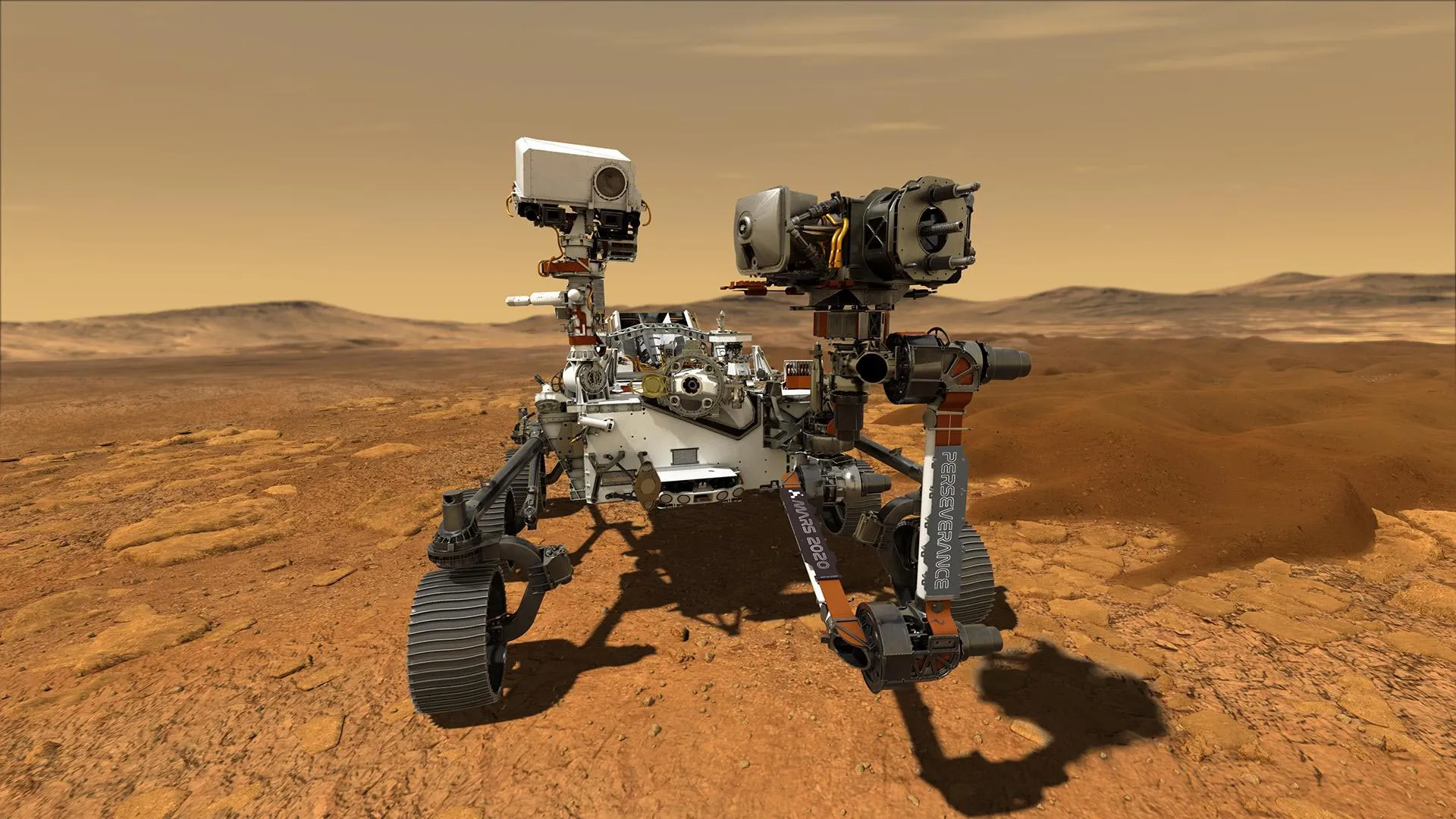
NASA’s Perseverance rover has officially set a new driving record on another world, traveling farther across an extraterrestrial surface than any vehicle before it. On October 11, its odometer reached 28.10 miles (45.22 kilometers), surpassing the previous record of 28.06 miles (45.16 kilometers) held by NASA’s Opportunity rover, which explored Mars from 2004 to 2018.
Even more impressive is how quickly Perseverance accomplished the feat. Opportunity needed nearly 15 years to cover its record distance, while Perseverance did it in just five and a half years. The milestone came on the rover’s 2,006th Martian day, known as a sol.
The record was set as Perseverance made its way toward a location called “Idubi,” traveling through an area beyond the western rim of Jezero Crater known as “Lac de Charmes.” This region contains what may be some of the oldest terrain ever examined in the solar system.
The landscape preserves a remarkable glimpse into the distant past. Similar rocks on Earth have largely disappeared because of erosion and the continual movement of the planet’s crust through plate tectonics (Mars doesn’t have tectonic plates). At Idubi, scientists hope to uncover evidence of ancient hydrothermal systems, where heated water once circulated through rocks and may have created conditions suitable for life.
How NASA’s Self-Driving Mars Rover Broke the Record
One of the biggest reasons Perseverance has been able to travel so far is its sophisticated autonomous driving system.
Known as AutoNav, the technology allows the rover to navigate much of the Martian landscape without waiting for detailed driving instructions from Earth. As Perseverance moves, it continuously captures images of its surroundings, constructs a three-dimensional map of potential obstacles, and selects a safe route between destinations chosen by mission controllers.
NASA engineers describe this process as “thinking while driving.”
The system operates while Perseverance travels at or near its maximum speed, allowing the rover to cover as much as 1,351 feet (412 meters) in a single Martian day.
More than 90% of the distance Perseverance has traveled has involved AutoNav evaluating the terrain. By comparison, the earliest versions of autonomous navigation used by Opportunity and its twin rover, Spirit, were responsible for assessing only about 5% of their driving distances.
The technological progress is even clearer when compared with NASA’s first Mars rover, Sojourner. That early robot evaluated just 20 measurement points to determine the safest route ahead. Perseverance now analyzes approximately 600,000 points each time it examines the surrounding terrain.
“It is an honor to be working on Perseverance at a moment when the technology has evolved to the point that drives like these are routine,” said Steven Lee, the project manager of the Curiosity and Perseverance rovers at NASA’s Jet Propulsion Laboratory in Southern California. “The original mission called for no more than 12.4 miles of driving. We’ve blown well past that, and with all mobility systems fully operational and favorable extended-ground-life test results, we expect Perseverance to keep adding to this record for many years to come.”
NASA has already approved Perseverance’s first mission extension. Beginning in October, the extended mission will allow the rover to continue investigating the rim of Jezero Crater through approximately the end of 2028.
Nearly 30 Years of Mars Rover Exploration
Perseverance’s achievement builds on almost three decades of robotic exploration on Mars. With each new generation, NASA’s rovers have become more capable of traveling longer distances, navigating difficult terrain, and investigating locations that earlier vehicles could never have reached.
The journey began in 1997 with Sojourner, a small rover roughly the size of a microwave oven. During its 83-sol mission, it traveled approximately 330 feet (100 meters).
NASA took a major step forward in 2004 with the arrival of Spirit and Opportunity. These golf-cart-size rovers were originally designed to operate for just 90 Martian days, but both dramatically exceeded expectations.
Spirit covered 4.8 miles (7.7 kilometers) before its mission ended in 2010 after it failed to survive the harsh Martian winter.
Opportunity continued operating much longer, remaining active for an extraordinary 5,111 sols. In 2015, it became the first vehicle to complete a marathon distance on another world. Its total mileage eventually established the driving record that Perseverance has now broken.
Meanwhile, NASA’s Curiosity rover, which landed in Gale Crater in 2012 and continues exploring today, has traveled more than 23.65 miles (38.07 kilometers).
Perseverance Is Becoming an Even Smarter Driver
Although Perseverance has already surpassed every previous extraterrestrial driving record, NASA engineers are continuing to improve its navigation capabilities.
“The rover that broke this record did so by making its own decisions about the path. Given the autonomy to just go, Perseverance is a better driver than the one that landed, and we’re not done,” Mark Maimone, deputy team chief for robotic operations on Perseverance, said. “Our newest software teaches Perseverance to steer less and roll more, and to check its own position against orbital maps mid-drive. The next frontier is sunlight itself. Glare in the navigation cameras is why we park by mid-afternoon if we’re driving toward the Sun, and if we can teach the rover to see past those artifacts, every rover that follows gets a longer working day.”
One challenge is that bright sunlight can interfere with the rover’s navigation cameras, making it harder for its software to interpret the terrain. When Perseverance travels toward the Sun, mission planners currently stop driving by mid-afternoon to avoid these problems.
Finding ways to overcome that limitation could allow Perseverance and future Mars rovers to spend more time exploring each day.
The rover’s record also extends beyond Mars. Earlier in its journey, Perseverance exceeded two historic driving distances achieved on the Moon.
In 1972, Apollo 17 astronauts Gene Cernan and Harrison Schmitt traveled 22.2 miles (35.7 kilometers) across the lunar surface. The following year, the Soviet Union’s robotic Lunokhod 2 rover covered 24.2 miles (39 kilometers). Perseverance has now surpassed both of those distances.
Exploring 4-Billion-Year-Old Rocks for Signs of Ancient Life
For NASA, however, setting mileage records is not the primary objective. The rover’s ability to travel farther and faster allows scientists to investigate more geological formations, examine a greater variety of rocks, and piece together Mars’ environmental history.
Perseverance has already explored several dramatically different landscapes. Its journey began on an ancient lakebed inside Jezero Crater and continued through the remains of a river system that once carried water and sediment into the basin.
Along that route, the rover encountered a rock called “Cheyava Falls,” where scientists identified a potential biosignature. A biosignature is a feature or chemical pattern that could provide evidence of past life, although nonbiological processes can sometimes produce similar clues.
The rover has since climbed toward the crater rim, where scientists are investigating a different type of ancient environment. Instead of the lake and river habitats examined earlier in the mission, researchers are now interested in the possibility that hydrothermal activity once occurred in this region.
Such systems form when water interacts with hot rocks, potentially creating chemical conditions that could support microbial life.
So far, Perseverance has gathered 29 samples of rock and regolith, the loose material that covers the Martian surface. These samples come from several distinct environments, including the crater floor, a fan-shaped deposit left by an ancient river, and the crater rim.
Some rocks in the rim region formed during major impacts approximately 4 billion years ago. They preserve evidence from an extremely early period of planetary history, much of which has been lost on Earth through geological activity.
After completing its investigation of Lac de Charmes, Perseverance is expected to continue traveling along the crater rim before heading south during its extended mission.
One future destination is Rainbow Falls, an enormous piece of ancient Martian crust measuring 328 feet (100-meter-wide). The formation was pushed upward by the powerful impact that originally created Jezero Crater.
As Perseverance continues its journey, each additional mile could bring scientists closer to understanding the ancient environments of Mars and whether the Red Planet once possessed the conditions necessary for life.
