


- Seabirds and native forests build climate resilience in atoll islands, a new study finds.
- Using data collected on 28 atoll islands in the Indian and Pacific oceans, the study finds that nutrients from seabird guano, along with native vegetation, boost island building and maintenance processes.
- Researchers find that on rat-free islands with abundant seabird populations, reef accretion (growth) will be able to keep pace with levels of sea-level rise projected under 2 degrees Celsius (3.6 degrees Fahrenheit) of warming, until 2100.
- The study shows that rewilding atoll islands by removing invasive predators and planting native vegetation would build resilience to sea-level rise.
Low-lying tropical atoll islands appear remarkably vulnerable to climate change. But when shrouded with native forests and with abundant seabird populations, these islands may keep up with rising sea levels, a new study finds.
Seabirds act as biological pumps, moving nutrients from feeding areas in the open ocean to roosting and nesting areas on land and, eventually, back into the ocean.
The recent Science Advances study traces how energy from nutrient-dense seabird guano trickles through terrestrial and marine ecosystems on atoll islands. The findings show that these nutrients, along with native vegetation, boost processes that build and maintain the island’s reef and underlying structure, even in the face of rising seas.
Rewilding atoll islands — many of which no longer support seabirds and have seen native forests replaced by coconut palms — builds climate resilience, as well as benefiting biodiversity, Nicholas Graham, distinguished professor at Lancaster University, England, and the study’s first author, told Mongabay in a video call.
“It’s really telling us something about the islands themselves,” Graham said. “Seabirds and native vegetation actually support the resilience of the islands themselves to sea level rise, which I think is fascinating and really quite positive.”
Graham and colleagues first began looking into the connection between seabirds, islands and reefs nearly a decade ago.
At the time, Graham was studying the impacts of climate change on coral and fish. As part of that work, he had been on a number of research expeditions to the Chagos Archipelago, a string of atolls — ring shaped islands built from coral — in the middle of the Indian Ocean. These multidisciplinary research expeditions often included seabird ecologists, and this drew his attention to a stark difference between islands, Graham said.
Some were quiet but for the sound of rustling palms and lapping waves on the white sand beaches — your postcard-perfect island paradise. Others were raucous affairs, with seabirds wheeling overhead and roosting in native forests, the air redolent with their pungent guano.
The primary reason for this stark contrast was rats. On islands where passing sailors had introduced rats, seabirds had all but disappeared. On islands without rats, seabirds thrived.
What effects, researchers wondered, did the seabirds — and all that nutrient-rich guano — have on the reefs?
Since then, Graham and colleagues tracked the diverse and profound impacts of seabird nutrients on atoll island ecosystems, all the way out to where the reef meets the open ocean. Their previous studies have shown that on reefs surrounding rat-free islands with numerous seabirds, fish grow faster and are more abundant, corals grow more quickly and recover faster, and more. At every step of the journey, the team has been “hugely surprised” at the breadth and magnitude of the impacts, Graham said.
In the latest study, researchers turned their attention to the island maintenance processes that build an atoll’s resilience to sea-level rise.

Atoll islands are ‘biogenic,’ meaning they are built and maintained through biological processes. Corals, calcifying algae and other organisms generate the carbonate reef structures that protect the island from incoming waves. Herbivorous fish and other organisms transform the carbonate structure into the sediments that make up the island. Vegetation binds the sediment together and prevents it from washing away.
The study finds that islands with abundant seabirds and native vegetation had higher rates of reef growth (or accretion), more sediment available for island maintenance, and better soil structure. The boost was enough to allow islands to keep pace with rates of sea-level rise projected under 2 degrees Celsius (3.6 degrees Fahrenheit) of warming, until the end of the century.
The findings show that rewilding atoll islands offers a “win-win-win” for land, sea and climate resilience, study co-author Cassandra Benkwitt, an ocean recovery scientist at the global nonprofit The Nature Conservancy, told Mongabay in a video call.
“It flips this narrative of atolls and atoll islands being subject to climate change and in this desperate place,” Benkwitt said. “This is showing that there are these nature-based solutions in the form of island restoration.”
The study was conducted by a multidisciplinary group of researchers, including a marine biology team led by Graham at Lancaster University; a terrestrial ecology team led by Yadvinder Malhi, a professor at the University of Oxford; and a reef geomorphology team led by Chris Perry, a professor at the University of Exeter, England.

Researchers used ecological data from 28 atoll islands in the Seychelles and Chagos Archipelago in the Indian Ocean, and Tetiaroa, French Polynesia in the Pacific Ocean. Reaching the remote field sites entailed a combination of commercial flights, military aircraft, small planes, fisheries vessels, ferries and chartered boats, Benkwitt said, and sometimes living on ships for weeks at a time.
For the analysis, researchers used an “energetics approach” to trace how energy moved through terrestrial and marine systems, beginning with the seabird guano. They focused on three key island building processes: reef accretion, sediment production and soil stabilization.
They found that nutrients from seabird guano meant corals and calcifying algae were more productive, and the carbonate reef structure grew 1.5 to 1.8 times more quickly on rat-free compared to rat-infested islands.
Crucially, the authors write, the growing reefs continue to protect islands from incoming wave energy, preventing erosion. In contrast, around rat-infested islands, reef accretion was already outpaced by current rates of sea-level rise.
Seabird guano nutrient also boosted sediment production, the study finds, with parrotfish, which turn coral reef into sand while feeding, growing bigger and processing sediment more efficiently. This, along with sediment from organisms like calcifying algae, meant 2.3 to 2.8 times as much sediment was available for island maintenance on rat-free islands with abundant seabirds, compared to rat-infested islands.

On land, the researchers looked at the impacts of seabird nutrients and vegetation on soil stability. On atolls, native vegetation typically has root systems with extensive networks of fine root hairs; in contrast, introduced coconut palms have shallow, rounded root balls.
The researchers found that atoll islands with more than 75% native vegetation — a threshold commonly used as a restoration target — had 4.6 times greater fine root length in soils. These dense mats of fine roots protect islands from erosion and storms. Native vegetation also provides roosting and nesting habitat for seabirds; in turn, the seabirds fertilize soils with guano, increasing root development.
“Collectively, you’ve got the reefs protecting from the wave energy, the sediment allowing the islands to grow and be able to adapt, and the fine roots binding and holding the island together,” Graham said.
The study “firmly establishes” that seabirds are key for healthy ecosystems and climate resilience, Stephanie Borrelle, Pacific marine regional coordinator at BirdLife International, who was not involved in the study, told Mongabay in a video call.
Seabirds play a crucial role in nutrient cycling, acting as biological pumps that move nutrients from marine areas to land. Yet they are the most threatened group of birds, with 30% of species at risk of extinction. Invasive predators, including rats, are considered the major threat.

The study shows why we need to “keep common species common,” alongside focusing on rare or endangered birds, Borrelle said.
“We’re talking about seabirds that breed in mass aggregations and density, so they’re producing a huge amount of guano. They’re contributing a huge amount of nutrients to these islands. And as you reduce the number of those birds, that influence obviously decreases as well,” Borrelle said.
Atoll islands are the “front line” for climate change, Graham said, many rising just 1 to 3 meters (4 to 10 feet) above water.
Over the last decade, the rate of sea-level rise has increased to approximately 3.5 centimeters per year (1.4 inches per year) roughly double that of the long-term average since 1901.
While engineering solutions may be appropriate on urbanized atolls, this study shows that rewilding is an attractive alternative for the many sparsely populated or uninhabited atolls, Graham said.
“Nature-based solutions through island restoration have great potential to support island resilience in many of the other island settings” Graham said.
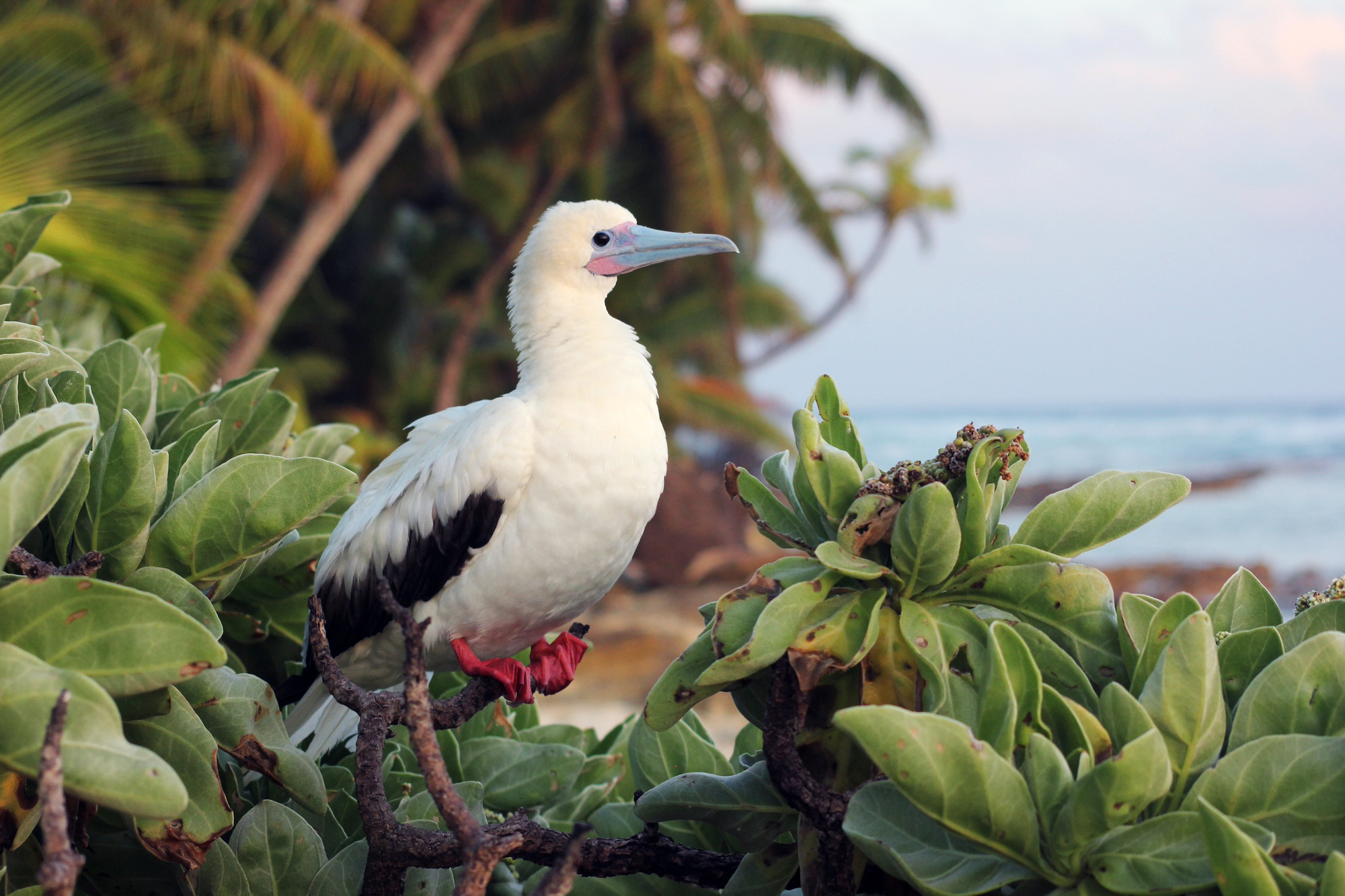
Banner image:A red-footed booby (Sula sula) chick on an atoll island in the central Indian Ocean. Seabirds transfer nutrients and energy from their feeding grounds in the open ocean to roosting and breeding habitat on islands. Image by Jon Slayer.
Half of seabirds are declining. Protecting marine flyways could help save them
From rat-ridden to reserve, Redonda is an island restoration role model
Citations:
Graham, N. A., Benkwitt, C. E., Lange, I. D., Perry, C. T., Thomson, E. R., Wedding, L. M., … Malhi, Y. (2026). Seabirds and native vegetation drive ecosystem processes that support atoll island resilience. Science Advances, 12(42). doi:10.1126/sciadv.aei1145
Graham, N. A., Wilson, S. K., Carr, P., Hoey, A. S., Jennings, S., & MacNeil, M. A. (2018). Seabirds enhance coral reef productivity and functioning in the absence of invasive rats. Nature, 559(7713), 250-253. doi:10.1038/s41586-018-0202-3
Benkwitt, C. E., D’Angelo, C., Dunn, R. E., Gunn, R. L., Healing, S., Mardones, M. L., … Graham, N. A. (2023). Seabirds boost coral reef resilience. Science Advances, 9(49). doi:10.1126/sciadv.adj0390
