


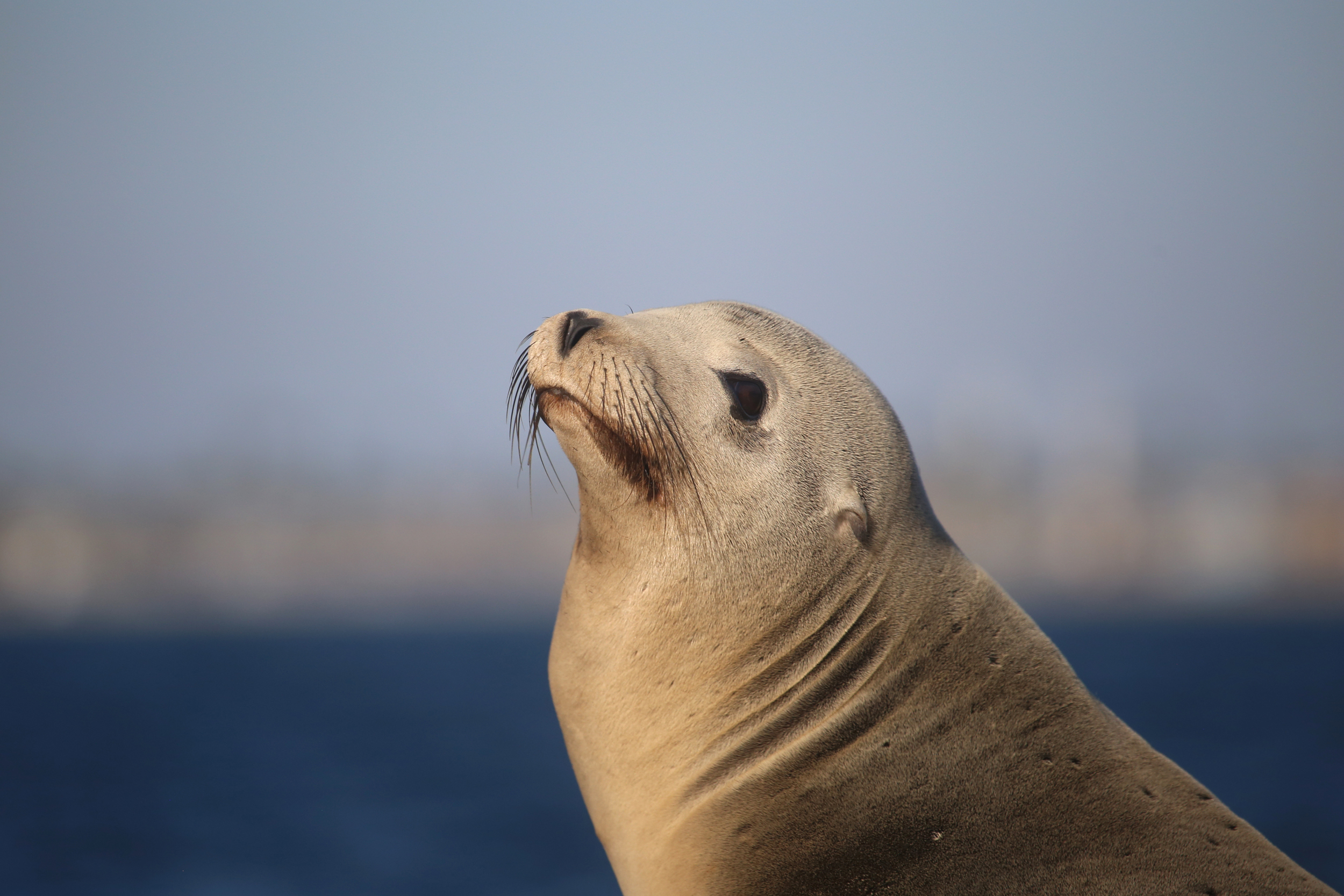
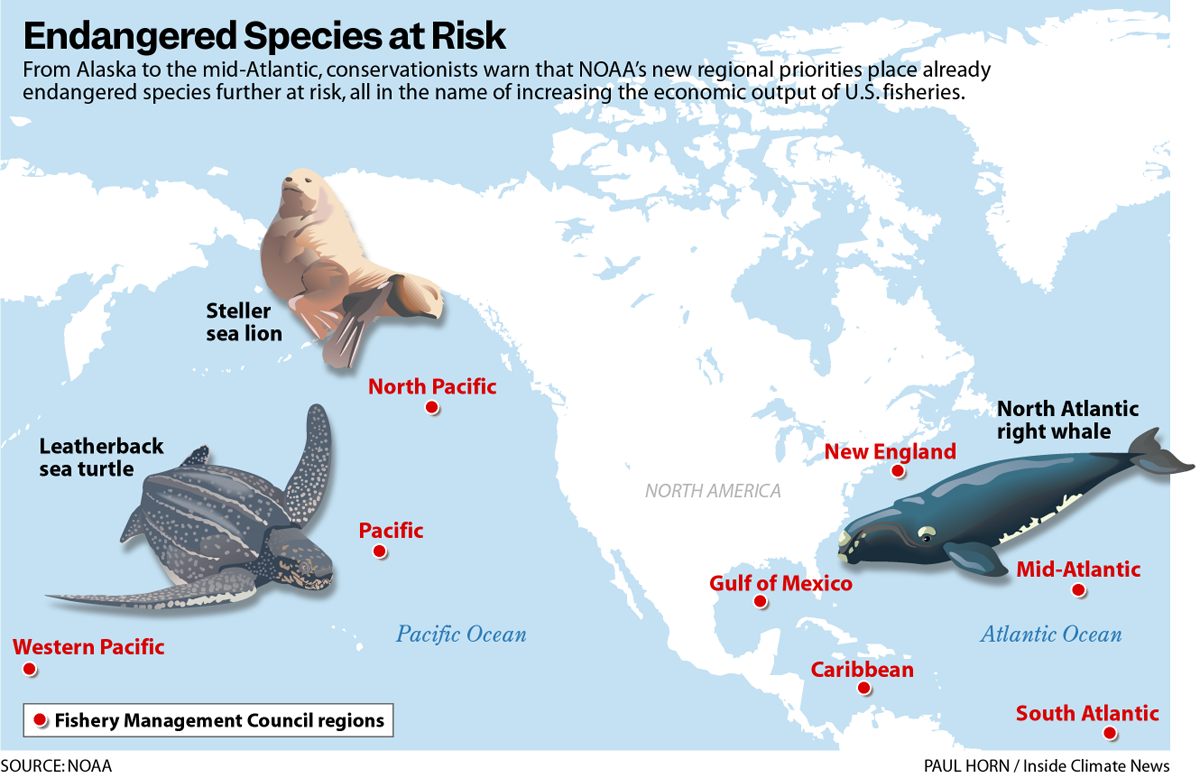
In the Western Pacific, protections for endangered leatherback turtles face elimination. In Alaskan waters, Steller sea lion sanctuaries could soon shrink. And in the North Atlantic, gear designed to save right whales from fatal entanglements might be permanently scrapped.
The National Oceanic and Atmospheric Administration (NOAA) sent letters to the nation’s regional fisheries councils last month, directing all of them to dismantle restrictions in favor of more permissive, economically advantageous fishing procedures.
The “regional priorities” are an effort by the Department of Commerce to fulfill President Donald Trump’s “Restoring American Seafood Competitiveness” executive order, signed in April 2025.
At stake are reassessments of marine protected areas (MPAs), the removal of species from conservation lists, changes to gear types and a wide array of expansions to commercial fishing operations.
“These letters reflect the administration’s view that fish are just commodities, science doesn’t matter, and short-term economic gains (and political points) matter more than sustaining ocean ecosystems,” said Andrea Treece, the senior attorney in the Oceans Program at Earthjustice, in an email to Inside Climate News. “They’re totally missing any sense of stewardship toward the ocean that supports all of us and belongs to all of us.”
The nine letters—sent to the eight fisheries management councils and one division for migratory species—were produced following consultation with hundreds of industry insiders and the management bodies themselves. Slashing decades of key environmental protections, they function like a deregulation wish list.
Indeed, according to a press release from Eugenio Piñeiro Soler—who was appointed to oversee NOAA Fisheries just three days before Trump’s executive order—the new priorities are designed to “reduce burdens on domestic fishing, increase production, stabilize markets, improve access, and enhance economic profitability.”
All nine letters call for councils to reassess their fisheries management plans and “consider removing species that no longer require conservation and management.” There was no clarity on what scientific determinations would be used to decide whether a species retained or lost its protections.
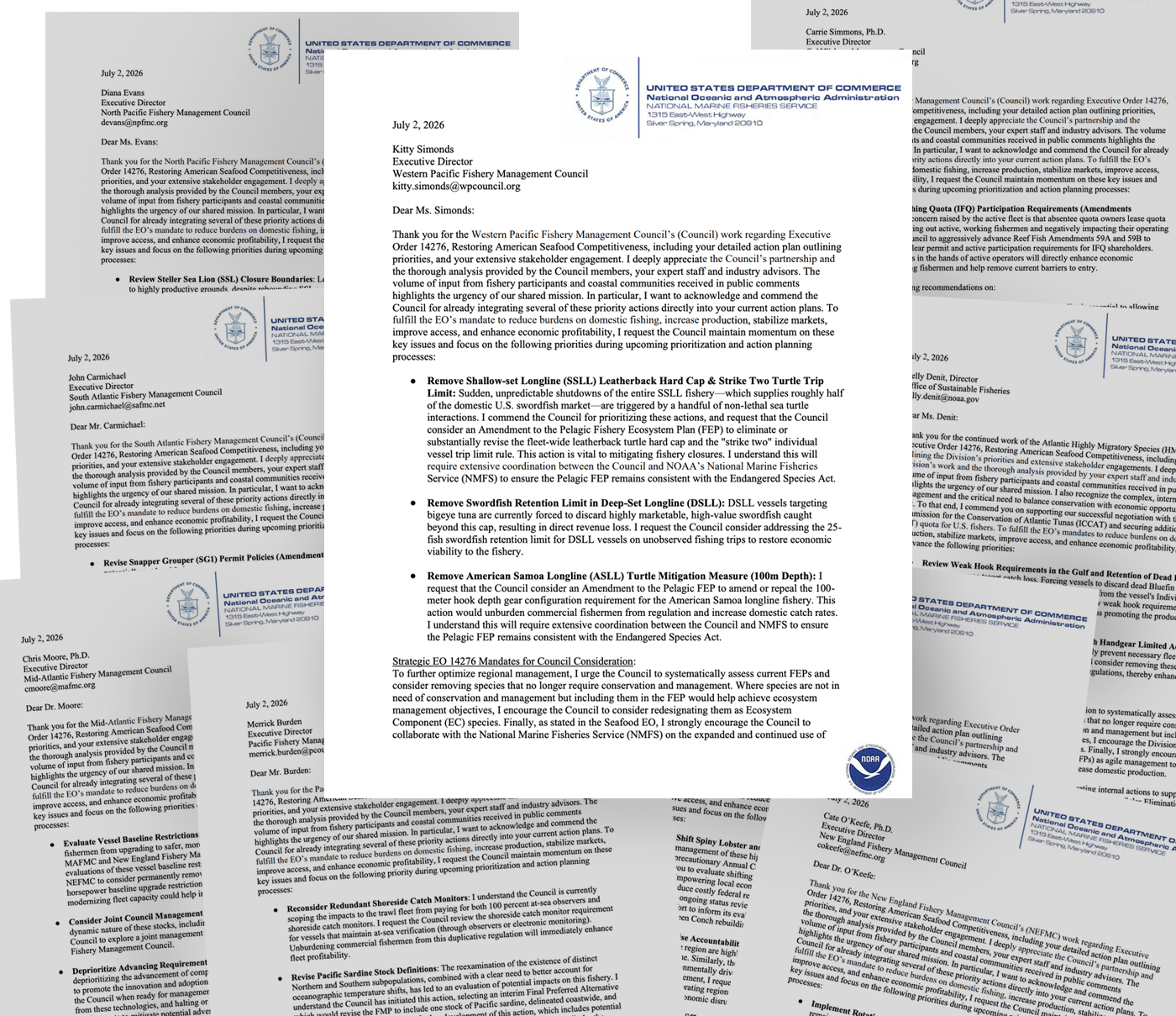
Commercial stocks identified for management reform included: revising sardine stock definitions to “increase production” in the Pacific; moving management of spiny lobsters and queen conches in the Caribbean from the federal to the state level to “maximize yield”; and amending gear types and rules to allow fishermen to keep migratory bluefin tuna measuring less than 73 inches.
“If the goal is seafood competitiveness, we need healthy fisheries,” said Elizabeth Cerny-Chipman, Ocean Conservancy’s policy manager for U.S. fisheries and a former policy fellow at NOAA’s Office for Coastal Management. “The focus is generally on shorter-term hot-button priorities when we know the focus really should be on long-term and science-based management.”
Three of the councils were also explicitly directed to remove or reduce marine protected areas.
In the blue-jeweled waters west of Puerto Rico, NOAA is pressuring councils to expand fishing access into Tourmaline Bank and Abrir La Sierra—seasonal no-take zones that protect red hind spawning grounds and provide habitat for large snappers and groupers.
This story is funded by readers like you.
Our nonprofit newsroom provides award-winning climate coverage free of charge and advertising. We rely on donations from readers like you to keep going. Please donate now to support our work.
In New England, NOAA is now pushing the regional council to open “traditional fishing grounds” for the scallop fleet—the nation’s highest-value commercial fishery—in the northern part of Georges Bank, a productive fishing ground between Cape Cod and Nova Scotia. The agency is also recommending unleashing the clam dredge fleet—a highly destructive gear type that heavily disturbs the ocean bottom— into the Great South Channel, a habitat management area east of Nantucket.
“I think it’s stupid to think about opening the areas,” said Andrew Rosenberg, former deputy director of NOAA’s National Marine Fisheries Service who personally closed the scallop grounds his second week on the job as regional administrator in 1994. “Those big areas have an abundance of scallops but that’s what’s keeping the whole fishery alive,” adding that these are complaints from an already profitable industry seeking more wealth.
Conservationists warn that removing species from conservation lists and reducing protected areas is short-sighted.
“Protecting spawning grounds is Fisheries 101: if you want more big fish to catch, you have to let them make little fish, and scooping up the breeding adults while they’re trying to make the little fish is a great way to crash a fish population,” said Treece, explaining that regardless of stock recovery, MPAs remain essential to continually grow populations and support a healthy fishery.
Across the letters, there are recommendations to remove protections for endangered species. Currently, the Hawaiʻi shallow-set longline fishery is closed for the year if 16 interactions are recorded between endangered leatherback turtles and industrial fishing operations. NOAA is now moving to abolish that cap.

Off Alaska, populations of Steller sea lions declined by more than 80 percent prior to their listing as endangered in 1990 and the subsequent introduction of fishing closures around their rookeries—areas where they raise their pups. While the Eastern population has steadily recovered, the Western population remains endangered and highly vulnerable to marine heat waves that impact reproductive rates.
Despite another Super El Niño highly likely this fall, NOAA is now calling to “modify and shrink closures” off Alaska to “improve access to fishing grounds.” Experts warn this could rob a struggling population of a safe refuge and, critically, undermine prey availability.
In New England and the mid-Atlantic, there are also calls to sideline requirements for ropeless gear. Over 300,000 whales, dolphins and porpoises die every year from fishing gear entanglements. And for decades, NOAA has been working to develop lobster traps that can rise to the surface without the need for permanent mooring lines—an attempt to better protect the last 350 North Atlantic right whales from getting caught in a maze of webbed water columns.

While NOAA has claimed it will continue to promote and research such gear inventions, it is pushing to make implementation optional for fishermen or even halt the program altogether.
“Instead of blaming these creatures for trying to survive in their own habitat, we should be working towards more sustainable fishing practices, and figuring out how to support healthier fish populations so that humans and marine predators don’t have to compete for dwindling numbers of fish,” Treece said.
For the policy experts that Inside Climate News spoke with, the imposition of a top-down ordering of fisheries councils to enact policy change doesn’t just subvert standard procedure, it also defies NOAA’s purpose.
Under the Magnuson-Stevens Act, regional councils retain the right to develop their own fishery management plans, while the agency’s role is to ensure adherence to legal requirements like preventing overfishing, minimizing bycatch and protecting habitats.
“It’s a series of incoherent measures that don’t fit together in any policy,” said Rosenberg, who spent almost four decades navigating the council system. “None of these measures do anything to improve sustainability. I didn’t see a single one that would improve sustainability. Some will make it worse.”
Treece added that NOAA lacks the authority to override council due process. “It doesn’t allow [NOAA Fisheries] to bully the councils into deregulating fisheries and removing protections for endangered species or MPAs to satisfy special interests, or sacrifice the long-term stability of a fishery,” she said.
Notably, the letters ignore climate change entirely.
“It’s foolish because the letters totally ignore the fact that some of the biggest pressures on marine resources right now are because of climate change,” said Rosenberg, noting how management plans are written for a fixed geographic environment even as stocks are moving poleward or deeper as waters warm.
When asked for comment on these issues, a spokesperson for NOAA told Inside Climate News that “the best available information” could be found in the letters and press releases themselves.
The agency did not respond to direct questions regarding how many protected areas remain in the administration’s crosshairs; what species would lose management measures; what safeguards would be kept in place for affected whales, sea lions and turtles; and whether NOAA Fisheries now prioritizes commercial profits over environmental stewardship.
For conservation advocates, the administration’s priorities set out a troubling trajectory.
“With climate change and marine heat waves like the Super El Niño bearing down on the country, many of these short-term priorities aren’t based in science and are putting fisheries and whole ecosystems at even greater risk,” said Cerny-Chipman. “Now is not the time to roll back protections that help keep fish and marine life healthy.”
About This Story
Perhaps you noticed: This story, like all the news we publish, is free to read. That’s because Inside Climate News is a 501c3 nonprofit organization. We do not charge a subscription fee, lock our news behind a paywall, or clutter our website with ads. We make our news on climate and the environment freely available to you and anyone who wants it.
That’s not all. We also share our news for free with scores of other media organizations around the country. Many of them can’t afford to do environmental journalism of their own. We’ve built bureaus from coast to coast to report local stories, collaborate with local newsrooms and co-publish articles so that this vital work is shared as widely as possible.
Two of us launched ICN in 2007. Six years later we earned a Pulitzer Prize for National Reporting, and now we run the oldest and largest dedicated climate newsroom in the nation. We tell the story in all its complexity. We hold polluters accountable. We expose environmental injustice. We debunk misinformation. We scrutinize solutions and inspire action.
Donations from readers like you fund every aspect of what we do. If you don’t already, will you support our ongoing work, our reporting on the biggest crisis facing our planet, and help us reach even more readers in more places?
Please take a moment to make a tax-deductible donation. Every one of them makes a difference.
Thank you,

Fisheries Reporter
Johnny Sturgeon is a London-based reporter covering fisheries and aquaculture. Joining us from the Outlaw Ocean Project, he has experience producing in-depth maritime investigations for nonprofit newsrooms. A former boatbuilder, he holds a B.A. in History & Politics from the University of Oxford, and an M.S. from Columbia Journalism School.
