


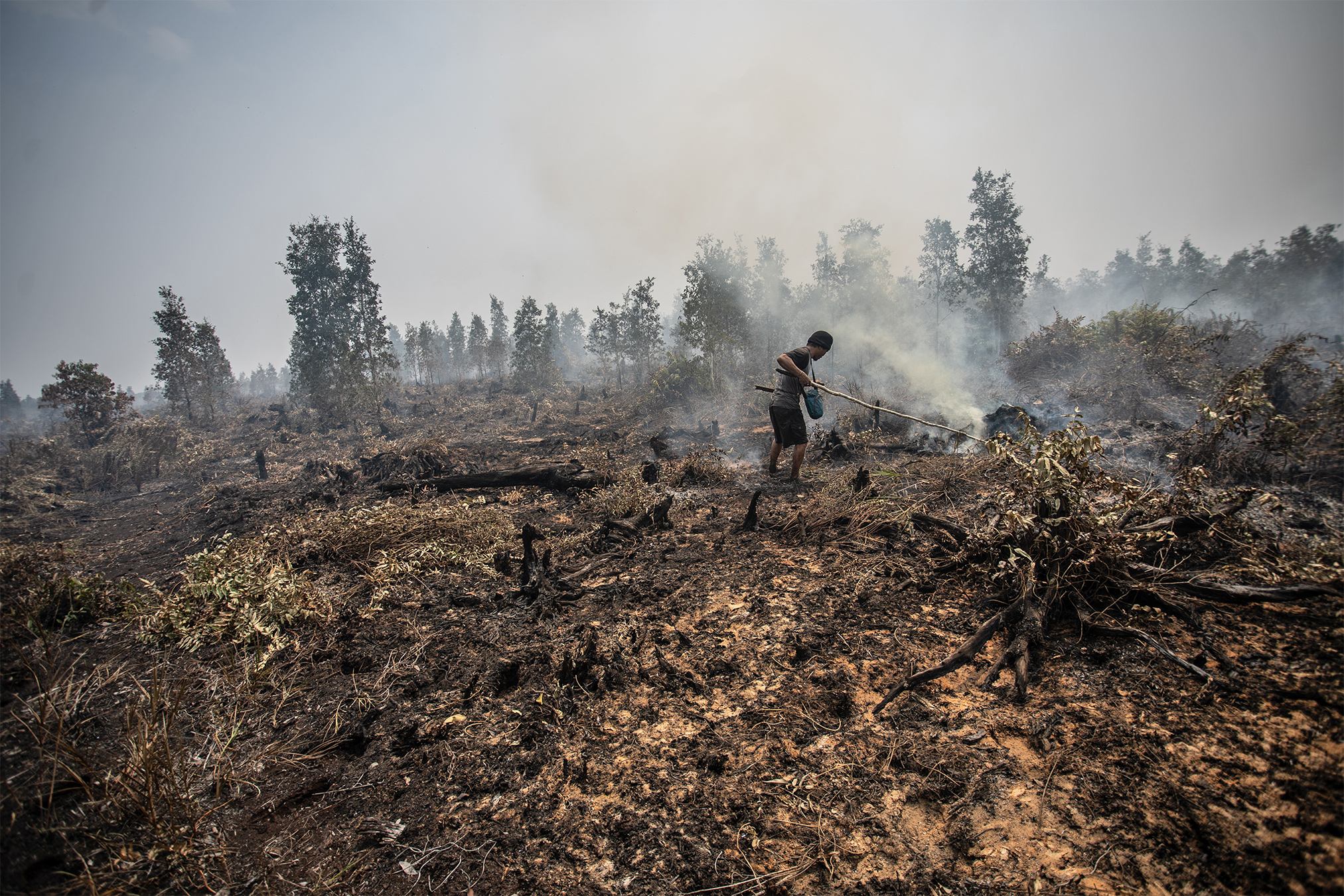
- The world is facing an El Niño event of unprecedented proportions.
- Millions of Indonesians have already been breathing toxic wildfire smoke and bravely fighting the blazes for months, although this event’s likely record-breaking fire season has barely kicked into gear.
- “These communities are inspiring, and they can teach us some lessons about resilience and fortitude in the face of a Super El Niño that’s coming for many of us,” a new op-ed argues.
- This article is a commentary. The views expressed are those of the author, not necessarily of Mongabay.
In October 2006, I was supposed to be starting my dissertation research on tropical reforestation in Indonesia. Instead, I found myself in the forests of Tanjung Puting National Park in Central Kalimantan helping locals to fight fires with brooms, backpack pumps, and hoses connected to hand-dug water wells. It was an ‘all hands-on deck’ moment for the local NGO I was working with then — Friends of Nature, People and Forests (FNPF) — including Basuki Santoso, FNPF’s Kalimantan program manager, alongside Adut and Isam, who were teenagers at the time.
On our first night of firefighting, we slept in the forest on a raised platform that would later become part of a field station. I was awoken in the middle of the night by a sun bear rifling through our makeshift kitchen about 20 feet away. I sat frozen, watching this wild animal who was fleeing the fires while everyone else slept soundly. It was a surreal and humbling moment.
Twenty years ago, these severe forest and peatland fires were due to a dangerous combination of El Niño-induced drought, slash-and-burn agriculture and other land clearing, and the grass-fire cycle. Much of Southeast Asia was left choking on the haze, and that was a weak El Niño year.
History keeps repeating itself, and it’s hard to watch. Experts say we are now facing a Super El Niño. For the past three months, millions of Indonesians have been breathing in toxic haze from what will likely become record-breaking wildfires.
In Indonesia alone, at least 1.5 million acres (over 607,000 hectares) of land burned through the first half of this year, according to recent reports, while the current toll may be well over 2 million acres (more than 809,000 hectares). With this Super El Niño is till gaining strength, the worst may be yet to come, and for a long time: A recent report found a correlation between the severity of an El Niño event and the intensity of the following year’s fire season.
Nowadays, I work on urgent environmental and climate issues through my position at the Governors’ Climate and Forests Task Force (GCF Task Force), the world’s largest network of subnational governments dedicated to protecting forests, reducing emissions, and enhancing livelihoods across the tropics.

The GCF Task Force Global Secretariat is based at the University of California-Los Angeles, in partnership with the University of Colorado-Boulder; both based in the U.S. We were founded in 2008 by then-California Governor Arnold Schwarzenegger as a small coalition of states and provinces from the U.S., Brazil and Indonesia working on the climate and forests agenda. We are now an international network of 54 subnational members, covering more than one-third of the world’s tropical forests.
I just returned home from our latest technical exchange in Indonesia where I witnessed vice governors, secretaries of environment, civil servants, NGOs, and private partners all working together to brainstorm and shape actionable and equitable climate solutions for their communities. The two-day technical exchange with 100 participants from all over the world was originally supposed to take place in West Kalimantan, but at the last minute, we had to relocate the entire conference to Bogor, Java, due to the ongoing fires.
Despite this — and travel delays due to the Anak Krakatau volcano eruption — the technical exchange was a success. It gave policymakers, civil servants, and other participants an opportunity to share best practices for how they implement conservation and restoration projects, and to learn from others. The urgency of the climate crisis hung over these lessons, but we remained undeterred, as do my friends in Central Kalimantan, like Basuki, Adut, and Isam, who are literally risking their health and their lives to fight fires and protect their homes and their livelihoods.

Even in the face of global warming, a Super El Niño, and environmental catastrophe, I remain an optimist. I think you have to be if you are working in the climate space, otherwise, it is far too depressing. But how does one maintain hope when the U.N. just declared that in the next few years, the global temperature will surpass the 1.5°C (2.7°F) threshold of average warming above pre-industrial temperatures, and when global warming and extreme weather have caused unprecedented fires across Canada, Spain, and France? Or when a still-growing Super El Niño is causing devastating fires across Indonesia?
I, for one, maintain hope by supporting the people, organizations, and subnational governments that are on the ground doing everything from fighting fires with their bare hands and planting native tree seedlings for restoration to organizing technical and knowledge exchanges and changing policies and institutional frameworks to support forest conservation and sustainable development.
More than that, these communities are inspiring, and they can teach us some lessons about resilience and fortitude in the face of a Super El Niño that’s coming for many of us.
Akane Nishimura, Ph.D., is an ecologist who serves as program associate for Impact Assessment with the Governors’ Climate and Forests Task Force at the Emmett Institute on Climate Change and the Environment at UCLA in the U.S.
Banner image: An Indigenous Dayak Ngaju man fights a burning peatland fire in Mantangai, Central Kalimantan, Indonesia. Image courtesy of Jurnasyanto Sukarno / Greenpeace.
See related coverage:
As fires spread, Indonesia’s rubber growers draw on traditional ways to fight back
Citation:
D’Antonio, C. M., … Vitousek, P. M. (1992). Biological invasions by exotic grasses, the grass/Fire cycle, and global change. Annual Review of Ecology and Systematics, 23(1), 63-87. doi:10.1146/annurev.es.23.110192.000431

