


- A scientific collaboration between Australian scientists and First Nations Bardi Jawi rangers and elders has highlighted how fish species rely on the connectivity of reef and mangrove ecosystems.
- The study found that culturally important fish species, which form part of traditional fishery practices in the Kimberley region of northwestern Australia, migrated between the two ecosystems more than other species.
- The collaboration enabled Western scientists to draw on millennia of traditional ecological knowledge in carrying out the study and interpreting its findings.
- While most of the findings were already part of traditional ecological knowledge, rangers say they learned how certain species may not be able to survive if either reefs or mangroves were threatened by climate change and environmental impacts.
In a recent scientific article in the journal Ocean & Coastal Management, alongside the list of scientist-authors were the Bardi Jawi and Oorany Rangers and the Bardi Jawi Traditional Owners.
For the past decade, Bardi Jawi rangers and traditional owners have been working with the Australian Institute of Marine Science (AIMS) to study and protect their mangrove and reef ecosystems, as well as their traditional Indigenous fishing grounds.
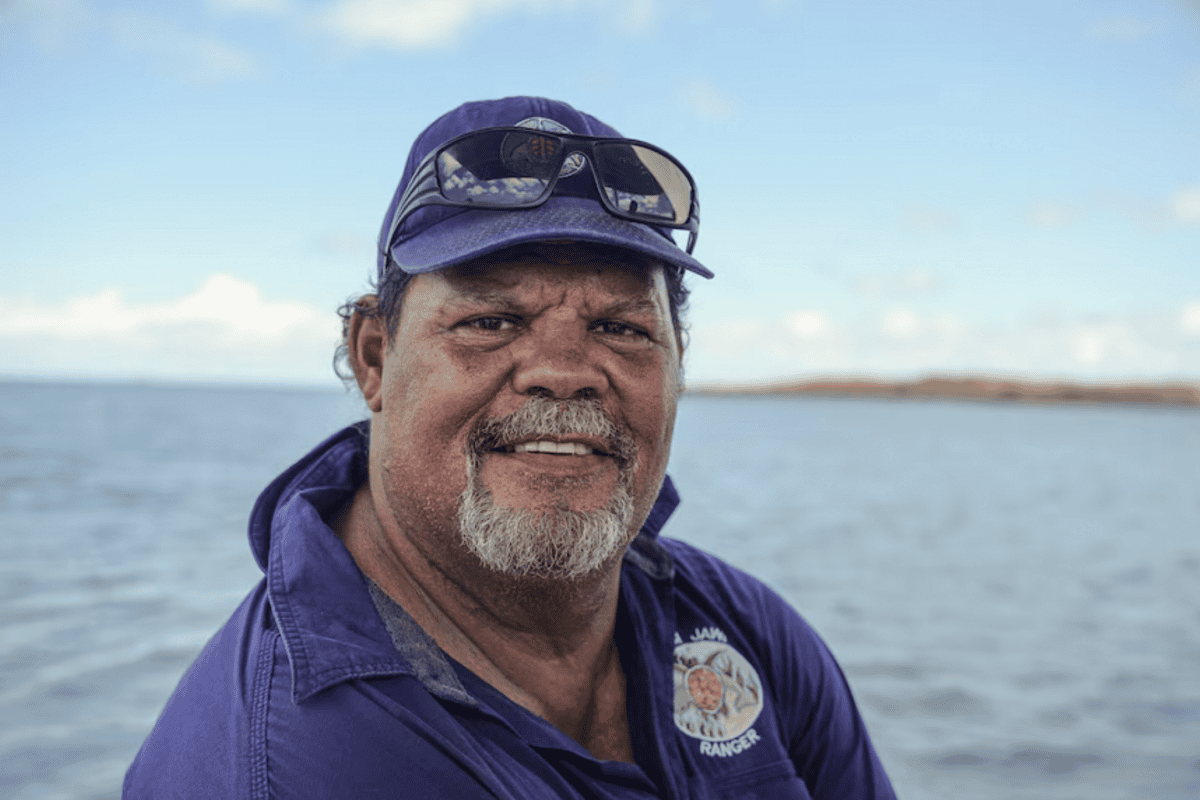
The Bardi Jawi, according to Phillip “Bibido” McCarthy, are a “Saltwater People” whose traditional diet revolves around healthy oceans. Their land, located in the Kimberley region of northwestern Australia, is of “red earth, blue ocean, and green mangroves,” Bibido, the 59-year-old coordinator of the Bardi Jawi men’s ranger program, tells Mongabay.
Bardi Jawi Country forms part of the 95,000-hectare (235,000-acre) Bardi Jawi Indigenous Protected Area (declared in 2013 and administered by the Bardi Jawi) and the 204,000-hectare (504,000-acre) Bardi Jawi Gaarra Marine Park (established in 2022, with a zoning scheme that came into force in July 2026).
Among the most important findings in the study was the interconnectedness between reef and mangrove ecosystems for sustaining fisheries — an aspect long recognized in Bardi Jawi traditional ecological knowledge. The overall project and its findings also guided the design of both the IPA and marine park.
-
Cape Leveque on the Dampier Peninsula in Western Australia. Image by Marty Southwell via Unsplash.
-

Goldlined rabbitfish (Siganus lineatus). Image by © Kristin Anderson via iNaturalist. CC BY-NC 4.0.
Much scientific work in recent years has focused on the role of mangroves as nursery areas for fish species, but the 2026 study found this role went even further.
Although reef ecosystems have greater overall biodiversity than mangroves, the study found that 10 fish species that were culturally important for the Bardi Jawi and in their traditional fishing practices were similarly abundant in mangroves. Aided by tidal movements particular to the Kimberley region, these 10 species, like the barrambarr or bluebone (Choerodon schoenleinii), were able to move or migrate between the two ecosystems, and did so long after the nursery stage was completed. Exceptions included the gambarl or surgeonfish (Acanthurus grammoptilus), which had higher average abundance and biomass in reefs.
“It was the first time that we looked at species that were of interest for fisheries for Traditional Owners in a specific locality,” says Katherine Cure, a fish biologist with AIMS and lead author of the study. “And it was interesting that we found a pattern that was really different for those species than for the overall fish community.”
Some species, Cure says, were also able to use mangroves as refuges when reef ecosystems were vulnerable. Four species had larger individuals in mangroves compared to reefs, like the gambarl, despite the fish being more abundant in reefs.
Little that the study found came as much of a surprise to the Bardi Jawi, though they learned how certain species may not be able to survive if either reefs or mangroves were threatened by climate change or environmental impacts.
-

Smooth-fruited yellow mangrove (Ceriops australis). Image by ©Tony Eales via iNaturalist.
“We knew most of it,” says Bibido, also one of the emerging leaders of the Bardi Jawi. “But the science confirmed it. They told us, ‘You were right.’”
An interconnected web
But as much as the scientific findings, it was the process involved, including the use of the Bardi Jawi’s traditional ecological knowledge, that was among the more significant aspects of the research, the authors say.
“The work we have been doing with the Bardi Jawi has been very much led by them over the past eight to ten years,” Cure says.
It started with a research project on a topic scientists were interested in.
“And then our relationship developed and the IPA began and they needed some metrics to understand the different ecosystems they had and how they’re faring, and the health of those systems,” Cure says. “And so that has developed into this relationship where we have research questions that are very much guided and based on the needs of the Traditional Owners locally and that are also of interest to the scientists.”
The partnership between scientists and traditional knowledge holders is, according to Cure, the natural evolution of the guidance that Indigenous elders and rangers have long provided to scientists.
“First Nations peoples are the first scientists of the world,” she says. “Science is about observation and asking questions. I guess we make more experiments sometimes. But Indigenous people would have also made experiments by, for example, moving to a different area and then moving out again, and asking questions essential to their survival. It’s observation and experimentation, and they’ve done this for thousands of years. It’s definitely a type of science and should be recognized as such.”
-

Phillip “Bibido” McCarthy, Bardi Jawi Ranger Coordinator for Kimberly Land Council, Sunday Islands, One Arm Point. Image courtesy of © Lockie Cooke, iyarn – Founder and Bardi adopted community member.
It’s a role that comes easily to Traditional Owners, Bibido says.
“We’ve been here for 30,000 years, and knowledge has passed down from generation to generation. That makes it really easy for the scientists, because we know the area, we know what they need to look for, we know the tidal movements,” he tells Mongabay.
Ecological knowledge accumulated over millennia can be particularly useful for Western science’s need for long-term data sets to measure changes in ecosystems over time, Cure says.
Using their traditional knowledge, rangers were able to tell the AIMS scientists the best sites and times to study.
“We’re looking at fish populations in this case in a very contemporary manner, but we know that there’s a lot of really long-term information that is held by the traditional owners,” Cure says.
Another reason why Bardi Jawi knowledge was so important in the study is their holistic approach to studying their environment, she adds.
“Everything is connected — the songlines, cultural protocols, language, kinship,” Bibido says. “You have to look at the whole ecosystem. Scientists will come and say they want to research this. We can do that, but we also bring the traditional knowledge, history, the stories, the cultural information to any research we do. Then you work out what’s the next step.”
-

Green sea turtle (Chelonia mydas) Western Australia. © Kristin Anderson via iNaturalist. CC BY-NC 4.0.
-

Blackspot tuskfish (Choerodon schoenleinii). Image by © Mark Rosenstein via iNaturalist. CC BY 4.0.
The parameters of the study itself — which fish species to study, when and where to study them — were determined only after detailed consultation between the Bardi Jawi and Western scientists.
“Ecology is very complex, and there are a lot of cycles within cycles that have to be looked at together, and that’s the beauty of the Indigenous knowledge,” Cure says. “As scientists we tend to compartmentalize things, but Traditional Owners have everything together in their heads. Often, we’ll go and ask about the mangroves and they’ll say that we can’t just talk about the mangrove because the mangrove is connected to this and that. They see it as an overall system.”
Working together
The exchange of knowledge goes both ways.
Studies have shown that while many mangrove systems, in the Kimberley region and elsewhere, have shown signs of recovery and otherwise expanded in size during the past four decades of rising global temperatures, reefs are extremely vulnerable. In 2025, a marine heat wave caused coral bleaching in the reef systems of the marine park.
“Without the mangroves, certain species might not survive up here,” Bibido says. “Without the reefs the same. That was the big, important thing we learned. That, and how important it is that both ecosystems are healthy, and that the fish species survive for future generations.”
Healthy mangroves therefore offer resilience at the landscape level, Cure says.
“A lot of the fish species come to get nutrients from the mangroves and then they go back to the reefs,” she says. “One hypothesis is that because they are getting resilience from the mangroves, they are helping the overall ecosystem to be resilient.”
-

People watch as the sun sets at Cable Beach in Broome, Western Australia, Saturday, Aug. 22, 2026. Image by AP Photo/Mark Baker.
Modern technology that Western scientists bring has also helped the Bardi Jawi to both chart and better understand their rapidly changing world.
“Changes are happening really quickly. We could see the coral bleaching happen,” Bibido says. “But by using drones and cameras we could see it over a large area. We can see how certain types of fish are being affected.”
And having the numbers and verifiable measurements that Western science can produce helps the Bardi Jawi to speak the language of government policymakers.
“Working with the scientists connects us to the outside world,” Bibido says. “The research we did played a big part in setting up the marine park.”
Banner image: Phillip “Bibido” McCarthy. Image courtesy of ABC Kimberley/Dunja Karagic.
Indigenous rangers pull killer ‘ghost nets’ from Australia’s northern coast
Citations:
Cure, K., Depczynski, M., Radford, B., Howard, A., McCarthy, P., Pyke, D., … Barneche, D. R. (2026). Habitat mosaics of mangroves and reefs support fisheries sustainability for Traditional Owners. Ocean & Coastal Management, 276, 108110. doi:10.1016/j.ocecoaman.2026.108110
Zhang, Z., Murray, N. J., Song, X., Bunting, P., Worthington, T. A., Fatoyinbo, L., … Friess, D. A. (2026). Unexpected expansion and regrowth in Earth’s mangrove forests over the past four decades. Science, 392(6802), 1082-1087. doi:10.1126/science.aec9773
FEEDBACK: Use this form to send a message to the author of this post. If you want to post a public comment, you can do that at the bottom of the page.
