


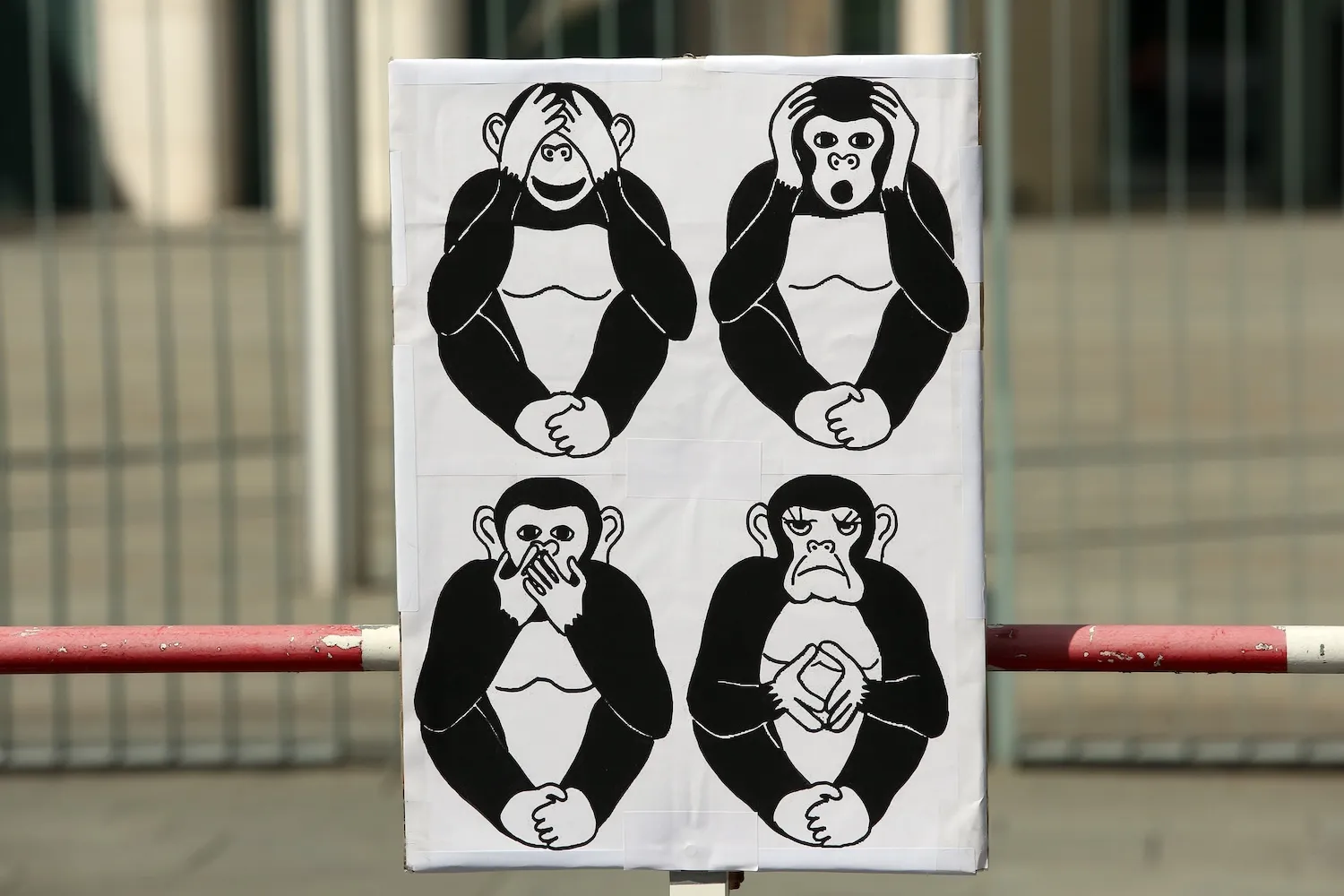
We are all fallible and life is uncertain, so sometimes we believe things that turn out to be mistaken and we recommend policies that don’t work out as we expected. When this happens, we ought to admit we were wrong, try to figure out why, revise our beliefs accordingly, and then formulate new ideas about what to do in light of our enhanced understanding. In a perfect world, decision-makers, pundits, scholars, and ordinary citizens would be good Bayesians: We’d start with a set of prior beliefs, update them as new evidence accumulates, and adjust our behavior accordingly.
In the real world, of course, that happens less often than it should, which is one reason why policies that are visibly failing can be hard to change and why past mistakes keep getting repeated. As historian Barbara Tuchman put it in her book The March of Folly, decision-makers sometimes succumb to a kind of “mental standstill” that “fixes the principles and boundaries governing a political problem.” Both policymakers and pundits are often loath to admit that they made a mistake, even when it is abundantly clear that they were off-base. (For my own attempts to do better, see here and here). Just look at all those enthusiastic cheerleaders for war with Iran who confidently predicted that it would be quick, cheap, and yield nothing but positive results. How many of them have ‘fessed up and admitted that maybe, just maybe, they missed something? Instead of owning their mistakes, some of the loudest voices inside and outside the policy world keep insisting that they were right all along.
There are several time-honored ways to avoid having to admit you were wrong, and to keep from having to rethink your core beliefs about how the world works. Here are some common ways to defend your views in the face of predictive or analytic failure.
No 1: “I was right, but my advice wasn’t followed as I recommended.”
The classic way to conceal a prescriptive blunder is to argue that those charged with implementing the plan failed to pursue it as you intended. For instance, if you were in favor of the United States attacking Iran, you can now argue that it should have attacked the country sooner or harder; the problem was that your advice wasn’t followed enough.
Or you can argue that the policy would have worked if Washington had just stayed the course—success was within its grasp, but then those in charge got cold feet and pulled the plug too soon. Or just blame failure on inept commanders, feckless allies, or other circumstances beyond your control, and hope that no one points out that you should have taken those possibilities into account beforehand.
No. 2: “I was right, we were just unlucky.”
A closely related alternative is to say that your analysis was correct, but some random problem (the sudden death of a key foreign ally, bad weather, a random blunder by a subordinate, etc.) turned a potential success into an ignominious debacle. Who could have anticipated that three of the eight helicopters attempting to rescue U.S. hostages in Iran in April 1980 would experience mechanical problems, or that a helicopter and C-130 transport would subsequently collide during a refueling operation? When your recommendations don’t pan out, you can always try blaming fate.
No. 3: “Just wait: I will be proven right eventually.”
One of the things that makes it hard to hold people accountable for bad decisions is the time-horizon problem: At what point do we judge a policy to be a success or a failure? Even in the unlikely event that we all agreed on the criteria for evaluating outcomes, what looks like a blunder at first sometimes looks much better with hindsight. By the same logic, actions that looks good at first are sometimes recognized as serious missteps later on.
For example, that “Mission Accomplished” moment back in 2003 was clearly premature, and a seeming moment of triumph for President George W. Bush turned into a significant embarrassment when the occupation of Iraq went south. Similarly, NATO enlargement seemed like a winning strategy during its early stages—Poland, Hungary, and the Czech Republic joined and Russia didn’t do much in response—but its open-ended character looks more dubious now that Ukraine has been engulfed in war for nearly five years, and the Cassandras who cautioned against it in the 1990s now seem prophetic. Because the ultimate effects of a given policy may not be fully known until a lot of time has passed, it is easy for people to cling to their original beliefs and insist that history will eventually prove them right.
No. 4: “Shift the goalposts.”
When a given policy doesn’t deliver the promised results, its defenders can say that the real goal was something completely different and that the net effect of the action in question is still positive.
If the goal in attacking Iraq in 2003 was eliminating its weapons of mass destruction and it turns out there weren’t any, just say the real goal was spreading liberty or helping the Kurds. If the goal of attacking Iran in 2026 was regime change and that clearly didn’t happen, just say the real aim was to completely destroy Iran’s nuclear capabilities. If this goal wasn’t achieved either, then talk about how Iran’s navy has been mostly sunk and describe all the facilities and weapons that have been damaged or destroyed. If imposing tariffs willy-nilly was supposed to bring back manufacturing jobs and that’s not happening, say the real goal was to generate revenues to reduce the deficit, or strengthen the dollar, or get other states to invest more in the United States, or whatever. If you keep shifting the goalposts, you may never have to consider whether maybe, just maybe, your entire program is wrong-headed and the worldview on which it rests it needs to be rethought.
No. 5: “The policy is working, and any reports that it isn’t are ‘fake news.’”
If you really don’t want to admit that you were mistaken or be forced to contemplate changing your mind, you can argue that reports of failure are simply mistaken or at least greatly exaggerated. You can blame your political opponents of bad faith or accuse them of falling for enemy propaganda. Or you can tell critics that your information is better than theirs, perhaps because it is based on secret or classified information to which they are not privy. “If you knew what I knew, you’d agree with me” is one of the oldest debating tricks in the business, and it’s also an effective way for insiders to avoid having to face the possibility that they are wrong.
When you see someone making one or more of these arguments, it is impossible to know for certain whether they are being sincere or disingenuous. Sometimes they really do believe that they were (and are) right, but in other cases, they may understand that they were wrong but are merely trying to salvage their own reputations or bamboozle the public into not blaming them for a debacle.
Moreover, the various defenses listed above aren’t always wrong. Sometimes a necessary war takes longer to win than one might have expected, but it was still the right thing to do, and it makes sense to stay the course. Sometimes the failure of a good plan was due to bad luck and not much more. Sometimes the merits of a controversial and costly action only become clear with the passage of time, and sometimes a given action can produce a broadly positive outcome even if all its original objectives weren’t achieved. And on rare occasions, outsiders really do misunderstand what’s going on and falsely label successes as failures.
But if one of your predictions or recommendations does not go as you expected and you find yourself using any or all of the above arguments to justify your earlier advocacy, you should at a minimum ask yourself the Mother of All Awkward Questions: might I be wrong? And if you decide that is indeed the case, the next step is to figure out where you weren’t off-course? Even if my analysis made seemed logical, and had a solid evidentiary base, did it rest on a critical assumption that turned to be incorrect? Did I indulge in worst-case assumptions when weighing the options I rejected, but then rely on wishful thinking and misplaced confidence when making the case for the policy I preferred?
Medical professionals and well-run militaries do this sort of “after-action” assessment as a matter of routine, but it’s far from common practice in most of the foreign policy community both in the United States and elsewhere. Maybe that explains why Bad Ideas never die no matter how often they are refuted, and why smart and well-credentialed experts keep repeating past mistakes.
