


Welcome to Foreign Policy’s South Asia Brief.
The highlights this week: Bangladesh’s measles crisis could portend major outbreaks of other diseases, an Indian official makes a rare acknowledgement of Chinese incursions at the border, and Nepal receives assistance from the United Nations’ climate loss and damage fund.
Bangladesh Measles Crisis Growing Worse
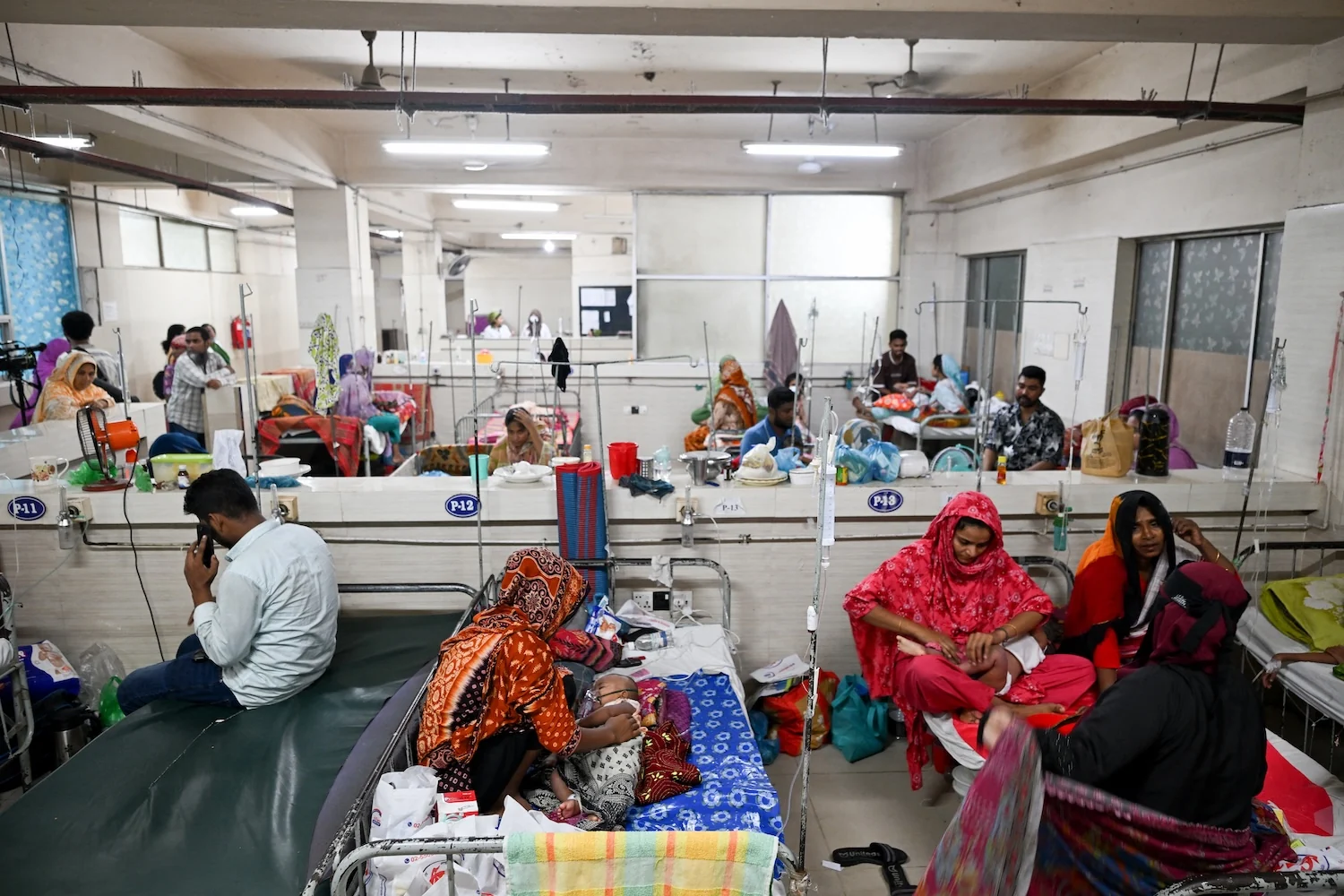
The news about Bangladesh’s measles crisis—already the world’s most severe—keeps getting worse. On Monday, an independent committee of national and international experts submitted a report to the country’s government declaring the outbreak a “litmus test and a warning sign of a deteriorating immunization system.”
The report warns that without urgent steps, Bangladesh could experience major outbreaks of other serious diseases, including pertussis, or whooping cough; diphtheria; and even wild polio, which remains endemic in only two countries, Afghanistan and Pakistan.
The experts’ warnings come on the heels of Reuters reporting last week based in part on new World Health Organization data. According to Reuters, there were 202,000 suspected measles cases in Bangladesh from mid-March through Oct. 9, leading to 1,147 deaths—94 percent of them among children under 5.
The latest government figures, published this week, indicate that more than 1,200 children have now died in the outbreak since March. Six children died in a 24-hour period from Sunday to Monday—raising further concerns that the death rate could rise if the crisis isn’t properly addressed.
Experts say the outbreak’s origins trace back to political instability in 2024, when mass protests ousted Prime Minister Sheikh Hasina. The turmoil that followed interrupted vaccination campaigns, and the country hasn’t gotten back on track.
The crisis is compounded by poor data gathering, resulting in millions of children missing vaccines. In its haste to move quickly on new inoculation efforts, the government that assumed power this year hasn’t implemented enough readiness checks prior to its vaccination campaigns, causing additional complications.
Dhaka has responded swiftly to the experts’ warnings, vowing to move quickly to hire more vaccinators; according to the report, a whopping 40 percent of such positions are unfilled. But the crisis is rapidly becoming a major policy challenge, burdening a young administration that is already grappling with economic stress and severe energy constraints.
Prime Minister Tarique Rahman took office just days before the Iran war began, quickly saddling his government with constraints that were no fault of its own. With the measles outbreak, the government has similarly inherited a challenge that first emerged under the interim government that led Bangladesh from August 2024 until mid-February.
Of course, the onus is on the current government to fix the problem. On one level, the political implications of the measles outbreak are not as great as the other challenges that it faces. But the number of people affected will rapidly grow if cases continue to rise—and if the vaccination crisis leads to the reemergence of other serious communicable diseases, as the experts warn.
A worsening public health environment could also complicate efforts to fix Bangladesh’s economic crisis. That’s not to mention the optics of a government falling behind in efforts to keep children healthy, which risks creating the perception that it is incapable of providing for basic needs.
Bangladesh has a track record of vaccination success, having eliminated polio and neonatal tetanus and reduced the incidence of rubella and hepatitis B. Its health digitization efforts, including major successes during the COVID-19 pandemic, are a major reason why.
But this latest challenge comes at an especially difficult moment, following decades of robust economic growth. This suggests that overcoming the current health crisis will be more difficult than before, as other issues vie for the government’s immediate attention.
What We’re Following
Indian official admits to Chinese border incursions. Last week, Indo-Tibetan Border Police Director-General Shatrujeet Kapur acknowledged recent clashes between Indian and Chinese troops along the border following Chinese encroachments into the Indian state of Arunachal Pradesh. This is a striking disclosure for a few reasons.
Indian officials are typically cautious in their public statements about the disputed border with China. Kapur’s acknowledgement also came after the Indian government had denied that such clashes are taking place. According to the Diplomat, reports and videos have surfaced since the summer detailing Chinese encroachments.
Earlier reports suggest very serious provocations. According to one account, Chinese forces had moved nearly 40 miles into India in July, when a confrontation between border troops lasted several days before calming down. Kapur did not go into specifics about the clashes, and the details in the earlier reports are not confirmed.
Nepal first to receive climate funds. Nepal will be the first country to receive funding from a United Nations entity established in 2023 to provide financial assistance to the countries that are most vulnerable to climate change. After emergency deliberations, the Fund for Responding to Loss and Damage will provide $21.6 million to Nepal following catastrophic floods in August.
Nepal formally requested assistance from the fund days after the disaster. According to initial estimates, Nepal’s total reconstruction bill could approach $5 billion. Still, it’s a major victory for Kathmandu and potentially heartening news for the at least 119 other countries that have applied for aid from the fund.
Mecca pact members meet in Tehran. Pakistani Army chief Asim Munir joined senior officials from Turkey and Saudi Arabia for talks in Tehran on Monday. In August, the three countries signed the Mecca pact, a mutual defense agreement. Monday’s talks centered on efforts to reduce tensions in the Middle East amid rising Houthi attacks against Saudi Arabia.
Saudi Arabia recently invoked the agreement, with Pakistan and Turkey announcing military deployments to assist the Saudi campaign against the Houthis. That the three signatories met with Iranian officials is significant. They insist that the agreement does not target any specific country, though they have projected it as bolstering regional deterrence amid the Iran war.
Negotiating directly with Iran suggests that the Mecca pact signatories are keen to engage with the country and don’t view it as a hostile actor—something that Pakistan is especially keen to convey, given that it values its own ties with Iran and its position as a mediator in the war.
FP’s Most Read This Week
Under the Radar
Pakistan struggles with stability on its borders; the frontiers that it shares with rival India and Taliban-led Afghanistan capture the most attention. Yet its western border with Iran is also volatile—and not just because of its proximity to conflict in the Middle East.
On Oct. 17, Pakistan closed several border crossings with Iran, bringing most land-based trade to a standstill. Thousands of trucks were stranded for days. Perhaps the biggest impact for Pakistan was energy: On Monday, Pakistan’s petroleum minister, Ali Pervaiz Malik, said the border closure was one of the main reasons for a price spike in liquefied petroleum gas in recent days.
By early this week, Iran said the border was open again, but local business leaders estimated that several thousand trucks were still stranded on both sides. Some commentators have questioned whether Pakistan closed the border under pressure from the United States.
However, the reason was most likely security-focused. The Pakistan-Iran border is prone to militant attacks, including one that took place on Thursday, with trucks targeted by gunmen at a border crossing on the Pakistani side. Balochistan, the Pakistani province that abuts Iran, saw nearly 60 percent of the armed attacks recorded across Pakistan in September.
Border violence is a long-standing tension point for Islamabad and Tehran. In early 2024, the two briefly traded airstrikes, with each side targeting militants across the border. This is one of various delicate issues that Pakistan must navigate with Iran as it aims to remain a conflict mediator.
