


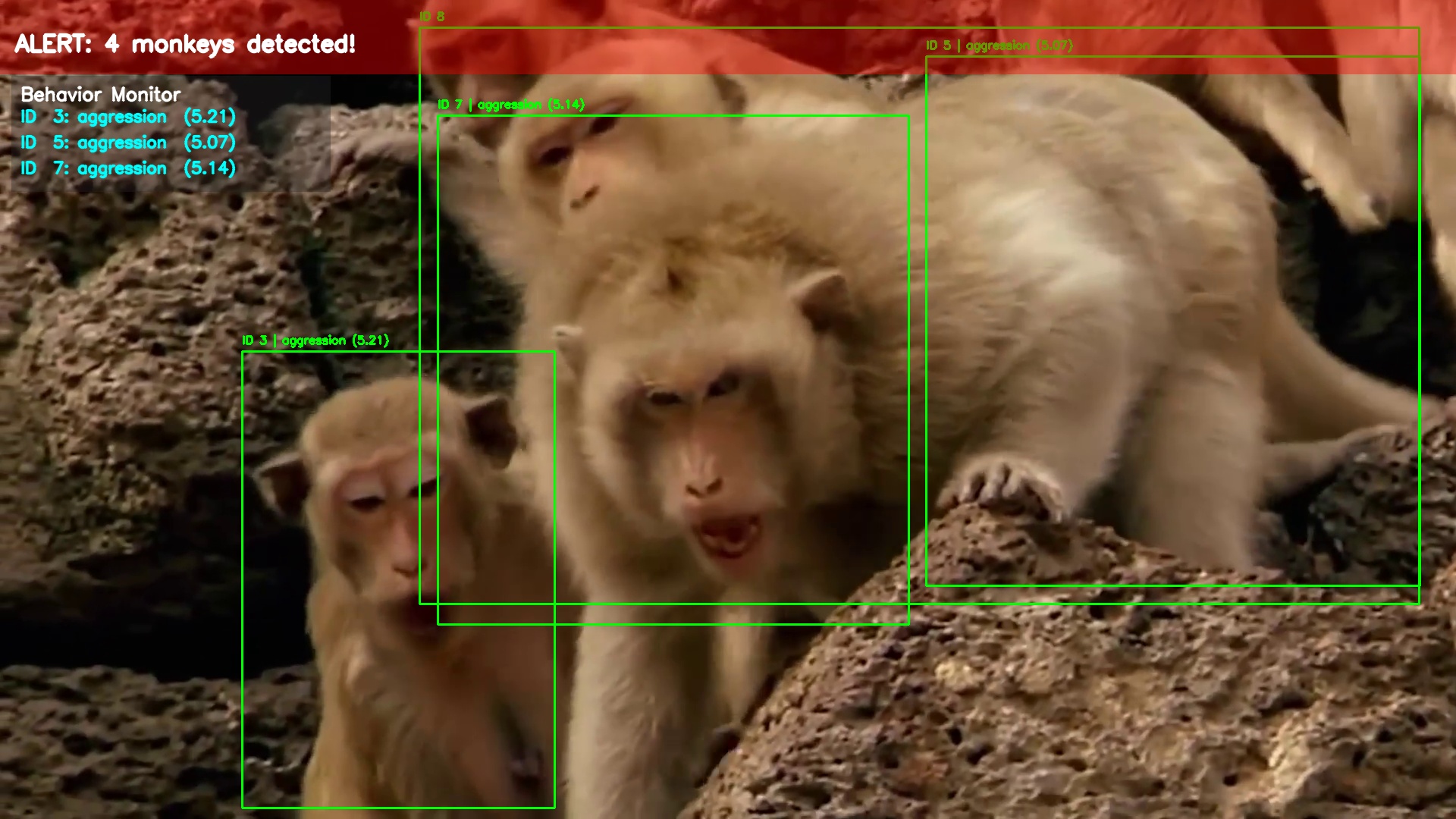
In a village in central Nepal, growing conflict between farmers and rhesus macaques has prompted researchers to test artificial intelligence-based systems that can swiftly detect and deter the monkeys, reports contributor Praveen Kumar Yadav for Mongabay.
A 2026 study that followed rhesus macaques (Macaca mulatta) in one central Nepal region, found that nearly half of their diet consists of cultivated crops. In villages like Birta Deurali, also in central Nepal, farmers take turns guarding fields every two hours, Yadav reported.
To alleviate this burden, researchers in the country are developing AI-driven solutions.
Progress Jung Thapa, a researcher at Madan Bhandari University of Science and Technology, has developed a system built on cameras and lightweight computing devices trained on more than 4,000 annotated images. It detects monkeys and interprets their behavior, such as whether the monkeys are moving, feeding, or being vigilant, with an 88% accuracy across 28 field trials.
“If a monkey is still watching, the farmer has time,” Thapa said. “If it is already feeding, the response has to be immediate. A machine can detect. But a human decides.” Once a threat is identified, the system sends an alert straight to the farmer’s phone.
Meanwhile, Santosh Giri, an assistant professor at Tribhuvan University, is developing a prototype that pairs AI detection with an ultrasonic deterrent to repel monkeys. The deterrent system is, however, yet to be tested in working farm environments.
Both Thapa and Giri acknowledged that translating these technologies to field conditions is challenging. Poor visibility from rain or dense foliage, for example, reduces accuracy of detections.
Furthermore, even if farmers receive phone alerts, labor shortages make it hard for farmers to respond to them, according to zoologist Laxman Khanal.
Experts also warned of the macaques’ adaptability. “Monkeys are highly adaptive,” said Naresh Subedi, a wildlife researcher. “If deterrents do not represent real risk, they may eventually stop responding.”
The conflict with rhesus macaques has long been recognized at the policy level, but progress to address it effectively remains slow. A 2026 review of Nepal’s relief policies for wildlife-induced damage found that compensation for crop damage has struggled to keep pace with the scale of conflict, forcing farmers to bear losses alone.
While Nepal’s Ministry of Agriculture, Forests and Environment formed a 15-member technical task force in May 2026 to evaluate relief systems, the group has yet to release its report.
Read the full story by Praveen Kumar Yadav here.
Banner image: Monkeys displaying aggressive behaviors detected by the detection system designed by Progress Jung Thapa and his team. Image courtesy of Progress Jung Thapa.
