


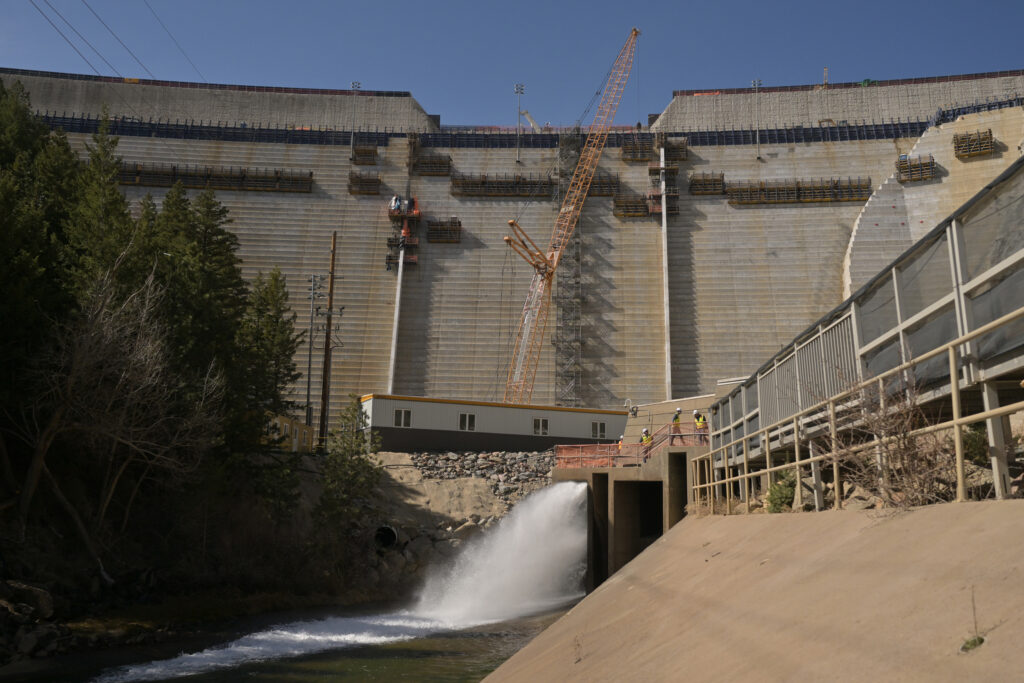
SANTA FE, N.M.—Is climate change enough justification to stop the expansion of a reservoir that will take more water from the dwindling Colorado River?
That’s the central question in a lawsuit pitting the U.S. Army Corps of Engineers and Colorado’s largest water utility against a consortium of environmental nonprofits. The environmentalists say the Colorado River has no more water to give, while Denver Water, the utility whose Gross Reservoir would nearly triple in capacity, argues it is ensuring its customers can withstand droughts. The Corps contends it is not required to consider climate change or the downstream effects of its expansion of a dam to grow the reservoir.
The case in the 10th U.S. Circuit Court of Appeals has the potential to ripple through Western water management as states, tribes, cities and the federal government struggle to find a compromise on how to steeply cut water use. Some see history repeating itself, with the Gross Dam expansion emblematic of the kind of thinking that helped put the West into the very water crisis the project is meant to buffer the region against.
“Does it make sense for major water projects like this to continue to move forward?” asked Sarah Matsumoto, an associate professor of clinical law at the University of Colorado, Boulder, and director of the Getches-Green Natural Resources, Energy, and Environmental Law Clinic. “I just don’t think it does anymore, without at minimum considering impacts of climate and impacts of overappropriation on the river.”
That’s exactly what a 2024 district court opinion ruled, in a major win for the environmental groups.
The Corps and Denver Water appealed that decision, arguing that construction of the dam expansion is nearly complete, and topping off the reservoir behind it is in the public’s best interest. There are no other alternatives to consider, the utility asserts. The National Environmental Policy Act (NEPA), which requires evaluating the impacts of projects that need federal approval, does not require the assessment of climate change, they contend.
“We believe that considering potential climate impacts to a project goes beyond the scope
of any guidelines, practicability, or NEPA reasonableness analysis,” said U.S. Department of Justice attorney Kyle Glynn, representing the Army Corps, during oral arguments for the case before the 10th Circuit Court of Appeals.
The expansion of Denver Water’s Gross Reservoir would hold an additional 77,000 acre feet of water diverted from the declining Colorado River, enough water for roughly 150,000 homes. Denver Water would get that water incrementally from an unused 1945 water right of 18,000 annual acre feet to ensure it can supply the growing metropolis of Denver and protect its water supplies during droughts.
The utility plans to only use its water right during wet years when it can stockpile water from excess supply. Of the 77,000 acre feet in diversions, 5,000 would be sequestered in an “environmental pool” that would enhance streamflows on South Boulder Creek and serve as additional storage for the cities of Boulder and Lafayette.
But environmentalists are not convinced there will be enough surplus water in the future for the utility to fill the reservoir. If the state is required to cut back its water use to address system-wide shortages on the Colorado River, reductions the seven states that depend on the river are currently negotiating, what happens to the over $800 million project, they wonder.
Those are the concerns driving the environmental groups, which sued over what they called an inadequate NEPA process and a failure to properly examine alternatives to the project. Natural resource professors watching the case share their concerns. The court’s decision, both say, could have far-reaching consequences for Southwestern states and nearly 40 million people who rely on the Colorado River, and could determine how climate change is considered in any future litigation.
Denver Water’s position is in direct contradiction with what Colorado is arguing in the current negotiations about how much water from the river states must give up, said Gary Wockner, founder of Save the Colorado, the environmental group that’s led the push against the Gross Reservoir expansion.

Colorado has maintained that it and other states close to the river’s headwaters should not have to make mandatory cuts because climate change is already limiting their supply by reducing river and stream flows. Should the negotiations over cuts to allocations from the river devolve so completely that states in the upper and lower halves of the Colorado River Basin sue one another, some water law experts believe climate change would figure prominently in the litigation.
“If the court supports Denver Water and says that Denver Water did not have to account for climate change to prove that they could operate the project, it sets a very difficult and perhaps powerful precedent, potentially undermining the state of Colorado’s position in the entire Colorado River negotiations,” Wockner said.
Can a Dam’s Progress Block Climate Considerations?
On the last day of July, attorneys for the environmental groups, Denver Water and U.S. Army Corps of Engineers gathered before three justices on the 10th Circuit Court of Appeals in a courtroom in Santa Fe, New Mexico. Their oral arguments came nearly two years after senior federal judge Christine Arguello ruled in favor of the environmentalists, saying that “the cracked foundation of the Colorado River’s management system all but demands skepticism over any proposal that will affect the hydrology of the Colorado River basin.”
Arguello’s decision didn’t stop construction to expand the dam, but forced the parties to meet and agree on remedies. Those discussions failed, however, leading Arguello to issue an injunction to stop construction in April 2025. That was lifted due to safety concerns about the dam being left incomplete, but an injunction remained preventing the clearing of the forest below to make room for the additional water, or filling the added space behind the dam.
The Gross Reservoir expansion solves a problem Denver Water has been trying to address for 23 years, said Jessica Brody, general counsel for the utility, in the 10th Circuit last month.
Denver Water’s storage and delivery network is divided into north and south systems, which are unconnected and imbalanced. The south system provides 80 percent of the utility’s water supply, and if it were to go down, the north system, which includes Gross Reservoir, could run out of water in just one year. That leaves the utility’s system vulnerable in times of severe drought, wildfires or other emergencies.
Despite construction being nearly done, Brody said, Denver Water has a dam it cannot fill because of the lower court’s opinion.
That decision was an “abuse” of the court’s power, she said, as the water rights at stake are under the jurisdiction of the state, not federal agencies. Plaintiffs never sought a preliminary injunction to stop construction, although they did when later mediation failed. Jurisdiction over the cutting of trees to make room for the expanded reservoir lies with the U.S. Forest Service and the Federal Energy Regulatory Commission, not the Corps, she said.
The arguments from Denver Water and the Corps seemed to resonate with the three justices presiding over the case, largely due to the fact the dam is nearly complete.
“Poor pun: It’s water over the dam, because it’s built,” said Judge Timothy Tymkovich. “So costs, and I think climate change, are off the table now.”
“In effect, they’re building a giant bathtub, even though there’s likely no water to ever fill it.”
William Eubanks, the attorney representing the environmental groups, disagreed. The dam expansion is part of Denver Water’s Moffat Collection System project, which requires work in addition to the Gross Reservoir project, such as felling the trees.
And there is still the question of where the water will come from.
A central point for the lawsuit, he said, is that under the Clean Water Act, water infrastructure developers have to show a project can be built and fulfill the expected need—in this case, a reservoir with more water. That wasn’t done here, Eubanks said.
“With the Moffat Collection System project, Denver Water and the Army Corps have recklessly gambled with over $800 million of ratepayer money,” Eubanks said before the court. Neither the Corps nor the utility forecasted whether there would be enough surplus water in the Colorado River for Denver Water to fill its reservoir, he argued. “In effect, they’re building a giant bathtub, even though there’s likely no water to ever fill it.”
CU Boulder professor Matsumoto is one of 11 natural resource law experts who submitted an amicus brief to the court asking it to affirm the lower court’s decision.
This case, they wrote, is a “classic example of why we need NEPA”—illustrating the consequences of an agency permitting and approving a project without a full evaluation of other alternatives and whether the project was even feasible. The foundational U.S. environmental law was designed to push agencies to “fully appreciate the consequences of their actions before they move forward with those actions,” they wrote.
The Corps violated NEPA by limiting the number of alternatives it considered for the project and only examining impacts up to 50 miles downstream, not along the full course of the river, the brief noted.
“It just doesn’t make any sense for the amount of water that they’re getting,” said Mark Squillace, a natural resources law professor at the University of Colorado in Boulder, and another one of the professors part of the amicus brief. “It’s insane.”
A Complicating Compact
Since 1922, the Colorado River has been governed by its eponymous compact, which is now widely acknowledged to have overallocated the river by millions of acre feet of water. Under the compact, both the Upper Colorado River Basin, made up of Colorado, New Mexico, Utah and Wyoming, and the Lower Basin states of Arizona, California and Nevada, are entitled to 7.5 million acre feet of water, with another 1.5 million acre feet going to Mexico. But the river has averaged closer to 11 million acre feet since 2020—more than 6 million acre feet less than the total that has been allocated, according to the most recent federal data.
Though both basins get an equal share of the river, Article III(d) of the compact specifies that the Upper Basin “will not cause the flow of the river” to be depleted below an average of 7.5 million acre feet per year over any 10-year period downstream.
This story is funded by readers like you.
Our nonprofit newsroom provides award-winning climate coverage free of charge and advertising. We rely on donations from readers like you to keep going. Please donate now to support our work.
Failing to meet that requirement could trigger the Lower Basin to demand more water from the Upper Basin in what is known as a “compact call.” That unprecedented action could force severe water usage curtailments in the Upper Basin, and how that would affect users like Denver Water is unclear. The system is dangerously close to the hydrological conditions that could trigger a compact call.
It’s a known risk for this project, the professors say, but one that was ignored during permitting.
Gross Reservoir is far from the only new diversion proposed in the Upper Basin, which has never used its full allocation from the river, but sees that water as key to the region’s continued economic growth and prosperity. Over 1 million acre feet of diversions have been proposed across 30 projects in the Upper Basin. Many of those may not be developed, but they have become a sticking point in negotiations over the river’s future.
“Repeating the Same Mistakes”
As the lawyers argued in Santa Fe, news of a short-term federal proposal for managing the Colorado River rippled across the basin. In the absence of a new consensus among the states over how to allocate the water, the federal government stepped in to manage the crisis.
Its track record on the Colorado River is deeply checkered.
The compact has served as the bedrock for a web of dams, reservoirs, canals and ditches built largely with federal funding and engineering prowess to distribute water across arid Western lands. The magnitude of this diffuse system and its overreliance on diverting and impounding water, experts say, is at least partially responsible for the severity of the West’s water crisis.

Some believed not everyone has learned the lesson. “We’re just repeating the same mistakes,” Squillace said. “A lot of it just results from a lack of imagination about a better way to do things.”
As water supplies shift, water utilities across the West are squeezing every last drop out of their systems through a range of modifications and adjustments to their infrastructure.
After the first of the West’s deep 21st-century droughts in 2002, Denver Water, which serves 1.5 million people across Colorado’s Front Range, decided it needed to act. The utility convinced the Army Corps of Engineers, which completed the original Gross Reservoir in the 1950s, that raising the dam to triple the amount of water it could impound would be the best course of action to combat drought.
Since then, Denver Water has also invested in water efficiency, which allowed it to better endure droughts from 2002 to 2026. Despite a growing population, water use is below the benchmarks from the 1970s, said Jeff Martin, Denver Water’s program manager for the reservoir expansion.
“We’ve really capitalized on most of our customer savings at this point,” he said. “Now, we need to shore up the rest of our need with the expanded reservoir.”
But a drier future is precisely what should preclude Denver Water and the Corps from seeing this project through, said Wockner with Save the Colorado.
“It’s nonsensical to be diverting more water out of rivers anywhere in the Southwest United States,” he said. “Because in many ways the climate change bullseye in the United States is on the Southwest and Colorado River Basin.”
The Colorado River, Wockner said, has no more water to give. But Martin sees room for more improvement in how the river is managed.
“I would be the first to say something needs to change there on how we use the river for all stakeholders, including some type of cuts throughout the system,” said Martin. “I’m not that decision maker though.”
The state, he said, controls Denver Water’s rights to the river. The utility has the right to use the water that may one day fill Gross Reservoir, he said, and has been planning to do so for decades.
Despite arguments that the water isn’t available, Martin has no doubt Denver Water will be able to one day fill the reservoir—if the courts allow it.
What Comes Next
The justices have given no indication of when a ruling on the Gross Reservoir Expansion Project will land.
If Denver Water loses its current appeal, the utility claims it will be unable to ensure a reliable water supply during times of drought, and the decision may deter developers from pursuing other ambitious projects to solve the West’s water problems, from new dams to expensive desalination plants.
In the Santa Fe courtroom, Teagen Blakey sat on a wooden bench watching the lawyers argue over a project that has loomed over more years of her life than it hasn’t.
President of The Environmental Group, a nonprofit from Colorado’s Front Range and one of the lawsuit’s plaintiffs, Blakey grew up in the area around Gross Reservoir. She remembers sitting in community meetings as a teenager when the project was being permitted.
Despite the project’s impacts on Boulder County, the water won’t serve residents there, she pointed out. But the dam and reservoir expansions’ impacts will fall on the local population. At the site where Denver Water will clear the forest is a hike featuring a waterfall that would be submerged.
“It’s something you can’t quantify as a value,” she said.
With such a high cost to something so special, Blakey said, there must be certainty about the benefit it will provide.
About This Story
Perhaps you noticed: This story, like all the news we publish, is free to read. That’s because Inside Climate News is a 501c3 nonprofit organization. We do not charge a subscription fee, lock our news behind a paywall, or clutter our website with ads. We make our news on climate and the environment freely available to you and anyone who wants it.
That’s not all. We also share our news for free with scores of other media organizations around the country. Many of them can’t afford to do environmental journalism of their own. We’ve built bureaus from coast to coast to report local stories, collaborate with local newsrooms and co-publish articles so that this vital work is shared as widely as possible.
Two of us launched ICN in 2007. Six years later we earned a Pulitzer Prize for National Reporting, and now we run the oldest and largest dedicated climate newsroom in the nation. We tell the story in all its complexity. We hold polluters accountable. We expose environmental injustice. We debunk misinformation. We scrutinize solutions and inspire action.
Donations from readers like you fund every aspect of what we do. If you don’t already, will you support our ongoing work, our reporting on the biggest crisis facing our planet, and help us reach even more readers in more places?
Please take a moment to make a tax-deductible donation. Every one of them makes a difference.
Thank you,

Reporter, Phoenix
Wyatt Myskow covers drought, biodiversity and the renewable energy transition throughout the Western U.S. Based in Phoenix, he previously reported for The Arizona Republic and The Chronicle of Higher Education. Wyatt has lived in the Southwest since birth and graduated from Arizona State University with his bachelor’s degree in journalism.

Reporter, Wyoming and the West
Jake Bolster reports on Wyoming and the West for Inside Climate News. Previously, he worked as a freelancer, covering climate change, energy, and the environment across the United States. He holds a Masters in Journalism from Columbia University.
