


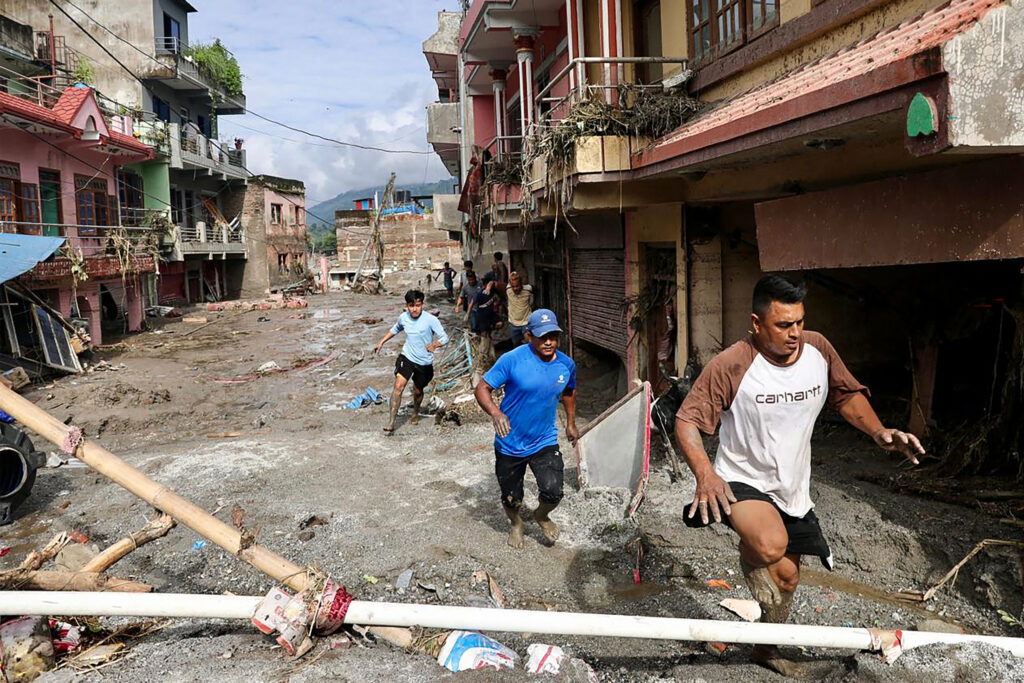
Residents and rescue workers in flood-ravaged valleys of Nepal faced the threat of a new wave of inundation Friday, as scientists warned that debris had blocked rivers upstream, forming fragile dams ready to burst.
In the narrow upper valleys, Wednesday’s flood wave crested over the tops of buildings and homes. It destroyed everything in its path—hydropower plants, farms, solar energy facilities, roads, forests.
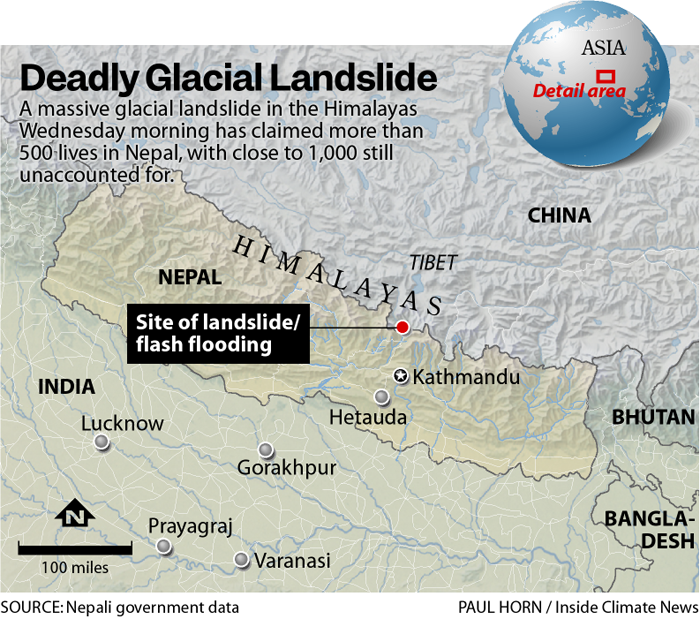
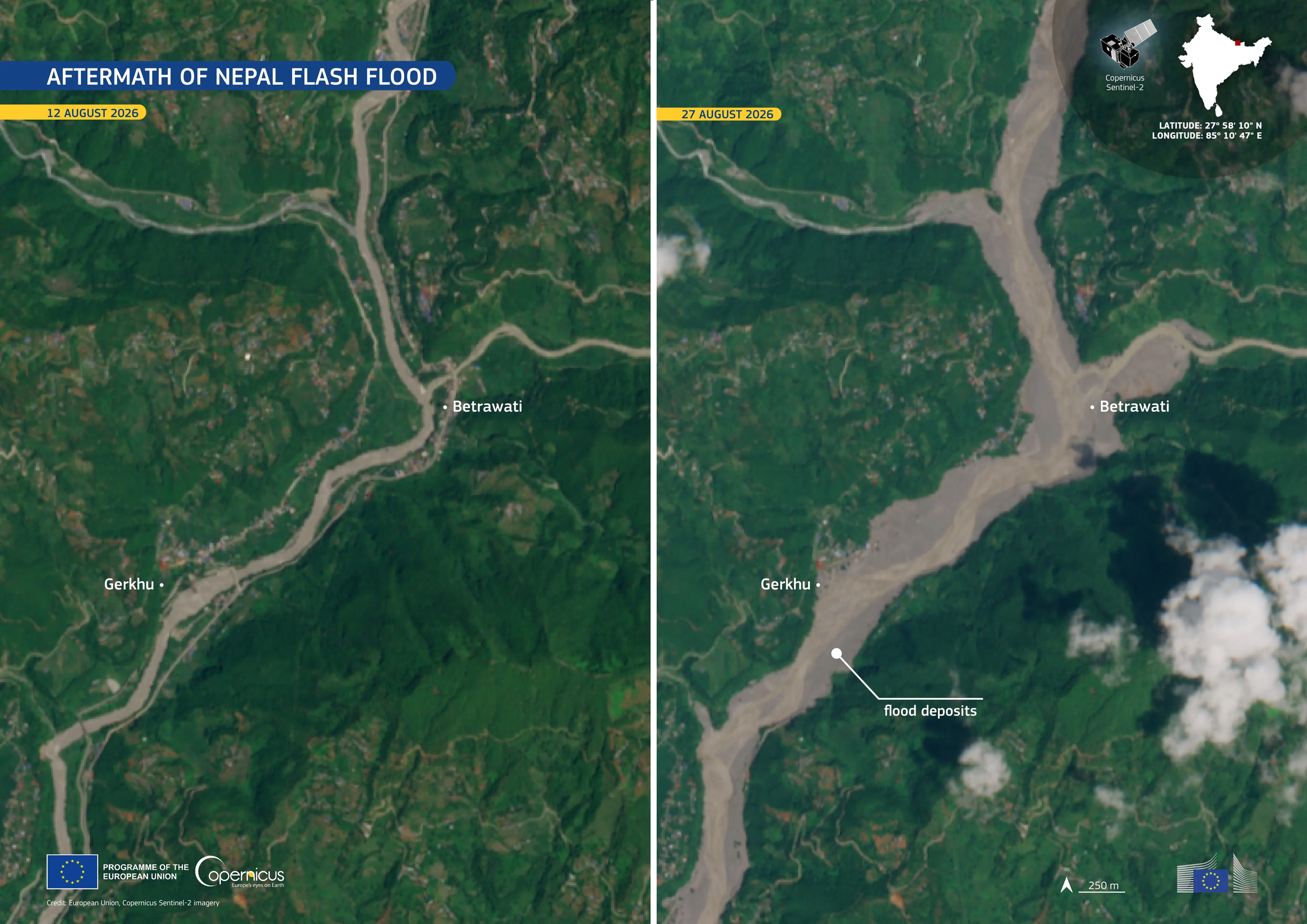
As of Friday afternoon, Nepal time, rescuers had recovered 538 bodies and nearly 1,000 people were missing, according to government reports. The debris flow and flooding traveled downstream more than 60 miles into Nepal’s Rasuwa district, eventually reaching the Bhote Koshi and Trishuli river systems.
Sunil Tamang, a doctoral student studying rock glaciers at the University of Canterbury in New Zealand, grew up in Syafru Besi, which lies along a popular trekking route and in the path of the flooding. Since the disaster, he’s been speaking with family in Kathmandu and looking at photos of bare, mud-covered mountainsides where his village once perched.
“Now there’s nothing,” Tamang said. “It’s gone.”
Tamang said his parents and sister were safe in Kathmandu, where they live most of the time. One aunt and uncle were alive because they had happened to go to their shop on higher ground, he had heard. But Tamang did not know whether many other family members or friends had survived, and he said he knew many most likely had not.
“People are gone. The friends that I grew up with, uncles and aunties,” Tamang said. “At some point I feel like, I just feel this is a dream. And then reality strikes me, like, ‘No, it’s real.’”
The floods in Nepal are the latest in a string of disasters linked to human-caused climate change hitting the globe this summer, with record-breaking wildfires and heat killing thousands in Europe, forcing hundreds of thousands of people to evacuate across the Northern Hemisphere and sending toxic smoke across international borders.
As of Friday, scientists said satellite images revealed that the destructive cascade of mud, water and debris in Nepal started when ice and rocks fell nearly 4,000 vertical feet off the northern flank of Langtang Lirung, a roughly 23,700-foot peak near the country’s border with Tibet, a region now controlled by China.
The images also show that a large lake has formed, which could burst and unleash another flood, threatening rescue workers and communities downstream along the Nepal-China border, geomorphologist Dan Shugar posted on Bluesky.
While scientists said it is too early to say exactly what led to the collapse, climate change is increasing the likelihood of high-mountain disasters by melting glaciers and thawing permafrost that has held mountain slopes in place for 20,000 or 30,000 years. As the frozen ground thaws, steep mountain slopes across the Himalayas and other alpine regions are becoming unstable and prone to landslides, studies have shown.
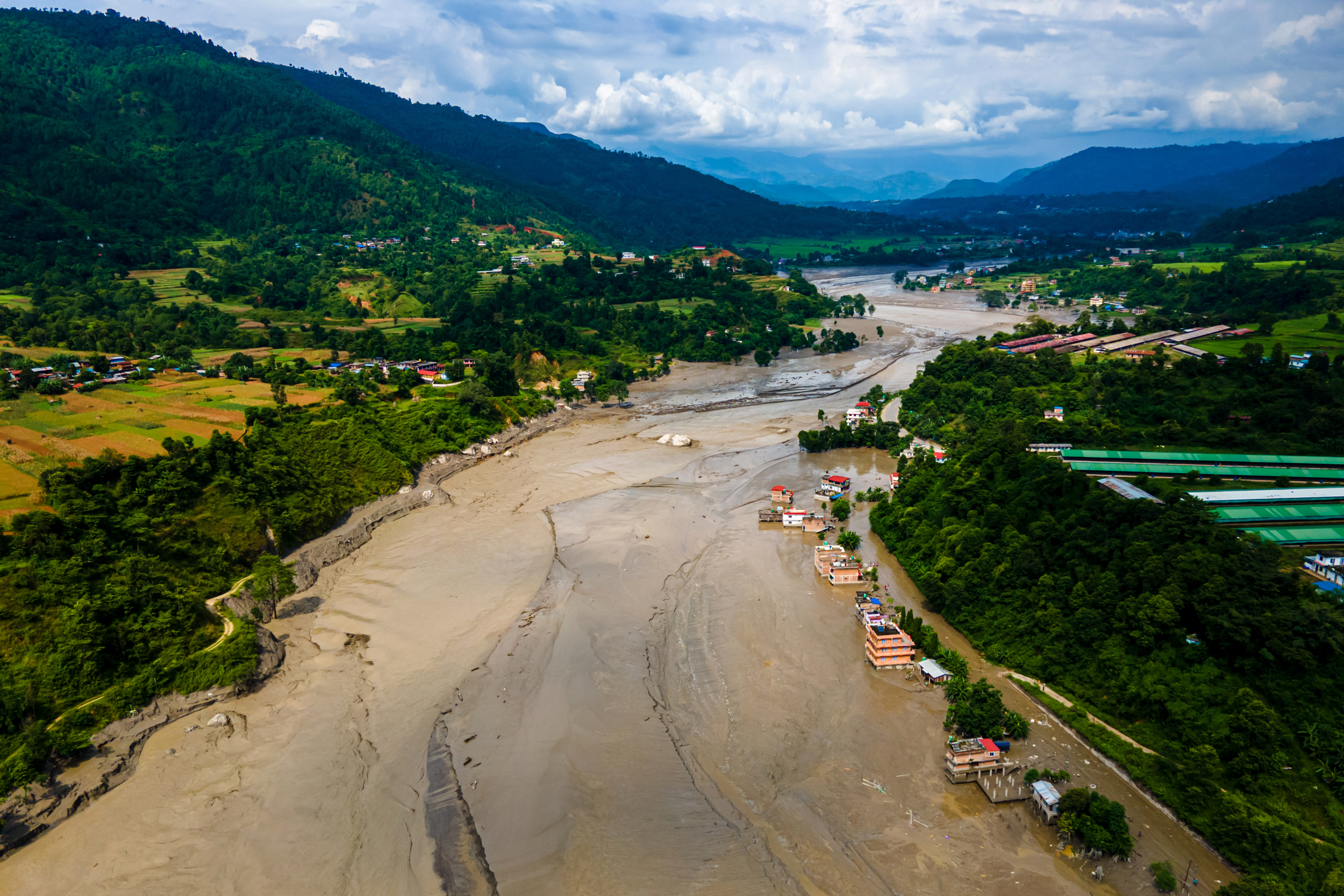
Similar landslides have struck other parts of the Himalayan region and Switzerland in recent years, causing widespread destruction. The same river valley in Nepal flooded last year after a glacial lake drained rapidly.
The glaciers of the Langtang Valley, which lie on the other side of the mountain where the collapse occurred, are among the most studied in the Himalayas. Research published in June found that its glaciers had shrunk by more than 40 percent since 1815, with the rate of loss accelerating in recent years. The high-mountain region above 4,000 meters (13,123 feet) is warming much faster than the globe as a whole.
Scientists said the situation in Nepal and along the border with China remained unstable.
“The reports of new barrier lakes are particularly concerning because conditions upstream are still changing,” said Jeff Da Costa, who researches flood early warning systems and disaster risk at the University of Reading in the United Kingdom.
This story is funded by readers like you.
Our nonprofit newsroom provides award-winning climate coverage free of charge and advertising. We rely on donations from readers like you to keep going. Please donate now to support our work.
Da Costa said close monitoring and timely information sharing between China and Nepal “could buy precious time for communities on both sides of the border.” The barrier lakes in the deep valleys can quickly fill with enormous amounts of water and may overpower the piles of rubble holding it back, sending another surge of floodwater downstream.
Despite the high risks the region faces, it does not have a comprehensive early warning system, scientists said.
A forensic examination of the disaster response should identify what was detected and when, as well as “who knew about it, and how quickly did that information reach people who could act,” Da Costa said. “Those are the questions that will tell us what can be improved before the next event.”
No matter how advanced the technology, however, there are limits to how much time a warning system could buy for upstream areas, said Hannah Cloke, a professor of meteorology and climate science at the University of Reading. Farther downstream along more populated river valleys, warnings came in time to save hundreds of lives in Nepal, Cloke said.
One challenge is that the flood arrived without rain, a situation that can lead people to ignore flood warnings, Cloke said.
The other challenge is simply how fast the wall of water, mud and rock moved through river valleys.
“This event really shows the limits of adaptation,” said Bethan Davies, a professor of glaciology at Newcastle University in the United Kingdom. Within minutes, the debris flow and flooding destroyed long-established communities along the rivers.
“Lives and livestock lost, bridges and roads and houses all swept away,” Davies said. Mountain communities can invest in measures like well-maintained early warning systems to enable evacuations. But ultimately, she said, “the only adaptation would be migration away from increasingly hazardous locations.”
Hermann Kreutzmann, a professor of geography at the Freie Universität Berlin who has conducted extensive research in the region, said the type of disaster that hit Nepal this week is likely to happen more often as the climate warms.
That science, however, might not be reaching the communities that need it the most.
“The mountain landscape is changing in such a way that it’s sometimes difficult for people in the mountains to understand what is happening,” said Tamang, the PhD student, adding that scientists who study mountain hazards should be working with locals as they collect data and communicate their findings in ways people can understand.
“From my experience, that’s not happening,” Tamang said. “Most of the time they come, they collect the data, and they go.”
Tamang said his home village and those near it now face a long road to recovery and the prospect of repeated disasters. It was only recently that he had helped his village rebuild after it was destroyed in a landslide triggered by an earthquake in 2015.
Now, he said, they will have to start again.
About This Story
Perhaps you noticed: This story, like all the news we publish, is free to read. That’s because Inside Climate News is a 501c3 nonprofit organization. We do not charge a subscription fee, lock our news behind a paywall, or clutter our website with ads. We make our news on climate and the environment freely available to you and anyone who wants it.
That’s not all. We also share our news for free with scores of other media organizations around the country. Many of them can’t afford to do environmental journalism of their own. We’ve built bureaus from coast to coast to report local stories, collaborate with local newsrooms and co-publish articles so that this vital work is shared as widely as possible.
Two of us launched ICN in 2007. Six years later we earned a Pulitzer Prize for National Reporting, and now we run the oldest and largest dedicated climate newsroom in the nation. We tell the story in all its complexity. We hold polluters accountable. We expose environmental injustice. We debunk misinformation. We scrutinize solutions and inspire action.
Donations from readers like you fund every aspect of what we do. If you don’t already, will you support our ongoing work, our reporting on the biggest crisis facing our planet, and help us reach even more readers in more places?
Please take a moment to make a tax-deductible donation. Every one of them makes a difference.
Thank you,

Reporter, Austria
Bob Berwyn is an Austria-based reporter who has covered climate science and international climate policy for more than a decade. Previously, he reported on the environment, endangered species and public lands for several Colorado newspapers, and also worked as editor and assistant editor at community newspapers in the Colorado Rockies.

Reporter, New York
