


- Daniel Janzen’s scientific work helped reshape ecologists’ understanding of tropical forests, especially the relationships among plants, insects, pathogens, predators, and seeds.
- With Winnie Hallwachs and Costa Rican partners, he helped turn degraded ranchlands in Guanacaste into a protected, working landscape that now connects ecosystems from the Pacific coast to cloud forest and Caribbean rain forest.
- ACG’s parataxonomists, educators, field staff, directors, and neighboring communities have made the project durable through their day-to-day work, linking conservation to local employment, education, and scientific expertise.
- Janzen and Hallwachs’s more recent work on DNA barcoding and bioliteracy aims to help Costa Rica identify, study, and value the extraordinary diversity of life within its borders.
In northwestern Costa Rica, the forest did not return all at once. First the cattle were removed. Then the fires had to be stopped. Introduced grasses made the old ranchlands burn too easily. Fence lines had to be watched. Seeds had to arrive by wind, birds, bats, and the stomachs of passing animals. People had to believe the land could become something other than pasture, and then stay long enough to see it happen.
A park on paper can still burn. It can still be poached, logged, ignored, or resented. The work requires science, salaries, political agreements, national investment, school programs, local trust, and daily maintenance. It requires people who remain after the first burst of money and attention has passed.
Popular accounts sometimes reduced the story to a solitary figure: an American ecologist with a beard, a camera, a theory, and a park. It was never that simple. For more than half a century, Daniel Hunt Janzen has worked in tandem with Winnie Hallwachs, his wife, scientific partner, and frequent interpreter to the human world. Around them grew a larger Costa Rican undertaking, carried by park leaders, field staff, parataxonomists, teachers, donors, government ministers, neighbors, and families who turned a conservation idea into a working landscape.
Janzen is now 87. His field work has slowed, and he has stepped back from university teaching to focus on his role as Chief Scientist of the Guanacaste Dry Forest Conservation Fund (GDFCF), the nonprofit conservation organization he and Hallwachs founded with his Kyoto Prize award money in 1997. They are currently in Guanacaste, where the scientific enterprise they helped build continues to produce important research. In June 2026, Janzen and Hallwachs were among the authors of a study in the Proceedings of the National Academy of Sciences built on more than 1.6 million DNA-barcoded insect specimens collected in Área de Conservación Guanacaste (ACG). They conservatively estimated that Earth may hold 14 million to 20 million insect species—two to three times the prevailing estimate—with a broader extrapolation approaching 30 million. Two more major publications followed, one tracing insect vulnerability to climate change and another examining insects’ distinct biogeographic distributions across Costa Rica. Each grew directly from the decades of biodiversity inventory that Janzen, Hallwachs, ACG’s parataxonomists, and their collaborators developed and sustained.
Janzen is one of the most influential tropical ecologists of his generation. He helped change how scientists understand tropical forests, especially the intricate relationships among plants, insects, predators, pathogens, and seeds. He also helped change what conservation means. His work treats a forest as a collection of specific life histories, each knowable and connected to others in ways that reward close attention.
Janzen was born in Milwaukee in 1939. His father came from a Mennonite farming family and later served as Director of the US Fish and Wildlife Service. Janzen grew up with the habits of a field naturalist: looking, collecting, sorting, and asking why one organism was there and another was not. A boyhood trip to Mexico, where he collected butterflies, helped set his course. He studied biology at the University of Minnesota and earned his Ph.D. at the University of California, Berkeley. Tropical biology was expanding rapidly when Janzen began his career, and he immersed himself in it.
His early scientific work ranged from broad ecological questions to close natural-history observation. He studied ants and acacias, seed predators, flowering cycles, caterpillars, parasitoids, and the many ways that animals and plants had shaped each other in co-evolution. Again and again, he turned observations in the field into questions other scientists could test. One of those questions became the Janzen-Connell hypothesis, developed independently with Joseph Connell. It proposed that tropical tree diversity could be maintained in part because seeds and seedlings near parent trees are attacked by enemies, including insects, fungi, and other pathogens. The idea helps explain why tropical forests can hold so many tree species in close proximity. It has also given generations of ecologists a hypothesis to refine, challenge, and build upon.
His papers often move from field detail to theory. He is willing to speculate, and he is willing to revise. His science keeps returning to the same conviction: organisms have histories, and those histories matter. A fallen fruit, a missing disperser, a bruchid beetle, an ant at the base of an acacia thorn, or a caterpillar feeding on one plant but not another can become evidence of a larger ecological pattern.
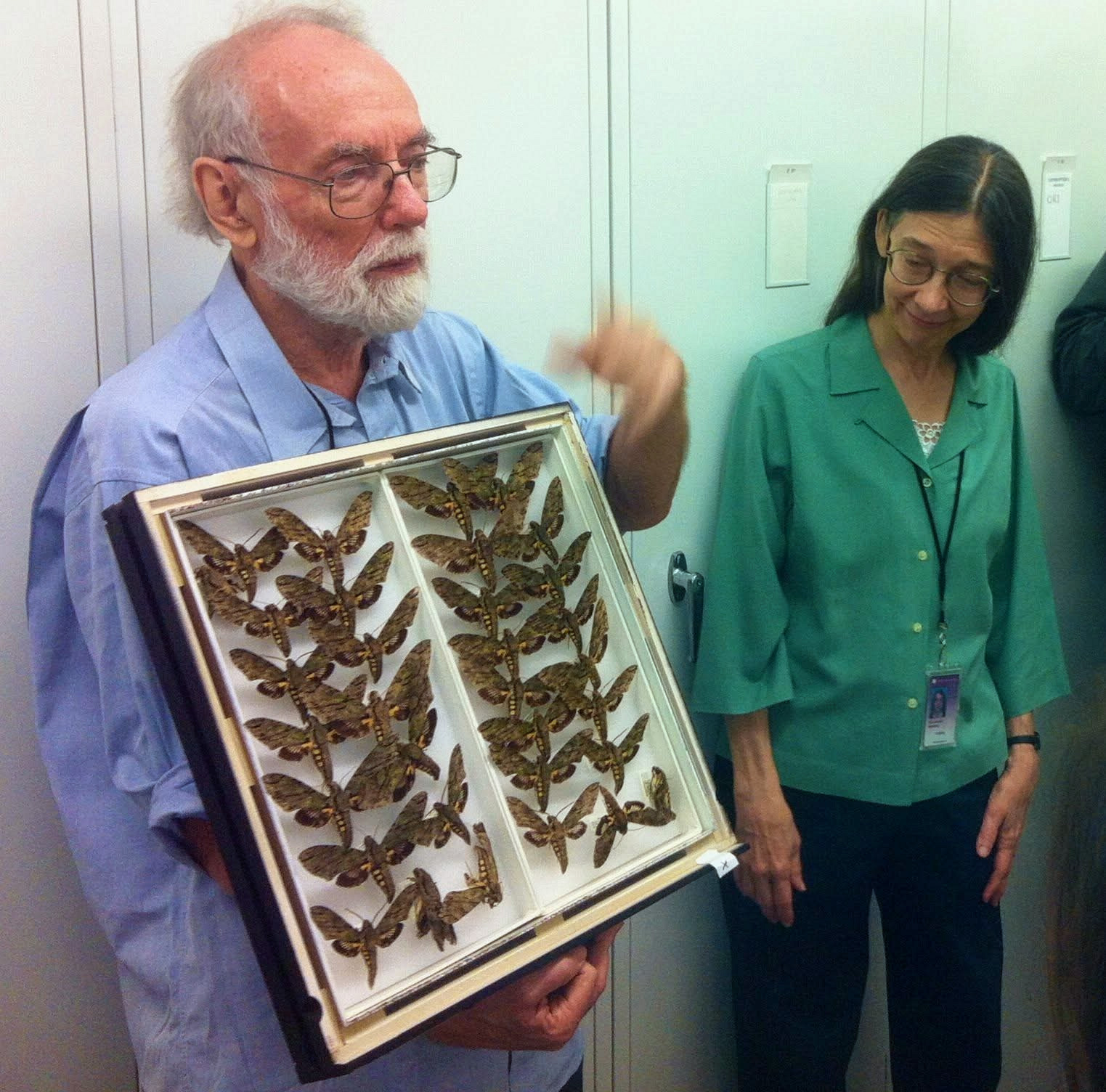
Janzen has little patience for abstractions that float free of organisms. Biodiversity, to him, is not a decorative word. It is a set of living things with names, roles, enemies, and uses. The word has to be brought down to earth, pinned, sequenced, reared, photographed, databased, taught to children, and made visible to the people living near it. That emphasis on identification helps explain his interest in DNA barcoding. A short genetic sequence, linked to careful field work, can help reveal what the eye alone misses. It can show that what has been treated as one species might be several. It can help a country know more of what it contains.

For much of his career, Janzen has held a professorship at the University of Pennsylvania. The center of his life, however, has been Costa Rica. He first went there in the 1960s, and the country became the place where his science and conservation work fused. In Guanacaste, he found a dry forest ecosystem that was reduced and damaged by ranching, fire, and conversion. Tropical dry forest once covered large areas of Central America. Much of it has been destroyed. It receives less public attention than rain forest, and its long dry season can make its richness harder for outsiders to see.
By the mid-1980s, he and Hallwachs shifted from studying the forest to helping rebuild and defend it. The project that became ACG connected existing national parks with degraded ranchlands and recovering forest. It stretches from the Pacific marine zone across dry forest, volcanoes, cloud forest, and down toward Caribbean rain forest. Degraded areas were allowed to recover through natural processes where possible, with people intervening where necessary, while the protected area was built into Costa Rican society rather than set apart from it.
Janzen sometimes calls it a “wild farm,” or a farm with hundreds of thousands of crops. The crops, in his formulation, are species, interactions, services, knowledge, beauty, education, climate benefits, and possibilities not yet understood. The farming analogy insists on management: workers, neighbors, productivity, and a place in the economy.

Janzen can lecture, cajole, raise money, write proposals, buttonhole visitors, and turn an idea into a diagram or a provocation. He can also be blunt. Hallwachs often makes the work understandable to other people. Janzen summarizes the division with characteristic economy: “Winnie thinks, I talk.” He has long acknowledged that many thoughts attributed to him were hers, or theirs. Friends and colleagues see the two as a unit, though that description can understate her own standing. Hallwachs is a tropical ecologist, a strategist, a field partner, and a co-builder of the institutions that make the work endure.
ACG has relied on Costa Rican leadership, staff who stay in place and develop allegiance to the land, and people from surrounding communities who can earn a living by knowing the forest better than almost anyone else. Children encounter the dry forest as a classroom rather than as wasted land. Government agencies and private donors support the same landscape. The institution is national in ambition and local in daily life.
ACG’s parataxonomists embody much of that work. The word, coined by analogy with paralegal and paramedic, never meant amateur. It described people trained to be professionals, to do serious field-based biodiversity work: collecting caterpillars, rearing them, identifying host plants and parasitoids, recording data, preparing specimens, taking photographs, and later linking that work with DNA barcodes. Many come from rural communities around ACG. Some work in remote research stations. Some work as couples or as part of families. Over time, the program has become multigenerational.
Their labor made possible a scale and continuity of scientific inventory—365 days a year—that visiting researchers alone could never sustain. It also tied conservation to employment and expertise. A person paid to know the forest has reasons to defend it. A family whose work is bound to a research station becomes part of the institution. A child who sees a neighbor employed in the naming and understanding of local species grows up with a different idea of what the forest is worth.
ACG’s Costa Rican directors, administrators, educators, field staff, parataxonomists, and local allies do the work day to day. They fight fires, maintain trails and field stations, host students, handle specimens, monitor species, manage relationships, and keep the institution functioning through political and financial changes.

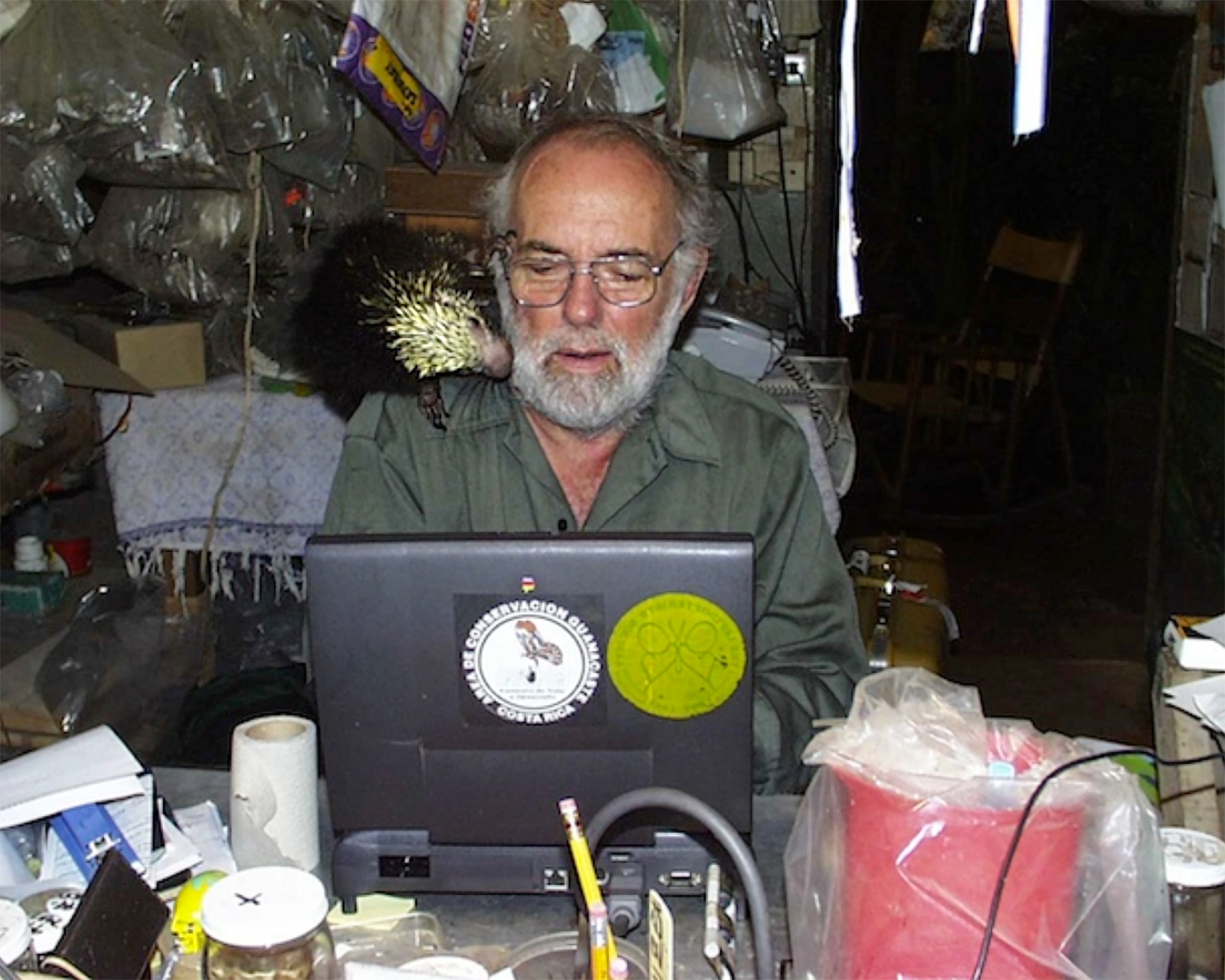
At Penn, visitors found a lean, bearded man walking on a treadmill while working at a raised desk, surrounded by specimens from Costa Rica. He logged miles indoors so he could keep doing field work outdoors. In Guanacaste, he and Hallwachs live for most of the year in modest quarters in Santa Rosa. Animals come to bowls of water outside. Over the years, they have taken in rescued creatures, including a porcupine and a pygmy owl. Janzen once wished aloud that a rattlesnake could be kept as a pet. From someone else, the wish might have seemed theatrical. From him, it sounded like a matter-of-fact disappointment.
In the 1990s, Janzen and Hallwachs helped arrange for waste from a Costa Rican orange juice company to be spread on degraded pasture in ACG in exchange for a land donation. The project became mired in legal dispute and was halted. Years later, researchers returned and found that the treated area had become a dense young forest, with far more aboveground biomass than nearby untreated land.

His honors are many: the Crafoord Prize, the Kyoto Prize, a MacArthur Fellowship, the BBVA Foundation Frontiers of Knowledge Award, the Blue Planet Prize, and election to the National Academy of Sciences, among others. He treated awards as leverage for the work in Costa Rica. Prize money, visibility, and institutional influence could be converted into land purchases, staff support, biodiversity research, and education.
In the later decades of his career, Janzen’s work has pushed toward what he and colleagues called bioliteracy. The ambition was to make a tropical country literate in its own living wealth. DNA barcoding, in this view, is a public instrument as well as a scientific one. A moth, a wasp, a caterpillar, or a fungus does not have to remain invisible because it is small, cryptic, or unnamed. If it can be recognized, it can enter databases, classrooms, management plans, and public imagination. A country cannot value every species individually, but it can learn that each is particular.
Janzen knows what has been lost and what is still being lost. He sees climate change lengthening dry seasons and altering the rhythms he has watched for decades. He knows that tropical forests are being simplified by forces far larger than any one protected area. He also distrusts despair when it becomes an excuse for inaction. He keeps returning to practical tasks: raise the money, train the people, collect the caterpillar, stop the fire, teach the child, sequence the tissue, repair the truck, defend the budget, and return again tomorrow.
Janzen treats conservation as a long negotiation between human needs and the needs of other species to complete their lives. He believes that wild biodiversity must be given a place in society, not as an ornament or a relic, but as a working part of the national future.
Janzen’s papers have altered tropical ecology, and his questions continue to guide research. The land he helped protect and restore is vast by the standards of most conservation projects. ACG also remains an unusual example of tropical conservation joined to national government, local employment, education, and long-term scientific work.
In Guanacaste, trees grow where cattle once grazed. Children learn to read tracks, leaves, insects, and seasonal change. Rural Costa Ricans become experts in forms of life that much of formal science has not yet named. Park staff stay long enough to make a protected area into a home institution. Scientists around the world receive specimens, sequences, papers, and provocations. Hallwachs remains beside and within the work, as thinker, builder, and witness.
Janzen has little use for too polished an account of what he and others have achieved. A restored forest remains vulnerable. An endowment can shrink. A political arrangement can fray. A species can disappear before it is known. A program built over decades can be damaged in a season. He has spent too long in the field to confuse success with completion.
Janzen and Hallwachs have helped leave behind procedures, institutions, habits, names, maps, trained hands, and defended places. Their work also rests on a particular way of seeing a forest: as an immense set of relationships, most overlooked, many fragile, and some recoverable if people work at the necessary scale and for long enough.
In Guanacaste, decades of work have left recovering forest, long-running inventories, trained Costa Rican staff, and institutions built to persist beyond any one researcher. Janzen’s name is attached to much of it, but not his alone. Hallwachs, ACG’s Costa Rican leaders and staff, parataxonomists, educators, neighbors, donors, and government partners have made the project durable. Janzen has spent more than half a century trying to understand the forest and keep it alive.
Banner image: Dan Janzen at work with pet porcupine Espinita exploring his cheek, and 1999 vintage laptop
