


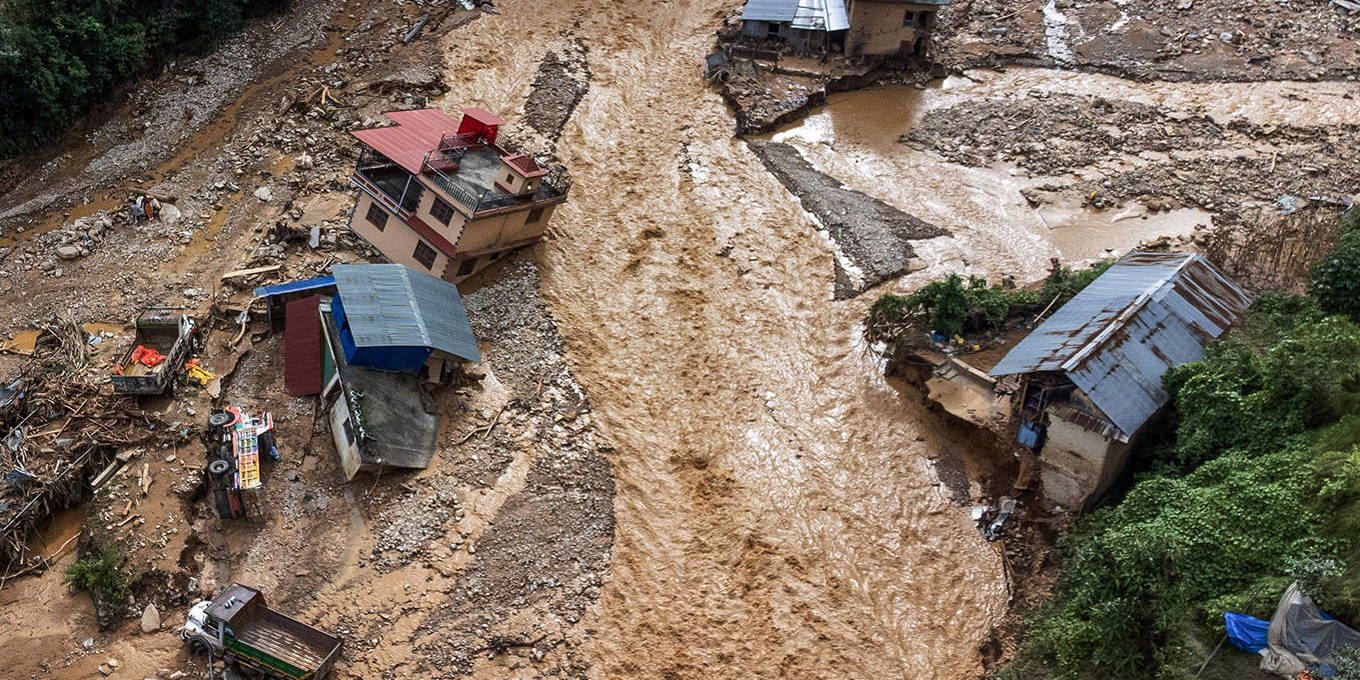
The dangerous flooding in Nepal and Tibet has demonstrated, once again, the need for prearranged disaster-risk financing to prepare for the economic chain reactions triggered by natural disasters. Asia’s policymakers must act now to help cash-strapped Nepal and strengthen other countries’ resilience before the next crisis hits.
SINGAPORE—The catastrophic flooding in Nepal has demonstrated, once again, the devastating human and economic toll of climate change. The immediate priority must be to save lives and support affected communities. But the devastation also highlights how physical hazards can quickly morph into macroeconomic shocks.
These events have different causes, and no single disaster should be casually attributed to El Niño or climate change. Nonetheless, the World Meteorological Organization expects a strong El Niño to intensify from August through October, increasing the likelihood of above-normal temperatures in much of the world and major shifts in rainfall. In Southeast Asia, El Niño often brings drier conditions and raises the risk of drought, wildfires, and haze, although its effects vary across countries and seasons.
For policymakers, the imperative is to prepare for the economic chain reactions triggered by extreme weather events. Droughts, floods, and heat waves damage crops and infrastructure. In countries with inadequate food stocks, weak logistics, and concentrated import sources, lower production can lead to shortages, higher prices, and declining household purchasing power. Governments face pressure to subsidize prices or facilitate emergency imports, while central banks confront the difficult combination of supply-driven inflation and weaker demand.
Then comes the fiscal aftershock. If roads, ports, irrigation systems, schools, and hospitals cannot be repaired or replaced in a timely manner, temporary disruptions can turn into a permanent drag on productive capacity. Governments may be forced to divert spending from development, borrow at short notice, or wait for external assistance. A post-disaster financing gap can all too easily become a long-lasting economic slump.
When disaster strikes, countries must be prepared not only to limit physical damage, but also to reduce economic downtime, maintain essential public services, contain financial stress, and prevent short-term losses from weakening long-term growth. A robust, rapid recovery requires providing humanitarian support and stabilizing macroeconomic conditions.
The scale of the challenge is staggering. According to the United Nations Office for Disaster Risk Reduction, direct disaster losses averaged $180–200 billion annually between 2001 and 2020. When accounting for indirect, cascading, and ecosystem effects, the total annual cost rises to more than $2.3 trillion.
Asia must be prepared. To that end, in May, finance ministers and central bank governors from ASEAN+3 countries (the Southeast Asian member states, plus China, Japan, and South Korea) endorsed the Disaster Risk Financing Initiative’s 2026–28 roadmap. This framework will help members develop national disaster-risk financing strategies and expand their use of insurance, catastrophe bonds, and other relevant instruments.
To be sure, prearranged financing cannot cover the full costs of a major disaster. Nor should insurance be expected to do so. Their value lies in providing reliable funding during the critical early stage of a crisis, when delays are most damaging, and governments have the least room to improvise. For example, on September 1, the Southeast Asia Disaster Risk Insurance Facility, a regional platform under the umbrella of ASEAN+3, paid $1 million to Laos within five business days after official data showed that more than 260,000 people had been affected by heavy rainfall and widespread flooding.
The right approach is to match financing to risk. Budget reserves and disaster funds can cover frequent, relatively small losses. Contingent credit may be used for medium-size shocks, while insurance and capital-market instruments should be reserved mainly for less frequent but fiscally severe events. To ensure that the funds reach affected communities quickly, governments must have effective social-protection systems and contingency plans.
This process converts uncertain post-disaster liabilities into risks that can be measured, priced, allocated, and, most importantly, managed in advance. When some of the recovery costs are prearranged, governments are less likely to increase taxes abruptly, slash public investment, resort to emergency borrowing, or delay aid. Fiscal exposure becomes more predictable, reducing uncertainty around public debt, inflation, and economic growth.
The benefits extend beyond government balance sheets. Such an approach also provides businesses and financial markets with greater clarity about post-disaster taxation, public-investment cuts, payment delays, and credit conditions. And it enables a quicker restoration of ports, roads, electricity, and communications, limiting disruption to regional supply chains. Across the closely integrated ASEAN+3 region, recovery in one economy helps preserve its neighbors’ stability.
The economics of climate change has reframed the role of disaster-risk finance. No longer merely a peripheral instrument that pays claims after an extreme weather event, it has become a policy lever that protects fiscal space and improves the medium-term outlook before a crisis occurs. Disaster-risk finance functions as a macroeconomic firewall for fiscal policy, financial stability, food security, social protection, and infrastructure planning, reducing both economic volatility and uncertainty about the recovery.
ASEAN+3 has spent decades building its regional financial safety net against currency and financial crises. As a strengthening El Niño threatens to take its toll on the region, the next task is clear: prevent natural disasters from becoming humanitarian, fiscal, and, ultimately, financial crises. With regional disaster-risk finance, governments will be in a better position to restart their economies, preserve fiscal space, and contain spillovers. That is what real resilience looks like in a warming world.
