


Welcome back to World Brief, where we’re looking at Europe’s response to alleged Russian hybrid warfare, who is being blamed for the deadly Ceuta mass crossing, and Estonia’s multimillion-dollar defense spending scandal.
An ‘Egregious and Reckless’ Attack
Tit-for-tat retaliations between Russia and Germany appear to be brewing into a larger diplomatic war as European nations join Berlin in punishing Moscow for an attempted drone attack on German soil.
Welcome back to World Brief, where we’re looking at Europe’s response to alleged Russian hybrid warfare, who is being blamed for the deadly Ceuta mass crossing, and Estonia’s multimillion-dollar defense spending scandal.
An ‘Egregious and Reckless’ Attack
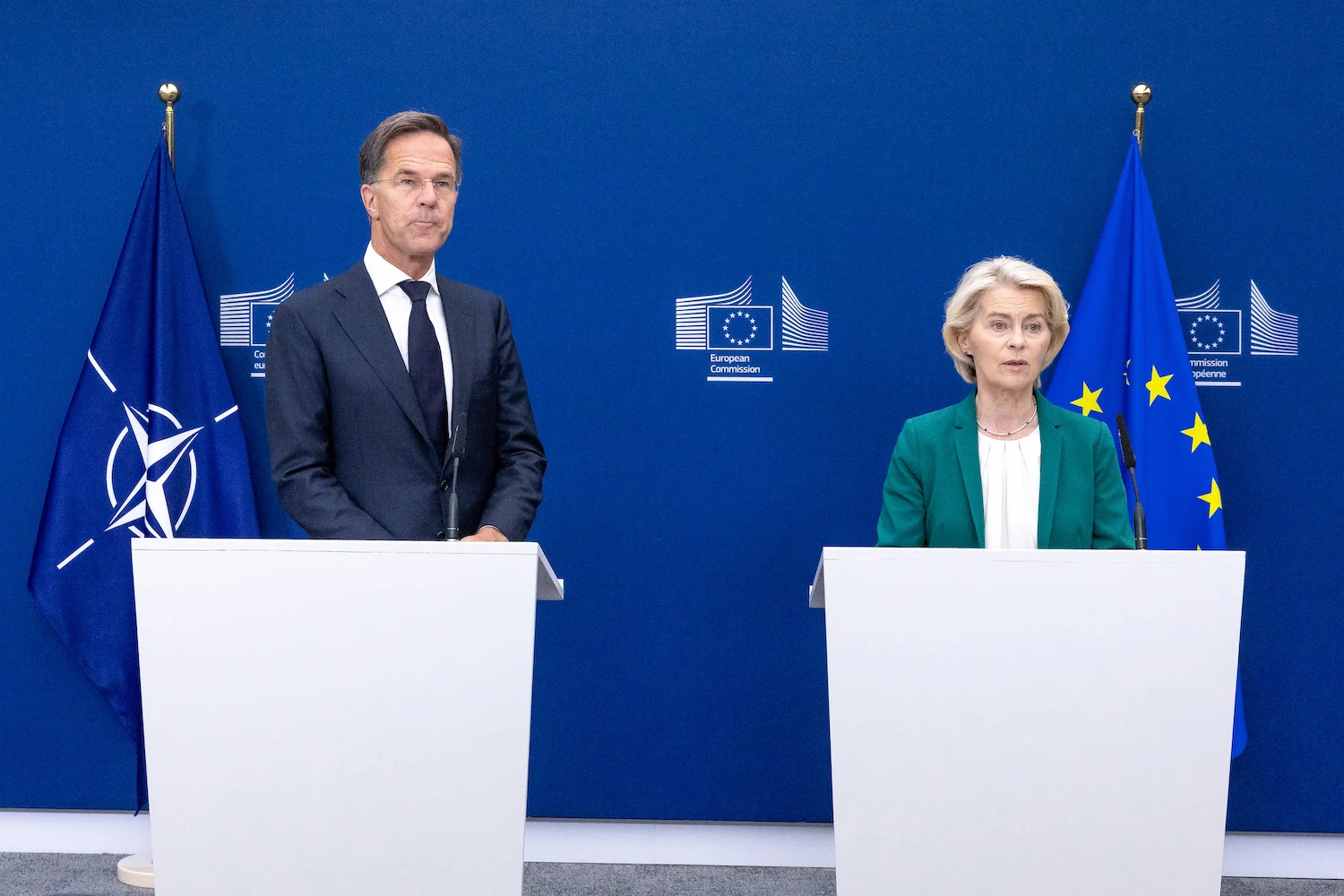
From right, European Commission President Ursula von der Leyen and NATO chief Mark Rutte give a press statement at European Union headquarters in Brussels on Sept. 2.Omar Havana/Getty Images
Tit-for-tat retaliations between Russia and Germany appear to be brewing into a larger diplomatic war as European nations join Berlin in punishing Moscow for an attempted drone attack on German soil.
On Aug. 4, local authorities discovered an explosive-laden drone near Ukrainian cargo planes at Germany’s Leipzig/Halle Airport, which serves as a hub for military aid to Ukraine. On Tuesday, Berlin formally blamed Moscow for the attempted operation, claiming that agents working “on behalf of Russian state entities” had controlled the drone.
As punishment for the alleged attack, Germany closed a Russian diplomatic mission in the city of Bonn, tightened restrictions on Russian travelers, and called on the European Union to impose greater sanctions on Moscow’s so-called shadow fleet of oil tankers and cargo ships. In response, Russian President Vladimir Putin accused Berlin of planting evidence to make the Kremlin a scapegoat for Germany’s political problems.
But the crisis has not ended there. A day later, the heads of NATO and the EU issued strong warnings against Russia, vowing to respond to this “new normal” of Russian hybrid warfare against Europe.
Europe and NATO “won’t just maintain our pressure on Russia. We will increase it,” European Commission President Ursula von der Leyen wrote on X on Wednesday, adding to a previous message pledging the EU’s “full solidarity” with Germany. Meanwhile, NATO chief Mark Rutte called the alliance’s commitment to collective defense “ironclad” and promised to “continue to strengthen our ability to deter and defend all Allies against any threat—including malign actions like those seen in Leipzig.”
Individual member nations have also taken up the call to diplomatic arms. During an EU foreign ministers’ meeting in Ireland on Wednesday, top diplomats from Belgium, France, and the Netherlands announced that they had summoned their respective Russian ambassadors to protest the failed operation.
“We will not let an act of such gravity go unpunished,” French Foreign Minister Jean-Noël Barrot said.
Since then, the Czech Republic, Denmark, Finland, Lithuania, Poland, and the United Kingdom have followed suit, summoning senior Russian diplomats stationed in their countries over what London called Moscow’s “egregious and reckless” attack.
At the same time, several EU countries—including Poland, Spain, and Sweden—have pushed for more than $224 billion in frozen Russian assets to be repurposed to help Ukraine. And Lithuania has reiterated that if Russia were to cause injuries or major damage on its territory like it targeted Leipzig, then it would “immediately” act in self-defense.
Moscow, however, maintains its innocence. On Wednesday, Russian Foreign Minister Sergey Lavrov announced plans to shutter German cultural centers across the country in response to Berlin’s closure of Russia’s Bonn facility. “They [Germany] deliberately took this step,” Lavrov said, according to Russian state news agency Tass. “They could not have failed to understand, which means the end of their cultural presence in Russia.”
Today’s Most Read
What We’re Following
Pointing fingers. There is no evidence to suggest that Morocco orchestrated a mass migrant crossing into the tiny Spanish exclave of Ceuta in late July, Spanish Prime Minister Pedro Sánchez told his parliament on Thursday.
“I can assure you that no institution—not the diplomatic service, nor the European Commission, nor any international body—has provided the Spanish government with any solid evidence that Morocco planned or carried out the incident. None whatsoever,” Sánchez said, denying allegations from a Spanish police report published last month that accused Morocco of deploying smaller-than-usual security teams to the area and failing to seriously try to disperse the crowds.
Sánchez also rejected claims that Madrid had mishandled the deadly crisis. “It’s absurd to think that the government knew and did nothing,” Sánchez said on Thursday. His address came less than 24 hours after tens of thousands of people backed by opposition parties held anti-government protests across the country, including in Ceuta, where at least 5,000 migrants remain stranded nearly five weeks after the mass crossing. More than 70,000 people initially fled from Morocco into Ceuta in late July.
Still, Sánchez is struggling to quell mounting domestic pressure over the incident, including calls for him to resign. On Thursday, he revealed that Madrid had summoned Morocco’s ambassador on Aug. 21 over “unacceptable statements” made by the country’s justice minister, who said that Rabat had a “historic right” to the Spanish territories of Ceuta and Melilla. However, it is unclear if that revelation will help Sánchez curry the public’s favor.
Defense spending scandal. Estonian Defense Minister Hanno Pevkur resigned on Wednesday over a controversial $81 million defense contract that was revealed in a National Audit Office report published on Friday.
In 2024, Estonia agreed to purchase artillery shells from Datasel SRL, an Italian-registered company owned by the India-based Neco Defense Munitions; under the deal, Tallinn would then supply Ukraine with this ammunition using money from the EU’s European Peace Facility. Estonia paid millions of dollars to Datasel in advance, but the shipments were delayed for months. Once the first batch finally arrived the following year, the ammunition was “not of sufficient quality,” according to Pevkur. It later became clear that Datasel had never previously sold a single artillery shell.
Pevkur took responsibility for the ministry’s failings in a Facebook post announcing his resignation on Wednesday, though he stressed that he was not personally involved in the Datasel contract. “A leader must have size and courage to take responsibility,” Pevkur wrote, “even though the minister does not count socks and cartridges and does not hold contract negotiations.”
Estonian Prime Minister Kristen Michal convened an emergency cabinet meeting on Wednesday to discuss the report’s findings and Pevkur’s resignation. The country’s Prosecutor’s Office is also examining the report as part of an ongoing criminal investigation opened in 2025 into the Defense Ministry’s accounting.
Mega dinghies. British Prime Minister Andy Burnham hosted French President Emmanuel Macron at Downing Street on Thursday, marking the first visit by an EU leader since Burnham took office. The two discussed “shared challenges,” including how best to support Ukraine in its war against Russia as well as ways to bolster EU cooperation with the United Kingdom. However, their primary topic of concern was migration.
In recent years, British authorities have recorded tens of thousands of people crossing the English Channel from France via small boats—nearly all of whom have claimed asylum. Although the number of migrants attempting the dangerous voyage dropped 43 percent thus far in 2026 compared to the previous year, the use of “mega dinghies” has introduced a new challenge for immigration enforcement officers. Just last month, a 15-meter-long vessel was spotted carrying a record 230 individuals.
“Smuggling gangs are constantly adapting their tactics, and we need to respond quickly and stay one step ahead of the criminals facilitating dangerous crossings,” Burnham wrote on X on Thursday, calling the “small boats crisis” a “shared European challenge.” He announced that London and Paris had agreed to increase the total number of deployed French officers tackling the issue to nearly 1,050 people.
Odds and Ends
A Hungarian man may have played a little too much Grand Theft Auto. Hungarian authorities allege that on Saturday, an intoxicated 24-year-old decided to take a Cessna 172 parked at Kalocsa Airport out for a joyride. But when he flew a little too close to Paks Nuclear Power Plant, the country’s sole commercial nuclear facility, defense radars deployed two standby fighter jets to intercept the aircraft. The man touched down in a sunflower field minutes later—only to then try to steal a car to get away. Local authorities managed to detain the man before he made it on the road, though, and officials have since opened criminal proceedings against him.
