

Close Menu
NCIJ Network NCIJ Network
    What's Hot

    Anthropic says its own AI models breached three companies during security tests

    July 31, 2026

    Nous Research Ships Three Integration Paths for Hermes Agent and Buzz, Block’s Open Source Nostr Workspace for Humans and Agents

    July 31, 2026

    Prompted by OpenAI Disclosure, Anthropic Finds Its Own Models Hacked 3 Organizations

    July 31, 2026
    Facebook X (Twitter) Instagram
    Trending
    • Anthropic says its own AI models breached three companies during security tests
    • Nous Research Ships Three Integration Paths for Hermes Agent and Buzz, Block’s Open Source Nostr Workspace for Humans and Agents
    • Prompted by OpenAI Disclosure, Anthropic Finds Its Own Models Hacked 3 Organizations
    • A flaw in Coldcard seed generation lets attackers recreate private keys from the press of a button
    • AI reveals explosive bursts in bird evolution
    • World Ranger Day: Justice for the protectors of the wild
    • Trump’s Canada Tariffs Decimate Border Crossings, Business in Upper Michigan — ProPublica
    • Spain’s Leader Rushes to Ceuta After Thousands of Migrants Burst Across Border: Live Updates
    • About
      • Our Team
      • Editorial Policy
      • Editorial Independence
      • International Support
    • Trust & Standards
      • AI Usage Policy
      • Conflict of Interest Policy
      • Corrections Policy
      • Ethics Policy
      • Fact-Checking Policy
      • Source Protection
    • Get Involved
      • Guide for Sources
      • Support Independent Journalism
    • Legal
      • Cookie Policy
      • Privacy Policy
      • Terms of Use
    Facebook X (Twitter) Instagram
    NCIJ Network NCIJ Network
    Friday, July 31
    • Home
    • World
    • Ai
    • Business
    • Politics
    • Health
    • Crypto
    • Science
    • Technology
    • Cybersecurity
    • Defense & Security
    • Economy
    • Energy
    • Europe
    • More
      • Fact Check
      • Investigations
      • Opinion & Analysis
      • Environment
    NCIJ Network NCIJ Network
    Home»Science

    Ultrafast X-rays capture chemistry unfolding atom by atom

    NCIJ NETWNCIJ NETWORKBy NCIJ NETWNCIJ NETWORKJuly 31, 2026 Science No Comments4 Mins Read
    Share
    Facebook Twitter LinkedIn Pinterest Email

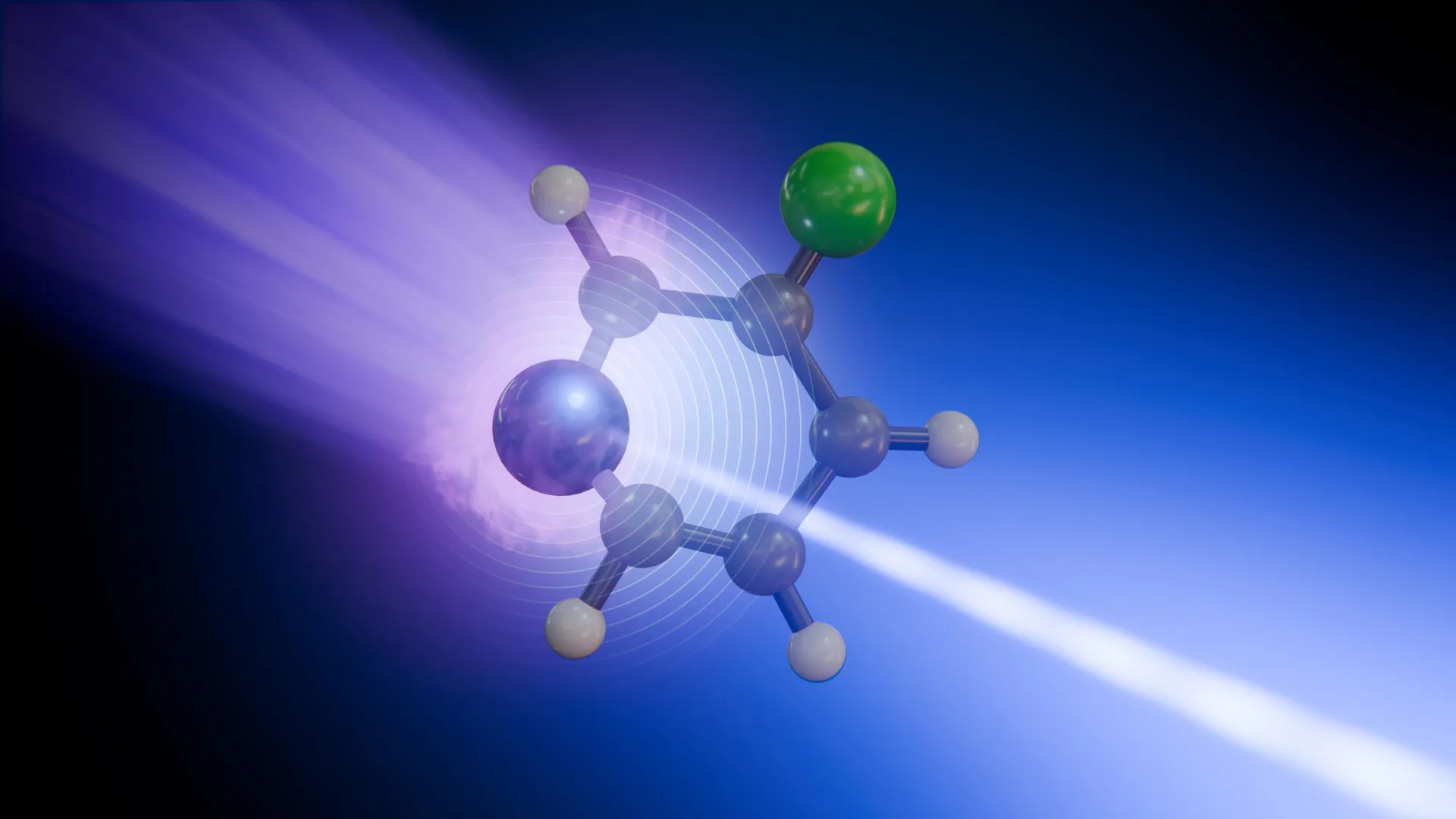
    Scientists have observed how energy moves through a molecule immediately after it absorbs light, revealing that individual atoms can record very different parts of the transformation.

    Using rapid X-ray flashes produced at the European XFEL, the researchers followed changes at specific atoms as the molecule released and redistributed the absorbed energy. Their results show that exposure to light can make an atom more responsive to the movement of neighboring atoms.

    The technique gives scientists a way to examine extremely fast chemical reactions at the atomic scale and in real time. It could eventually improve understanding of how DNA withstands light exposure, how energy travels through materials designed to harvest light, and how other fundamental light-driven processes occur.

    Following Energy Through a Molecule

    The researchers studied 3-fluoropyridine, a small ring-shaped molecule containing both nitrogen and fluorine atoms.

    When the molecule absorbs energy from a brief ultraviolet laser pulse, its electrons enter a higher energy state. The molecule then quickly bends out of its normally flat structure.

    As it changes shape, it passes through what scientists call a conical intersection: a short-lived but crucial crossing point where movements of electrons and the atoms’ cores become strongly coupled. These intersections play an important role in many reactions triggered by light because they allow energy to move rapidly between electronic and structural motion.

    After crossing this region, the molecule returns to its ground state. The excess electronic energy is then converted into vibrations that travel through the molecular structure.

    Different Atoms Reveal Different Changes

    The conversion of energy produced distinct signals at different locations within the molecule. The fluorine atom served as a relatively clear indicator of how the molecule’s vibrations relaxed over time.

    The nitrogen atom told a more complicated story. Because it played a more direct role in the original electronic excitation, its signal reflected both the redistribution of electrons and the molecule’s changing structure.

    “We can now see that not every atomic site tells the same story in the signals we capture from our X-ray pulses,” says Antonio Picón from the Instituto de Ciencia de Materiales de Madrid Consejo Superior de Investigaciones Científicas (ICMM-CSIC), co-author of the study. “Some atoms report where the charge is going, while others reveal how the whole molecule vibrates.”

    Reconstructing a Picosecond Transformation

    To capture the process, the team used time-resolved X-ray photoelectron spectroscopy (tr-XPS) at the Small Quantum Systems instrument (SQS) of European XFEL.

    First, an ultraviolet laser pulse delivered energy to the molecules. A carefully timed soft X-ray pulse then ionized them by removing deeply bound electrons from either the nitrogen or fluorine atoms.

    The researchers repeated the measurement with the X-ray pulse arriving at many different delays after the initial laser pulse. By recording the energies of the released electrons, they reconstructed how the chemical environment surrounding each atom changed over just a couple of picoseconds (trillionths of seconds).

    Advanced computer simulations and theoretical models were then used to interpret the experimental signals and connect them with the underlying electronic and structural changes.

    A New View of Ultrafast Photochemistry

    The findings demonstrate how the ultrashort, high-brightness X-ray pulses available at European XFEL can separate some of the fastest interconnected motions in matter.

    Although the experiment focused on one relatively simple molecule, the same approach could be applied to increasingly complex systems. Possible targets include functional organic molecules, biomolecular building blocks, and materials designed to capture or transfer energy from light.

    “This is what European XFEL was built to enable: watching chemical change where it begins, at specific atomic sites and on its natural timescale,” says Daniel Rivas, former instrument scientist, now guest scientist at SQS and co-author of the study. “By combining multi-site sensitivity with femtosecond resolution, we are opening a new window on the microscopic mechanisms that govern photochemistry.”

    atom capture chemistry Ultrafast unfolding Xrays
    NCIJ NETWNCIJ NETWORK
    • Website

    Keep Reading

    AI reveals explosive bursts in bird evolution

    Alien signals may be hiding where we rarely listen

    ‘Really upsetting’ that camp fire likely led to Isle of Wight rare habitat blaze

    A forgotten fossil just revealed a new Triassic predator from 210 million years ago

    Scientists found evolution repeating itself in the Galápagos Islands

    Students Take on Airborne Field Research with NASA

    Add A Comment
    Leave A Reply Cancel Reply

    Editors Picks

    Anthropic says its own AI models breached three companies during security tests

    July 31, 2026

    Nous Research Ships Three Integration Paths for Hermes Agent and Buzz, Block’s Open Source Nostr Workspace for Humans and Agents

    July 31, 2026

    Prompted by OpenAI Disclosure, Anthropic Finds Its Own Models Hacked 3 Organizations

    July 31, 2026

    A flaw in Coldcard seed generation lets attackers recreate private keys from the press of a button

    July 31, 2026
    Latest Posts

    Advancing the next era of national science

    July 22, 2026

    Arcee, a US open source AI lab, says Chinese models are not inherently dangerous

    July 22, 2026

    Most bus fares in England to be capped at £2 from January

    July 22, 2026

    Subscribe to News

    Get the latest sports news from NewsSite about world, sports and politics.

    NCIJ Network is an independent digital news platform delivering trusted investigative journalism, European and global news, in-depth analysis, and fact-based reporting with accuracy, transparency, and integrity.

    Facebook X (Twitter) Instagram Pinterest YouTube

    Anthropic says its own AI models breached three companies during security tests

    July 31, 2026

    Nous Research Ships Three Integration Paths for Hermes Agent and Buzz, Block’s Open Source Nostr Workspace for Humans and Agents

    July 31, 2026

    Prompted by OpenAI Disclosure, Anthropic Finds Its Own Models Hacked 3 Organizations

    July 31, 2026

    Subscribe to Updates

    Get the latest creative news from FooBar about art, design and business.

    Type above and press Enter to search. Press Esc to cancel.