


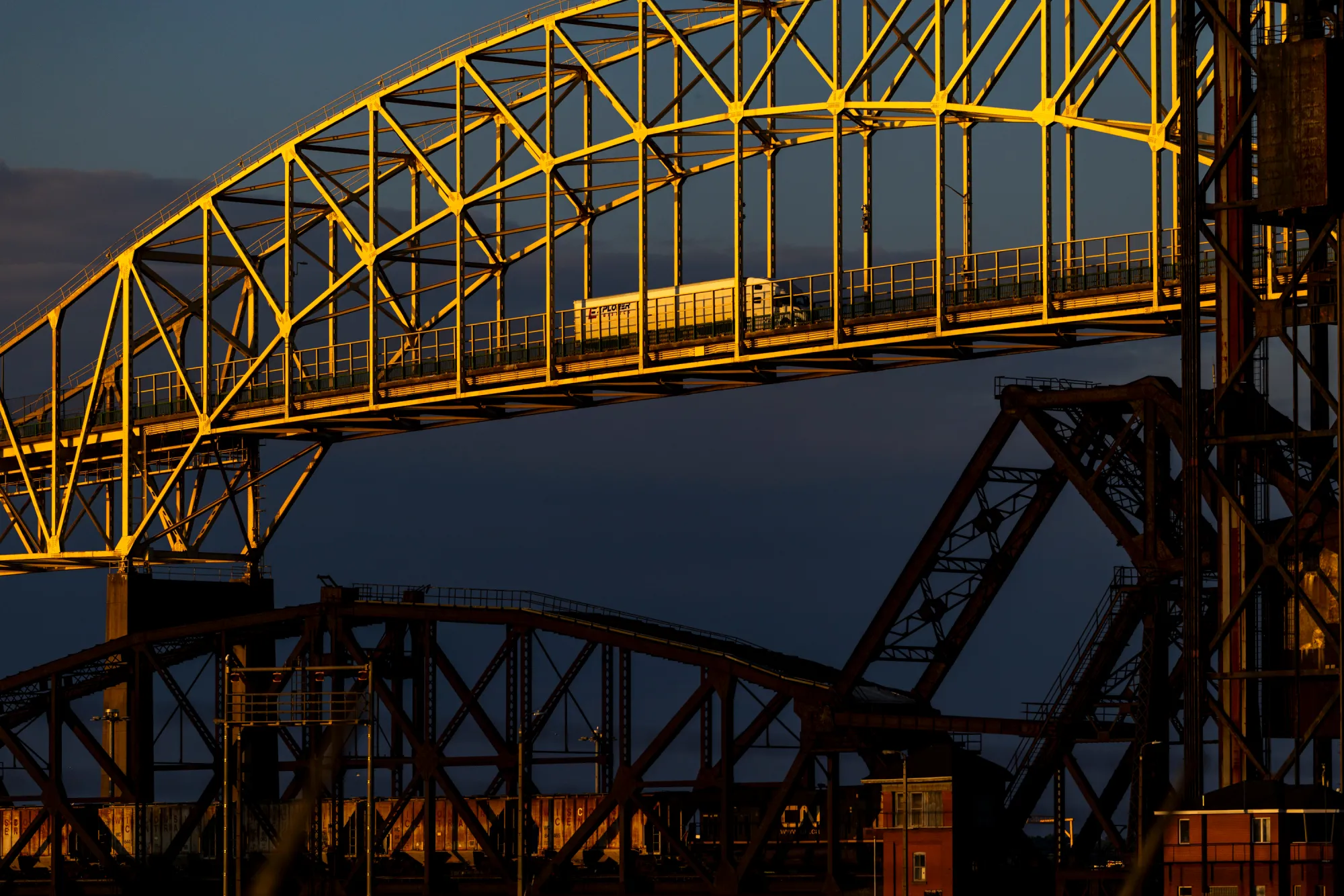
On the northeast edge of Michigan’s Upper Peninsula, nearly 1,100 people gathered in late June for the International Bridge Walk across the long span that links two cities with the same name: Sault Ste. Marie, Michigan, and Sault Ste. Marie, Ontario. Both the sun and the sentiments were bright.
“We don’t like to say there’s a border there, because we’re twin cities. We’re one family, the countries of Canada and the United States,” Don Gerrie, mayor of the Michigan Sault (pronounced “Soo”), told the crowd ahead of the annual walk.
He sported a black ballcap that he said was given to him by his counterpart in the Ontario Sault. It featured flags from both nations with the words “Stronger Together” and “Allies and Friends.”
Canadians in cheerful patriotic attire joined the bridge walk, with maple leaves tagging their scarves and socks, shirts and shorts. Americans came out in star-spangled T-shirts heralding the nation’s 250th birthday. But this lively tradition is clouded by an increasingly hostile relationship between the U.S. and Canada.
Traffic over the bridge is way down. And, in recent weeks, President Donald Trump threatened new tariffs in retaliation for thick wildfire smoke wafting into the U.S. When his administration announced an additional 50% tariff on an array of Canadian products, the White House cited “Canada’s discriminatory treatment of American products.” Then, using a separate mechanism, it hit Canada with a further 10% in tariffs.
Following pressure from the Trump administration that delayed it, a new publicly owned bridge, the Gordie Howe, opened Monday between Detroit and Windsor, Ontario. Canada hosted a Canada-only opening ceremony.
Trump wasn’t present for the bridge’s ribbon-cutting, even though he used to cheer the project. Up at the Sault bridge, there was no sign of the region’s congressional representative at the celebration of international friendship, even though, during Trump’s first term, Rep. Jack Bergman, a Republican, hailed relations with Canada.
In 2020, when Bergman was appointed to an interparliamentary group that provides a forum for exchange between Canadian and American legislators, he boasted of the Sault bridge as a point where “millions” cross every year “to conduct business, shop, work and enjoy what each country has to offer.”
Yet Bergman, who is endorsed by Trump in an upcoming contested primary, has been virtually silent on the new tariffs and their blowback in local communities, even as he’s prodded to speak out by many of his constituents. The only references to Sault Ste. Marie in the news items on his website during Trump’s second term are a mention of an infrastructure project and a February 2025 letter to the president about a purported member of a Venezuelan gang crossing the border.
As Canada responds to Trump’s moves with emergency interventions and “buy local” boosterism, significantly fewer Canadians are crossing the border for once-ordinary activities: shopping, eating, fueling vehicles, vacationing or visiting family and friends.
The Sault area lost at least $82.9 million last year in local spending because of decreased crossings, according to an estimate from the International Bridge Administration, which manages the span: $62.7 million on the Michigan side and $20.2 million on the Ontario side.
There were 270,000 fewer total crossings last year at the Sault Ste. Marie International Bridge — nearly a 24% drop from 2024, exceeding similar declines at Michigan’s other border crossings. Based on the currency used to pay bridge fares and information from the Canadian prime minister’s office, the drop is largely due to the loss of Canadian travelers. Halfway into 2026, auto traffic has lingered at the same lower volume, according to the bridge director, while commercial traffic has fallen nearly 15% further.
Nationwide, the total number of Canadians returning from the United States last year dropped by more than 25%, according to data from the Canadian government.
“What Canadians have done, of course, is they’re boycotting the U.S.,” said Michael Broadway, a geographer and professor emeritus at Northern Michigan University who has researched the travel trends (and joined the bridge walk). Ordinary people can only do so much about federal politics, he said, “but what they can do is they can vote with their feet.”
Cengiz Yar/ProPublica
The Sault bridge spans the St. Mary’s River, just west of the historic Soo Locks that serve as a hinge between two of the largest Great Lakes, Lake Superior and Lake Huron. Soaring high above the water to clear the thousand-foot freighters, it’s a critical gateway for commerce. And it’s the only vehicular border crossing for hundreds of miles in either direction.
The drop in traffic reversed a post-pandemic uptick, said Peter Petainen, bridge director and an Ontario Sault native. Just as the numbers were recovering, he told ProPublica, “the federal tariff dispute occurred and we’ve fallen off.”
Others noted that the turn in how the U.S. approaches noncitizens may have also chilled travel. Stories of Canadians detained in the U.S. are recurring headlines up north. And the Canadian dollar also doesn’t go as far as it once did in the U.S.
Altogether, it’s a problem for Michigan’s rural Upper Peninsula — and also for the publicly owned bridge, which depends on tolls for maintenance and operations. As the bridge authority put it in its five-year plan, issued in December: “Border challenges negatively affecting bridge traffic, trade and tourism may significantly reduce bridge revenue or increase expenditures beyond operational sustainability.”


Wilda Hopper, co-owner of Bird’s Eye Outfitters in the Michigan Sault, feels the change. She said that the drop-off in Canadian visitors was most noticeable in the off-season, when her gear shop and cafe relies on the local community — including those from the Ontario Sault — to carry it through the snowy months.
Between fewer Canadian customers and rising costs, Hopper said, business is down about 27% compared with what it was last summer.
“I can tell you that I’ve spoken to business after business up in the Sault Ste. Marie area, and in the eastern Upper Peninsula, and they’re all feeling the pressure from this,” said Michigan state Sen. John Damoose, a Republican who represents the community in Lansing. “Mackinac Island’s feeling the pressure, everybody is feeling the heat from this deterioration in our relationship with Canada.”
It’s a bewildering fallout, he said. After a brutal ice storm last year, he remembered Canadians crossing the Sault bridge to help Michiganders repair the electrical grid. “This is our best friend in the entire world,” Damoose said.
Only so much can be done about it from the statehouse, though, when it’s Republicans in Washington in the power position. Two of Michigan’s voices in Washington are the Democratic Sens. Gary Peters and Elissa Slotkin. They don’t flatly oppose tariffs, but they have challenged Trump’s approach, calling it, respectively, “chaotic” and “sloppy.” Slotkin has said that, constitutionally, only Congress can levy tariffs or raise taxes. Peters introduced bipartisan legislation that seeks more tariff transparency.
Bergman, who has represented a district that encompasses the Upper Peninsula and an additional northern swath of the state’s “mitten” since 2017, once stressed the critical role Canada plays in Michigan’s economy. He vowed to work with the Canadian Parliament to “expand market access between both our nations” during Trump’s first term. And he championed the president’s new North American trade deal with Canada and Mexico, citing the benefits for Michigan’s farmers, small businesses and consumers.
But Trump’s trade policies have made it hard on many Republicans who once touted free trade. Pete Hoekstra, the U.S. ambassador to Canada and a former Michigan congressman, pivoted dramatically on trade in the Trump era, as ProPublica reported.

Since Trump started his second term, there’s been no mention of tariffs in the press releases, articles and op-eds on Bergman’s website. Along with three of his colleagues in Congress, he criticized Canada’s handling of wildfires that sent thick smoke into Michigan in a recent letter to the prime minister.
ProPublica reached out to Bergman, his office and his campaign multiple times for comment on what’s happening in his district and received no response. Besides Trump’s endorsement, his reelection is supported by the Michigan and U.S. chambers of commerce.
He’s facing two challengers in the Republican primary on Aug. 4. Both of them told ProPublica that the district benefits from sustainable trading relationships.
They also echoed what many of Bergman’s constituents told ProPublica: that residents have had scarce opportunities to connect with the congressman in person. Bergman doesn’t appear to have hosted a public town hall in the district since his first year in office.
Bergman, who has a house in Louisiana, has faced long-standing allegations that he doesn’t even make Michigan his true home. Julie Hoffmeyer, a former member of Bergman’s staff who supports one of his primary challengers, told ProPublica that the congressman refers to his property in the western Upper Peninsula as a “cabin” or a “camp.”
Bergman, responding to past challenges to his Michigan residency, has called his home there his primary residence and noted that he’s a registered voter in the state.


Trump’s quick-shifting trade policies are especially difficult for Michigan’s agriculture industry, the state’s second-largest sector, according to a recent report from the state’s agriculture department. The report, which hasn’t yet been publicly released, said that exports to Canada fell 12.3% last year, “signalling severe strain with a country that is our strongest trading partner.”
Meanwhile, the relationship between the U.S. and Canada is fraying ever further. A White House fact sheet on the new 50% tariff acknowledged the ways that Canadians have changed how they do business.
The White House said that Canadian imports of U.S. motor vehicles dropped by about 22% between April 2025 and March 2026, compared with the same period the year before. And, it said, due to provincial restrictions, Canadian imports of U.S. alcoholic beverages have plummeted.
Mark Carney, Canada’s prime minister, said in a letter posted on social media that the series of tariffs imposed by the U.S. began with ones that were “in direct violation” of the standing North American trade deal — the deal from Trump’s first term that he once celebrated, and that Bergman described as a great economic victory for Michigan.
With the deal up for review this year, the Trump administration declined a long-term extension of the pact. Carney has also widely signaled that Canada is looking beyond its near neighbor for trading partners.
Carney said, in an April video posted on his YouTube channel: “Many of our former strengths, based on our close ties to America, have become our weaknesses — weaknesses that we must correct.”

