


Wildland fires occur across Europe every summer, but those that erupted in Spain and France in July 2026 were among the largest and most disruptive the two countries have faced in decades. Some of the most consequential fires emerged in southwestern France’s Gironde Department and Spain’s Ávila and Madrid provinces in mid-July, where blazes forced hundreds of thousands of people to evacuate and destroyed hundreds of homes.
Government officials in Spain say that a fire in Ávila, after charring around 50,000 hectares (124,000 acres), is the largest on record, surpassing a blaze that burned in Larouco, Quiroga, and Oencia in 2025. NASA satellites first observed signs of the Ávila fire burning near Burgohondo on July 22 and July 23. By July 24, it had merged with fires in neighboring provinces, pushing the total area burned to 77,000 hectares, an area about the size of New York City.
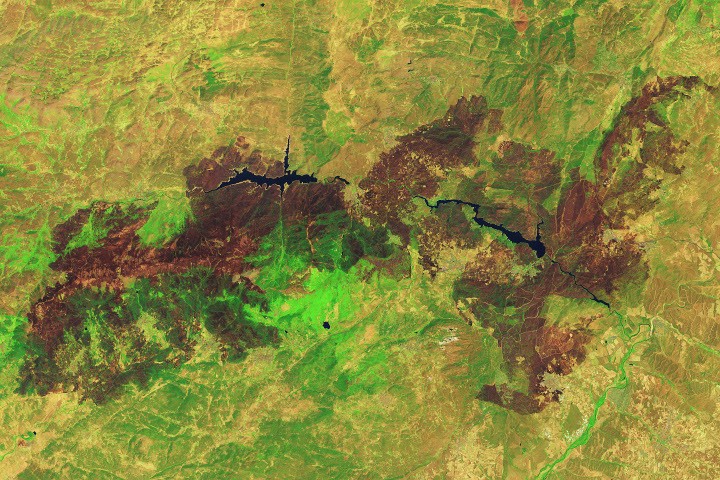
The image above, captured by Landsat 9, shows charred landscapes around Burgohondo on July 29, 2026. In the false-color image, unburned vegetation appears light green, and burned areas appear brown. The two reservoirs in the center of the image were heavily affected. Flames tore through homes, restaurants, campgrounds, marinas, and other infrastructure surrounding the reservoirs, according to news reports.
A similar crisis unfolded in southwestern France, west of Bordeaux. One of the largest fires to burn in France this decade charred more than 42,000 hectares, prompting large-scale evacuations and devastating the village of Le Porge. As of late July, fires had burned more than 90,000 hectares across France, more than any other season in decades, according to data from the European Forest Fire Information System.
Environmental conditions months before the fires ignited made the landscape in both Spain and France particularly susceptible to burning, according to an analysis conducted by researchers with The State of Wildfires Project. Unusually wet winter weather enhanced vegetation growth in grasslands, shrublands, and forest understories, and then a series of sweltering heat waves and a period of drought parched the vegetation and primed it to burn. Several days of strong winds reaching 65 kilometers (40 miles) per hour at times served as the final trigger, the researchers found, fanning flames and encouraging rapid spread.
On July 25, conditions at fires in southwestern France grew so intense that French firefighters reported the formation of a pyrocumulonimbus—a towering type of “fire cloud” that draws convective energy from the heat of the fires. An international group of atmospheric scientists and fire experts who track the unusual clouds has documented the occasional formation of the clouds in Spain and Portugal in recent decades, but members of the group note that this is the first report of a fire in France producing one.
Thousands of firefighters and military personnel have battled fires in both countries. Crews have used aircraft to attack the fires with water and flame retardant, while teams on the ground have constructed firebreaks using tools ranging from bulldozers to hand tools. Firefighters gained the advantage by late July, allowing authorities to start lifting evacuation orders. However, forecasters are warning that the risk of fire in the coming days remains high due to the persistence of hot, dry conditions.
Government satellite data are part of a global system of observations used to track fire behavior and analyze emerging trends. Among the real-time wildfire monitoring tools that NASA makes available are FIRMS (Fire Information for Resource Management System) and the Worldview browser.
NASA Earth Observatory image by Lauren Dauphin, using Landsat data from the U.S. Geological Survey. Story by Adam Voiland.
- AP (2026, July 30) As France tames wildfire and lets 84,000 evacuees go home, blazes flare across Europe. Accessed July 30, 2026.
- The Conversation (2026, July 29) ‘The fire has such power’: why the wildfires gripping France and Spain are off the charts. Accessed July 30, 2026.
- Drought.gov (2026, July 22) International. Accessed July 30, 2026.
- EFE (2026, July 25) France Wildfires: Record evacuations as fires near Bordeaux. Accessed July 30, 2026.
- EFE (2026, July 26) El incendio de Ávila ha quemado 50.000 hectáreas, el mayor fuego de la historia de España. Accessed July 30, 2026.
- European Commission (2026, July 30) Current wildfire situation in Europe. Accessed July 30, 2026.
- European Commission (2026, July 30) Current drought situation in Europe. Accessed July 30, 2026.
- France24 (2026, July 26) French firefighters face ‘pyrocumulonimbus’ for first time. Accessed July 30, 2026.
- NASA Earthdata, Wildfires. Accessed July 30, 2026.
- The New York Times (2026, July 28) The Fires in France and Spain Are Breaking Modern Records. Accessed July 30, 2026.
- Peterson, D., et al. (2025) Worldwide inventory reveals the frequency and variability of pyrocumulonimbus and stratospheric smoke plumes during 2013–2023. Climate and Atmospheric Science, 8, 325.
- Reuters (2026, July 27) Mapping the wildfires outside Bordeaux and Madrid. Accessed July 30, 2026.
- RTVE (2026, July 27) Anatomía del incendio más grande de la historia de España: más de 50.000 hectáreas en cinco días. Accessed July 30, 2026.
- State of Wildfires Project (2026, July) Understanding Spain’s 2026 Wildfires through hydroclimatic rebound. Accessed July 30, 2026.
- Time (2026, July 28) Photos Show the Destruction in France and Spain From Ferocious European Wildfires.Accessed July 30, 2026.
