


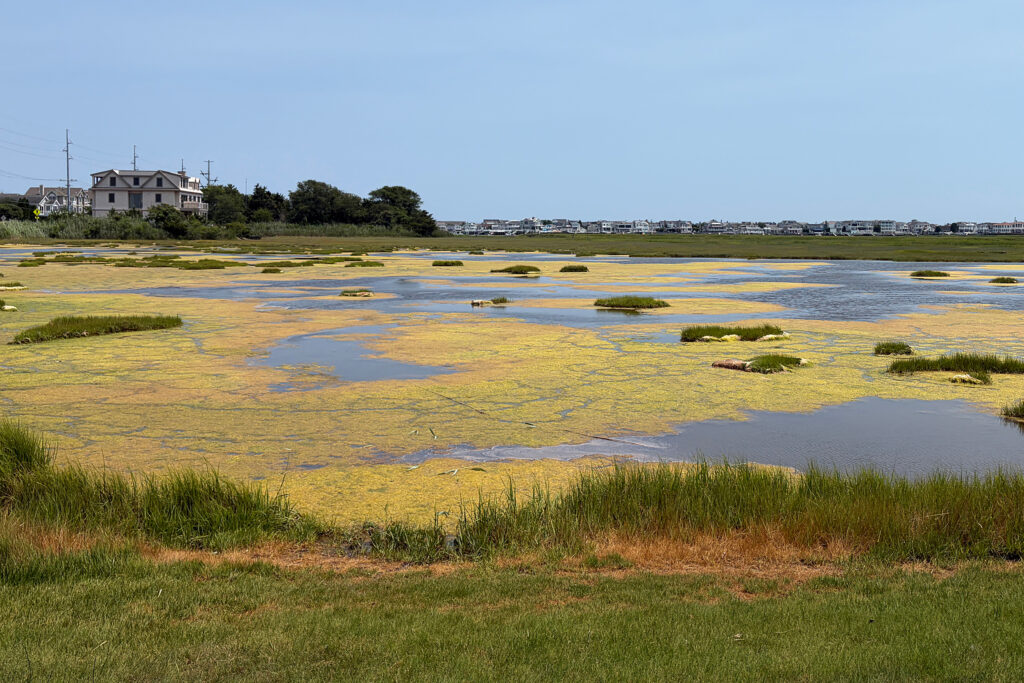
STONE HARBOR, N.J.—Against a lush carpet of marsh grasses, the five-and-a-half acre island of muddy sediment, shallow pools and tufts of straggly vegetation stood out like a sore thumb.
It wasn’t enough to catch the eye of young visitors to The Wetlands Institute, who were far more interested in the diamondback terrapin enclosure that was the centerpiece of “Totally Turtle Tuesday.” To the scientists studying it, however, this patch—known as the Scotch Bonnet Island enhancement project—is far more interesting. It’s an ongoing experiment in saving critically important marsh ecosystems from drowning in a relentlessly rising tide.
The restoration effort kicked off after The Wetlands Institute discovered that the marsh is disappearing at an alarming rate. Since the 1950s, more than 30 percent of the coastal wetland in the area has disappeared, becoming either mud flats or open water, and modeling projected that by 2050 just 34 out of 86 acres would remain.
For Lenore Tedesco, executive director of the institute, the analysis came as a shock. “As the data was coming in, I was getting more and more panicked,” she said. “I’m like, ‘Holy crow, this whole platform’s too low.’”
A rising sea level is the main culprit. While coastal wetlands need to be bathed by the tide, they rely on a delicate balance. Too little water will dry them out, but deep flooding can kill.
Marshes can keep pace with water levels that rise slowly, because tides deposit sediment that builds up over time. But Scotch Bonnet and many other coastal marshes around the country are struggling to keep pace with unprecedented rates of sea level rise caused by accelerating global warming. Last century, the world’s water levels rose an average of 1.7 millimeters every year, but from 2006 to 2018 that annual figure more than doubled to 3.8 millimeters.
Previous research estimates that roughly half of all historical salt marsh coverage globally has already been lost, and more is under threat. A new study by federal researchers found that 84 percent of U.S. wetlands along the Atlantic, Pacific and Gulf coasts are on track to move further inland or be destroyed altogether, converting marsh ecosystems into open water. The authors warned that without intervention, the accelerating pace of sea level rise “may lead to profound and irreversible ecological transformations that will occur over the course of a human lifetime.”
In response, scientists are searching for strategies to help these vitally important wetlands survive on a rapidly changing planet.
Tedesco, a geologist by training with cropped brunette hair and a no-nonsense manner, sees saving these wetlands as the most important and rewarding work of her career. “My job is to convince people and connect them to solutions,” she said. “I want everybody to understand the best ways to do this.”
Protectors of the Coast
As some of the most biodiverse ecosystems on Earth, wetlands like coastal marshes are refuges for fish, birds and other wildlife. More than a third of North American birds, including many endangered species, rely on wetlands to feed and nest. These ecosystems also play a key role for more than 75 percent of commercially fished and 90 percent of recreationally fished species that depend on them for food, cover and spawning grounds.
“There’s a whole host of benefits to culture, to flora and fauna, and economically speaking, so it is really important that we understand how [wetlands] are changing,” Justine Neville, a wetland ecologist and the lead author of the wetland loss study, said in a statement.
Marshes also remove pollutants from water and store significant amounts of carbon and nitrogen. But when marshes are lost to rising sea levels, those nutrients are released into the environment, creating feedback loops that can accelerate marsh loss. Degraded coastal ecosystems could be releasing as much as 1 billion tons of carbon dioxide every year, equal to 19 percent of the emissions from deforestation. And when nitrogen is discharged back into the water, it can pollute the surrounding area and trigger damaging algal blooms.
Additionally, because wetlands can hold significant amounts of water—roughly 1 million gallons per acre—they help protect against flooding, especially during storms. This can prevent hundreds of millions of dollars of property damage while shielding forests and farmland from the harmful effects of saltwater, which can kill trees and crops.
“If you can maintain native marsh, it does a lot to actually protect the upland area,” said Kate Tully, a researcher at the University of Maryland studying sea level rise and saltwater intrusion into farmland. “There’s a big push to figure out how to protect marshes.”
With sea levels rising and saltwater damaging coastal land, “we should have been doing this work 50 years ago, but here we are. So we need to get a move on,” she said.
Move or Die
At Scotch Bonnet, the marsh builds at a rate of around four millimeters a year. But due to the geology of the area, the sea level rise in southern New Jersey is twice the global average, increasing at a rate of about six millimeters every year.
This means the marsh is out of equilibrium. While some areas are still hanging on in the near-term, a severe weather event like a storm or a freeze could have disastrous effects. In the long-term, the landscape will simply be unable to keep up.
“The system is not healthy. It’s waiting to have a heart attack, basically,” The Wetlands Institute’s Tedesco said. “This is, in some ways, a preview of what will be coming elsewhere because it’s happening faster here.”
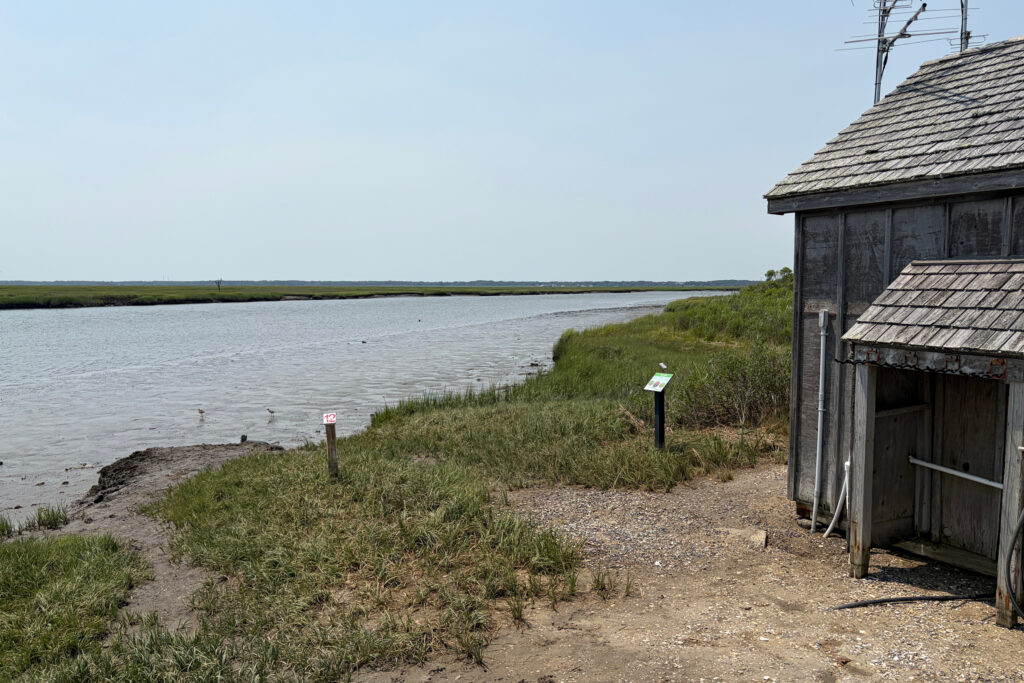
When rising water outpaces the rate of marsh growth, there are two options: migration or submergence. When space is available further inland, the vegetation can naturally retreat to higher ground. “If you can conserve big areas around these marshes, it helps them adapt a little better on their own,” which makes it an easier solution for marsh loss, said Samantha Chapman, a wetland ecologist at Villanova University and leader of the WETFEET Project, which studies how coastal wetlands are responding to changing conditions.
But when that space is unavailable—either because of natural or human-made barriers—the marsh plants have nowhere to go. They drown, and what was once a wetland becomes mud flats or open water.
This story is funded by readers like you.
Our nonprofit newsroom provides award-winning climate coverage free of charge and advertising. We rely on donations from readers like you to keep going. Please donate now to support our work.
Buying Marshes More Time
Backed up against a road and bookended by development, the Scotch Bonnet marsh had nowhere to go but up to escape the rising water level. So, researchers decided to experiment with raising the marsh as part of the Seven Mile Island Innovation Lab, a joint initiative between The Wetlands Institute, New Jersey and the U.S. Army Corps of Engineers that looks to advance marsh restoration techniques for large-scale projects up and down the mid-Atlantic.
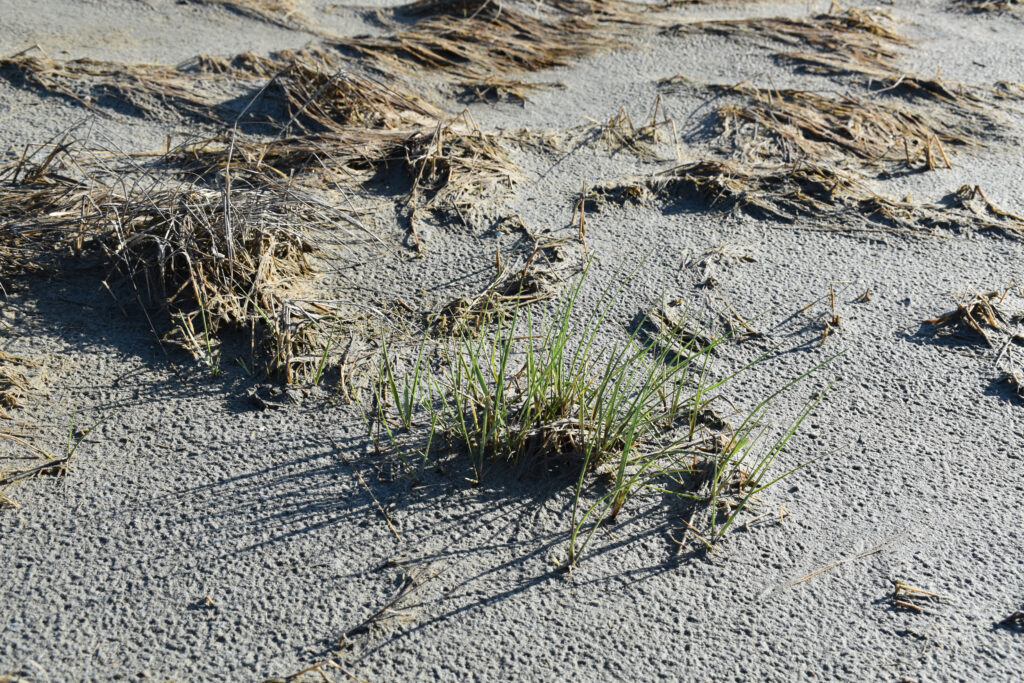
To elevate the land, the team had to get the right kind of sand and mud that would suit the environment, and because of the sheer volume needed, it would have to come from somewhere nearby. An adjacent navigation channel proved the solution. In fall of 2024, 14,000 cubic yards of sediment was dredged and pumped two miles through a floating pipeline before being deposited onto the marsh in jets of black slurry.
Finding the right elevation was a challenge that kept Tedesco up at night. The project would disturb the marsh and kill the vegetation, at least for a time, so it was important to justify the cost by buying the area decades of health as water levels rise. But if they didn’t add enough, the already destabilized system could have collapsed.
When it was first deposited, the muddy, sandy sludge was more than three feet thick in places. As it settled and the water drained away, it sank by roughly a foot.
Full marsh recovery can take two to three years, but the early results are promising. The sediment appears to be stable, and researchers have documented 32 bird species using the area for resting and fishing, including a rare American Golden-Plover that caused a stir among local bird watchers. Seeds of marsh grass have also spread across the dredged mud and are starting to grow in clumps.
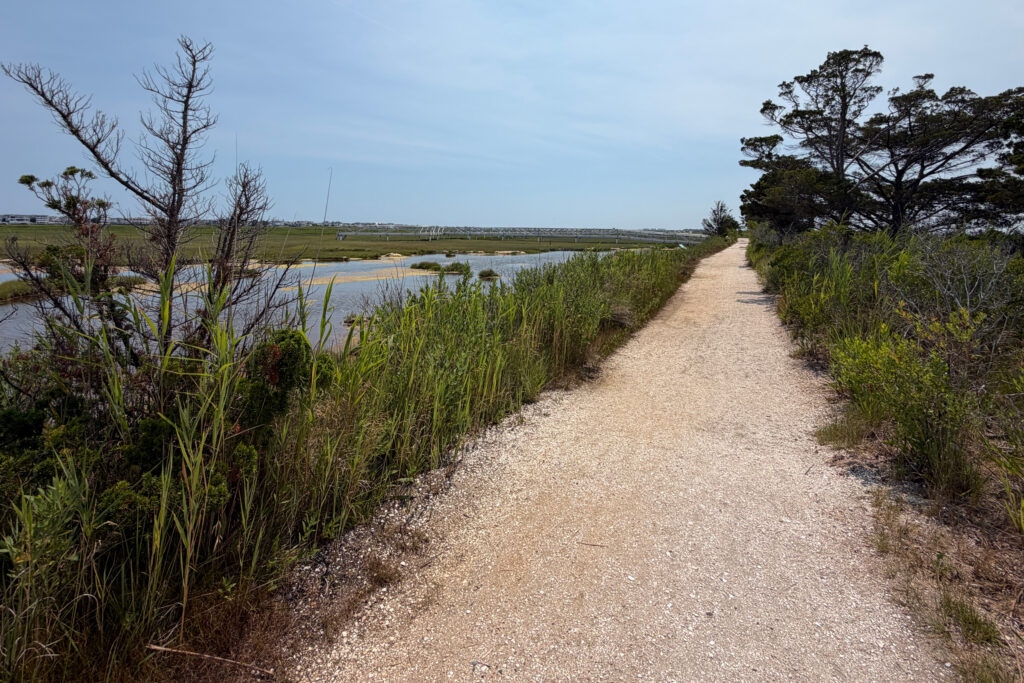
Institute scientists will continue to monitor the results for insights into how to best add elevation to other marshes along the mid-Atlantic. Tedesco has already set her sights on the next area in need of saving: a stretch along the institute’s salt marsh trail that serves as an important nesting ground for diamondback terrapins.
A quarter-century ago, the trail flooded twice a year. Now, it floods an average of 67 times annually.
Restoration work like this is happening all around the coastal U.S. at scales both large and small. While The Wetlands Institute’s salt marsh trail is just five acres, the South Atlantic Salt Marsh Initiative is looking to boost the resilience of around 1 million acres of coastal marsh between North Carolina and Florida.
Even with mitigation efforts, much of the coming sea level rise is already “baked into the system,” according to Chapman, the wetland ecologist. But she’s still hopeful that research on restoration and conservation strategies will help stem the tide of loss and preserve the important benefits these ecosystems provide.
“I think we can get a lot of wetlands back,” she said. “They’re not always on this one-way street to destruction.”
About This Story
Perhaps you noticed: This story, like all the news we publish, is free to read. That’s because Inside Climate News is a 501c3 nonprofit organization. We do not charge a subscription fee, lock our news behind a paywall, or clutter our website with ads. We make our news on climate and the environment freely available to you and anyone who wants it.
That’s not all. We also share our news for free with scores of other media organizations around the country. Many of them can’t afford to do environmental journalism of their own. We’ve built bureaus from coast to coast to report local stories, collaborate with local newsrooms and co-publish articles so that this vital work is shared as widely as possible.
Two of us launched ICN in 2007. Six years later we earned a Pulitzer Prize for National Reporting, and now we run the oldest and largest dedicated climate newsroom in the nation. We tell the story in all its complexity. We hold polluters accountable. We expose environmental injustice. We debunk misinformation. We scrutinize solutions and inspire action.
Donations from readers like you fund every aspect of what we do. If you don’t already, will you support our ongoing work, our reporting on the biggest crisis facing our planet, and help us reach even more readers in more places?
Please take a moment to make a tax-deductible donation. Every one of them makes a difference.
Thank you,

Fellow
Madeline Shaw is an Outrider fellow at Inside Climate News and a journalist in NYU’s Science, Health and Environmental Reporting Program. She has reported on issues involving conservation, poaching and biodiversity. Her work has been published in The New York Times and Scienceline.
