


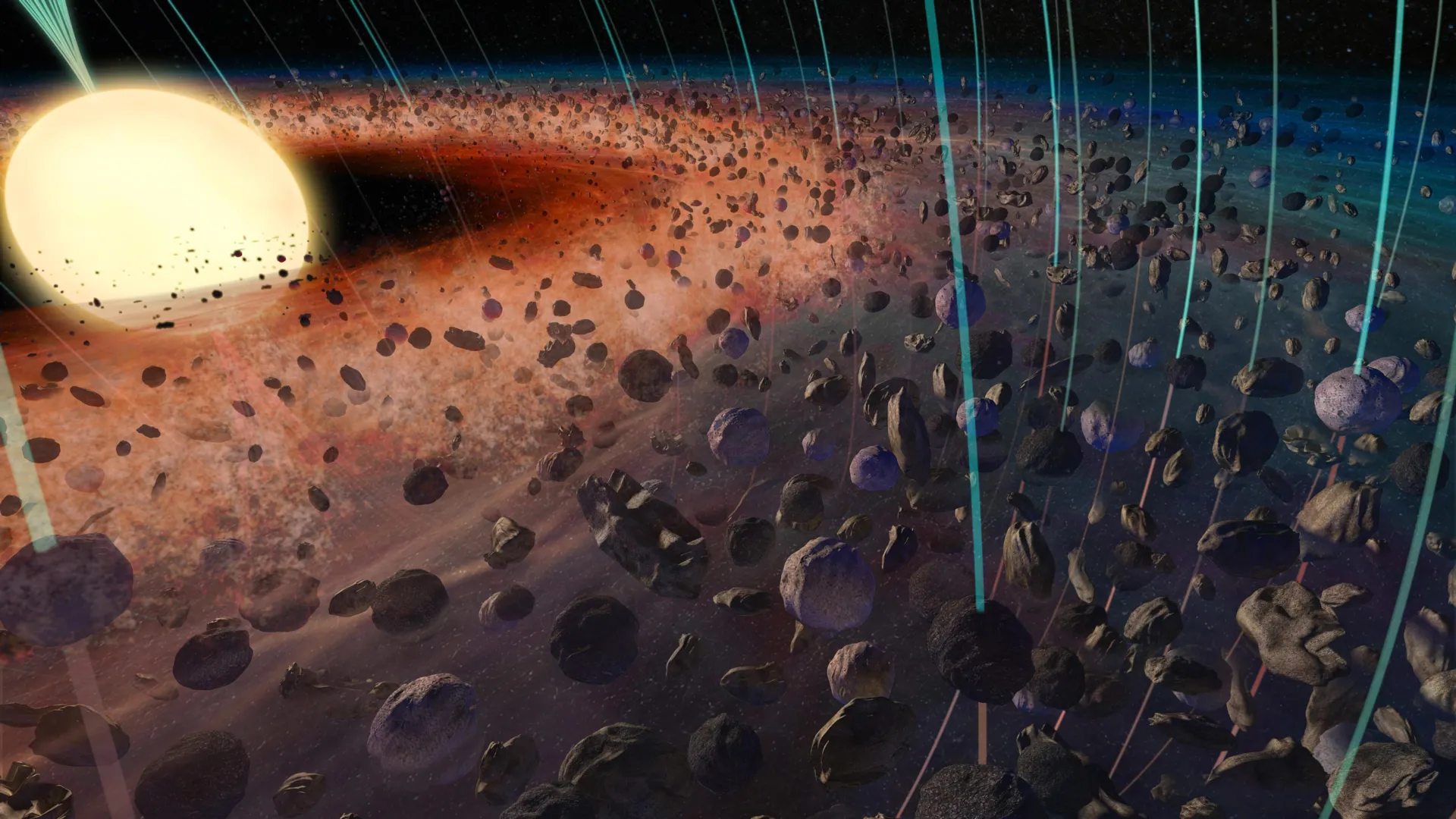
About 4.6 billion years ago, the solar system began as an enormous cloud of gas and dust. Over the next several million years, this “solar nebula” changed dramatically. The cloud collapsed and flattened into a disk, eventually giving rise to the sun at its center and the planets that formed around it.
Gravity has long been considered the main force behind this transformation. New research from MIT, however, suggests that magnetism may also have been an important part of the process.
Scientists found evidence of ancient magnetic fields preserved in some of the oldest meteorite material ever identified. The researchers studied microscopic grains inside a meteorite discovered in Antarctica in 2008. Known as calcium-aluminum-rich inclusions, or CAIs, these grains formed during the solar system’s first 200,000 years and represent the oldest known material from that period.
Their magnetic signatures indicate that a substantial magnetic field was already present during the solar nebula stage. The researchers estimate that this field was stronger than Earth’s magnetic field today and may have helped move primordial material inward as the young sun formed.
“This transition, from a spherical cloud to a protoplanetary disk, is one of the most significant events in all of solar system history,” says Benjamin Weiss, the Robert R. Shrock Professor of Earth and Planetary Sciences at MIT. “It has long been theorized that gravity caused this, but our measurements show magnetism likely played a role.”
The findings were reported in the Proceedings of the National Academy of Sciences. Along with Weiss, the study’s MIT co-authors are first author Cauê Borlina PhD ’22, Elias Mansbach PhD ’24, and Nilanjan Chatterjee. Other collaborators include Xue-Ning Bai of Tsinghua University, Po-Yen Tung and Richard Harrison of Cambridge University, François Tissot of Caltech, and Kevin McKeegan of the University of California at Los Angeles.
How Early Solar Magnetism Could Have Worked
Magnetic fields arise when electrically charged matter moves. During the earliest stage of solar system formation, the collapsing cloud of gas and dust may have generated a plasma containing charged particles. As those particles circulated through the developing disk, they could have created and maintained a magnetic field.
If a magnetic field was present, Weiss and his colleagues reasoned, it should have left a lasting imprint on some of the material forming within the disk. As that material condensed, tiny magnetic minerals could have recorded the strength of the surrounding field. If those minerals survived for billions of years and eventually reached Earth, their “remanent magnetization” could provide evidence that magnetism existed in the young solar system and influenced its development.
The researchers had already found evidence of magnetism from about 2 million years after the solar system began forming. By that point, scientists believe the sun had already formed and the planets were beginning to assemble. That earlier work suggested magnetic fields may have contributed to planet formation.
“Nowadays people don’t debate whether magnetism is present when planets are forming. But the debate is around the very early solar system, before planets are forming, when there’s just a disk,” says Borlina, who led the new study as an MIT graduate student and is now an assistant professor at Purdue University. “That’s where the debate still resides, and that’s where we’re operating now.”
A Meteorite With an Unusually Pristine Record
The latest study pushed the search even farther back in time, focusing on whether magnetism was present while the sun itself was still coming together.
The researchers examined samples from DOM 08006, a meteorite found in 2008 in Dominion Range, a mountain range along the East Antarctic Ice Sheet. Since its discovery, the meteorite has been studied extensively because of its unusually primitive composition.
DOM 08006 contains mineral grains from the earliest stages of solar system formation, possibly dating to before the sun had fully formed. Remarkably, the meteorite has retained much of its original mineral makeup despite surviving billions of years of solar system history.
“Other meteorites went through many different processes over this 4.5 billion year history,” Weiss says. “They were formed in the solar nebula, then added to bodies with water, then got destroyed, moved to the asteroid belt, and then landed here. But somehow, DOM has experienced less alteration than any other meteorite.”
That unusual preservation made DOM 08006 an especially promising place to search for evidence of magnetic fields from the earliest solar system.
If such a field existed, its signature might still be preserved in some of the meteorite’s CAIs.
“We know they are the oldest things we have of the early solar system,” Borlina says. “But CAI’s are very complex and are not all the same, even within a 1-millimeter piece of the meteorite. So we have to carefully identify what types they are.”
A Magnetic Field Stronger Than Earth’s
Using small pieces of the original meteorite, the team separated tiny mineral grains and identified several CAIs containing naturally magnetic minerals, including iron. The researchers then carried out a series of tests to determine whether those grains still preserved ancient magnetism.
They found traces of a magnetic field recorded inside the minerals. From those measurements, the team estimates that the early solar system had a magnetic field measuring roughly 150 to 600 microteslas. That is about three to 12 times stronger than Earth’s magnetic field today.
The result suggests that magnetism may have played a meaningful role in controlling how material moved through the protoplanetary disk as the sun was forming.
“We think these kinds of magnetic fields were helping to move gas from the protoplanetary disk, in toward this central star, the sun,” Borlina says. “Gravity is also playing a role. But we are now showing that, if you want to fully understand how the sun and planets formed, you should include magnetic fields in the ingredients that make them.”
This research was supported, in part, by NASA.
