


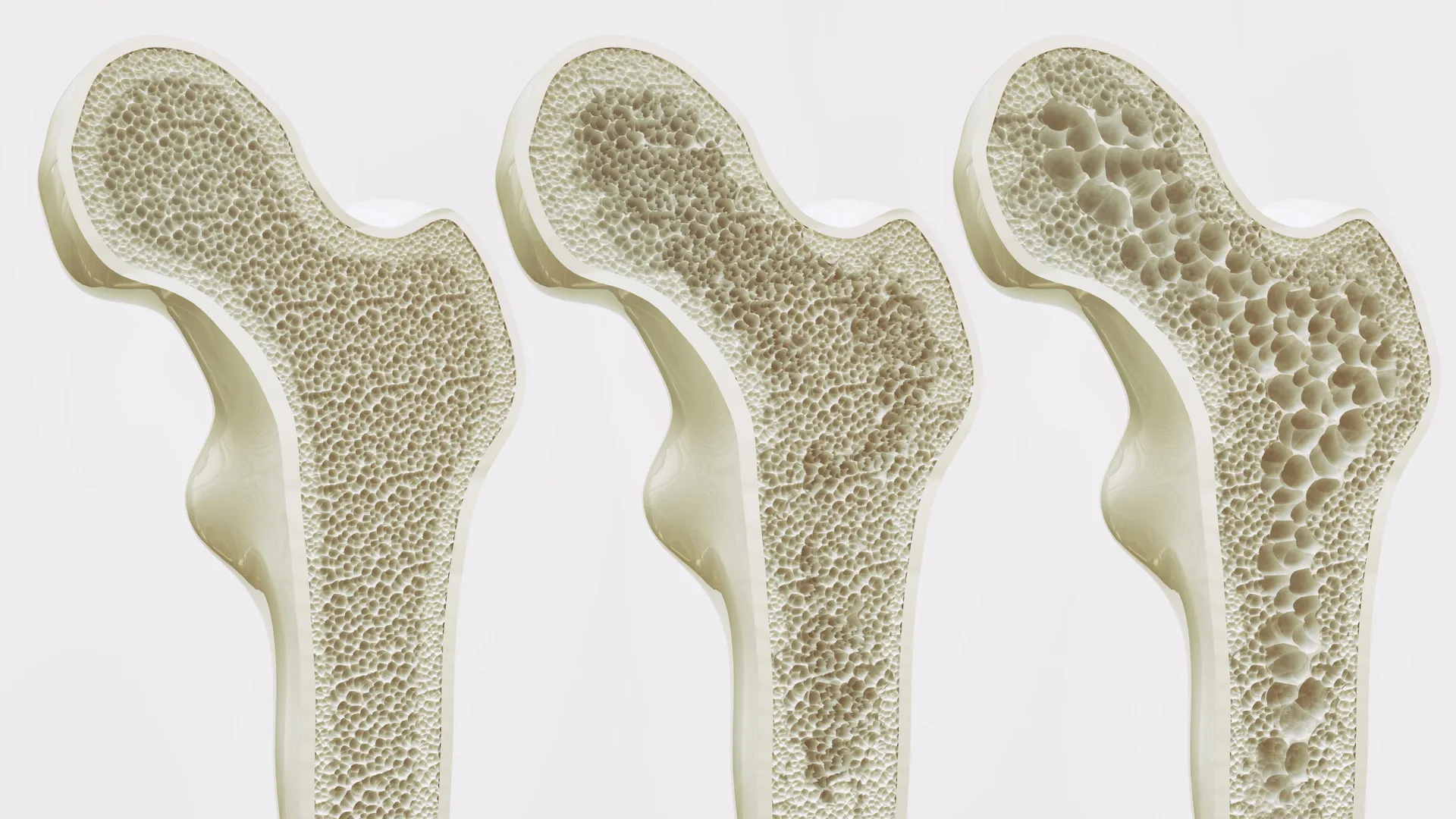
Weakening bones may reveal more about brain health than previously understood. A new study from Johns Hopkins University found that people with lower bone density in their spine experienced faster cognitive decline and more rapid deterioration of the brain’s white matter as they aged.
The findings, published in Radiology, a journal of the Radiological Society of North America (RSNA), suggest that bone health and brain aging may be more closely connected than scientists once realized.
Bone mineral density reflects how much mineral material, including calcium, is present in a given volume of bone. Lower density makes bones more fragile and increases the likelihood of fractures. Although the effects of bone loss on skeletal health are well established, scientists have conducted relatively little research into how declining bone density might relate to changes in the brain.
Using AI to Investigate Bone Density and Brain Health
To explore this connection, a research team led by Sara Momtazmanesh, M.D., a postdoctoral research fellow in the Department of Radiology and Radiological Sciences at Johns Hopkins University in Baltimore, Maryland, examined existing data from the Multi-Ethnic Study of Atherosclerosis (MESA). The analysis included information from participants who had undergone chest CT scans without contrast dye, multiple types of brain MRI examinations, and tests measuring cognitive performance.
The researchers applied a deep learning algorithm developed in the laboratory of Shadpour Demehri, M.D., a Johns Hopkins professor of radiology. The AI system analyzed non-contrast chest CT images from 2,086 MESA participants to determine their initial thoracic vertebral volumetric bone mineral density (vBMD), a measurement of bone density in the spine.
Of those participants, 715 had the required bone density measurements along with brain MRI results and cognitive testing, making them eligible for the final study group.
The researchers examined the MRI scans for two indicators of changes in the brain’s white matter. The first was white matter hyperintensities, areas of abnormal tissue that appear unusually bright on certain MRI images. The second was reduced fractional anisotropy, a measurement that can indicate deterioration in the microscopic organization of white matter. Both types of changes have been associated with cognitive decline and a greater risk of dementia.
Follow-up imaging data were available for 408 participants for white matter hyperintensities and 405 participants for fractional anisotropy, allowing researchers to examine how these brain changes progressed over time.
Lower Bone Density Linked to Faster Cognitive Decline
The analysis revealed a notable pattern: participants with lower spinal bone density at the beginning of the study tended to experience a faster decline in overall cognitive performance.
The researchers also identified changes in specific brain regions that are important for thinking and memory. Lower bone density was associated with greater accumulation of white matter hyperintensities in the corpus callosum, a structure that supports executive function, working memory, and attention.
Another connection emerged in the anterior limb of the internal capsule, a brain region involved in executive function. Participants with lower bone density showed a more pronounced decline in fractional anisotropy in this area, suggesting worsening white matter integrity.
“This study is the first longitudinal secondary analysis linking baseline vertebral bone mineral density to changes in white matter structure, white matter hyperintensity progression and cognition,” Dr. Demehri said. “This comprehensive study using both imaging and clinical assessments sends a clear signal that bone density at baseline is associated with both functional and imaging measures of age-related brain degeneration.”
Does Bone Loss Cause Dementia?
Despite the connection between weaker bones and declining brain health, the researchers emphasized that their findings do not establish that osteoporosis causes dementia.
Instead, bone deterioration and brain degeneration may be consequences of some of the same biological changes that occur with aging.
“This study is not about cause and effect, but rather the observation of a metabolic syndrome that may cause both bone and brain degeneration,” Dr. Demehri said. “The co-occurrence observed in the study may reflect shared metabolic drivers of aging, including insulin resistance, dyslipidemia, and menopausal change, rather than a direct bone-to-brain effect.”
These findings raise the possibility that identifying people with reduced bone density could also help recognize those at greater risk of neurological decline. Earlier identification might create opportunities for additional screening and better management of risk factors that affect both skeletal and brain health.
Routine CT Scans Could Reveal Hidden Signs of Brain Aging
One potentially valuable implication of the research is that doctors may be able to obtain useful information about bone density from CT scans that patients have already received for unrelated medical reasons.
“Chest CT is done for lung cancer screening, calcium scoring, nodule follow-up, and many other indications,” Dr. Momtazmanesh said. “These scans could provide an opportunistic measurement of bone density from the thoracic spine that is associated with a loss of cognitive function.”
By using AI to analyze existing medical images, researchers may be able to identify patterns of age-related disease that would otherwise go unnoticed. This approach could also help scientists investigate why conditions affecting different parts of the body often develop together.
Dr. Demehri concurred: “Diagnostic images contain an immense amount of data that AI can now synthesize at scale across multiple organ systems. This creates a robust, newly feasible opportunity to interconnect co-existing age-related pathologies that have traditionally been studied in isolation and to identify shared biological pathways and potential common causal mechanisms.”
The study highlights a potentially important connection between bone health and cognitive function, while also demonstrating how AI could make routine medical imaging more informative. Although further research is needed to understand the biological mechanisms involved, the findings suggest that measurements taken from the spine may provide valuable clues about changes occurring in the aging brain.
The study, “Deep Learning-derived Bone Mineral Density and Longitudinal White Matter Microstructure and Cognitive Decline: Multi-Ethnic Study of Atherosclerosis,” also included Quincy A. Hathaway, M.D., Ph.D., Michael P. Bancks, Ph.D., M.P.H., David A. Bluemke, M.D., M.S.B., Ph.D., R. Graham Barr, M.D., Dr.P.H., Wendy S. Post, M.D., M.S., Mohamad Habes, Ph.D., Ilya Nasrallah, M.D., Ph.D., Susan R. Heckbert, M.D., Ph.D., R. Nick Bryan, M.D., Ph.D., Jose A. Luchsinger, M.D., M.P.H., Mei Wan, Ph.D., Matthew Budoff, M.D., João A. C. Lima, M.D., M.B.A., Timothy M. Hughes, Ph.D., M.P.H., and Christos Davatzikos, Ph.D., who collaborated with Drs. Demehri and Momtazmanesh.
