


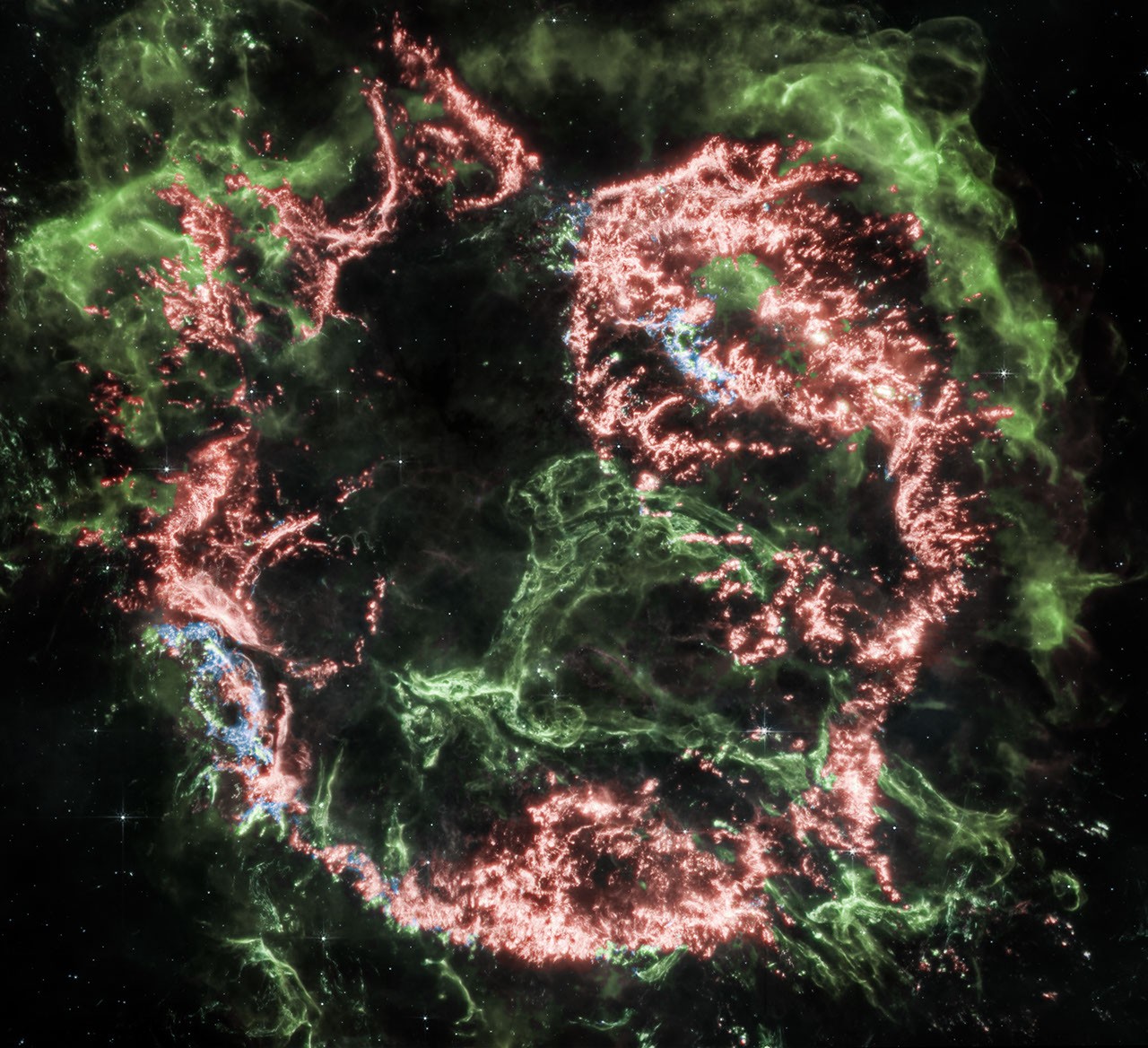
NASA’s James Webb Space Telescope has painted a vibrant tapestry of the legendary supernova remnant Cassiopeia A (Cas A). Remnants like these are the clouds of gas and dust that remain following the explosion of a massive star and will eventually seed a new generation of stars and planets.
This high-resolution, mid-infrared observation from Webb reveals new details that are helping astronomers chronicle the structure and evolution of Cas A’s original star. The Webb data supports a scenario in which the interior of the star underwent a dramatic change, possibly just hours before its demise. These results published Monday in The Astrophysical Journal Letters.
NASA’s James Webb Space Telescope reveals the hot dust that makes up Cassiopeia A. The composition of its dust provides clues to the structure of Cassiopeia A’s original star.
Image: NASA, ESA, CSA, STScI, Tea Temim (Columbia University), Rick Arendt (UMBC), Dan Milisavljevic (Purdue University); Image Processing: Joseph DePasquale (STScI)
Stars begin their lives as large clouds of mostly hydrogen gas and cosmic dust called molecular clouds. Eventually, gravity causes these molecular clouds to collapse, the material heats up, and protostars — infant stars — form. Under the constant pressure of gravity, hydrogen within a protostar begins to fuse into helium, which marks the point where protostars evolve into full-fledged stars like our Sun.
As hydrogen in the core runs out, the core contracts and heats until helium begins to fuse into heavier elements. This process repeats as stars like Cas A’s original star evolve, with increasingly heavier elements fusing in the core (eventually stopping at iron) and lighter elements fusing in surrounding layers. This leads to multiple shells of elements that provide a record of a star’s evolutionary history. When a star goes supernova, these elements are scattered into the surrounding space, where some of them condense to form dust grains, which can clump together. By studying and mapping the composition of these individual, solar-system-sized dust clumps in Cas A, Webb found evidence of a shell merger, a process in which the layers inside a star mix before the explosion.
“Material within these shells churns and circulates, which can cause the shells to merge shortly before the supernova explosion,” said Tea Temim, lead author of the study and research scientist from Columbia University in New York. “So, for example, the oxygen- and carbon-burning shells in a star merge together and change the structure of the star significantly. And that would then change the chemical abundances that you would see after a supernova explosion in the ejecta of a supernova remnant.”
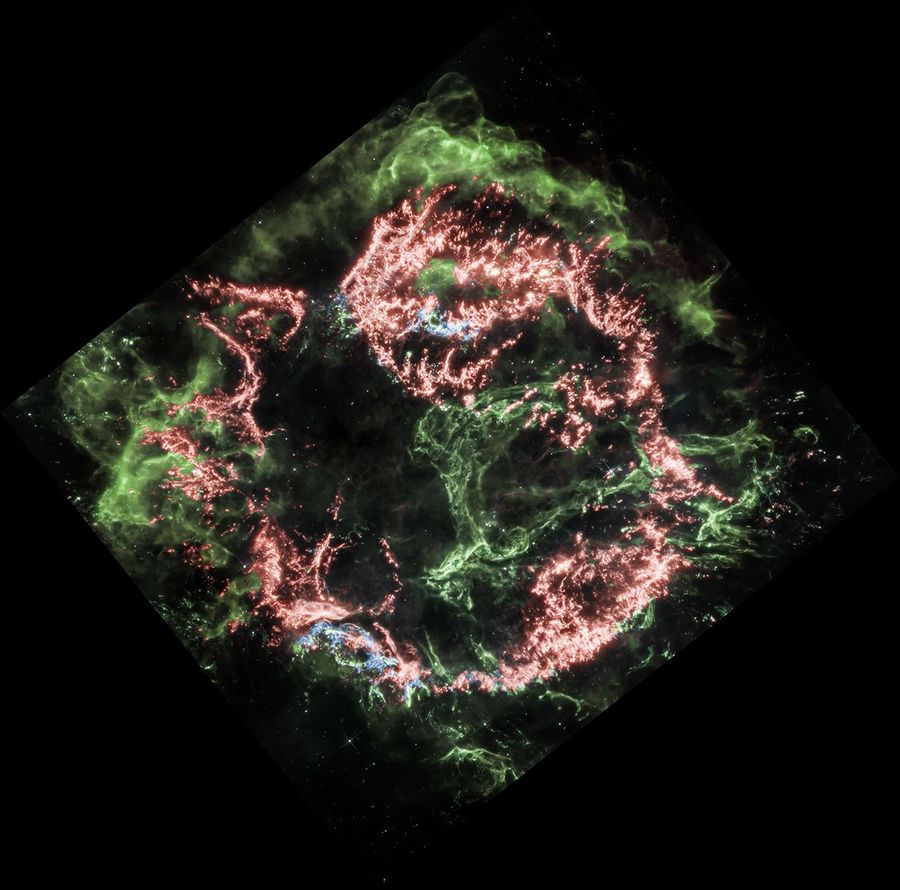
NASA’s James Webb Space Telescope reveals the hot dust that makes up Cassiopeia A. The composition of its dust provides clues to the structure of Cassiopeia A’s original star.
Image: NASA, ESA, CSA, STScI, Tea Temim (Columbia University), Rick Arendt (UMBC), Dan Milisavljevic (Purdue University); Image Processing: Joseph DePasquale (STScI)
For the researchers to know where to look with Webb, they also leveraged data from NASA’s retired Spitzer Space Telescope. Although it couldn’t resolve the minute details of the region during its observation, Spitzer identified three specific regions to observe with Webb’s keen eye.
Two of the targets were inside Cas A’s reverse-shocked region, where an inward-moving shock wave collides with debris thrown outward by the supernova. Webb observed that the ejecta in one of the two contained mostly silica dust, while the other was dominated by carbon dust. The third target was the “Green Monster,” a structure first discovered by Webb, which was found to be rich in complex magnesium silicates. Unlike the other two regions, the Green Monster originated from material the star shed before it exploded, rather than from the supernova’s ejecta.
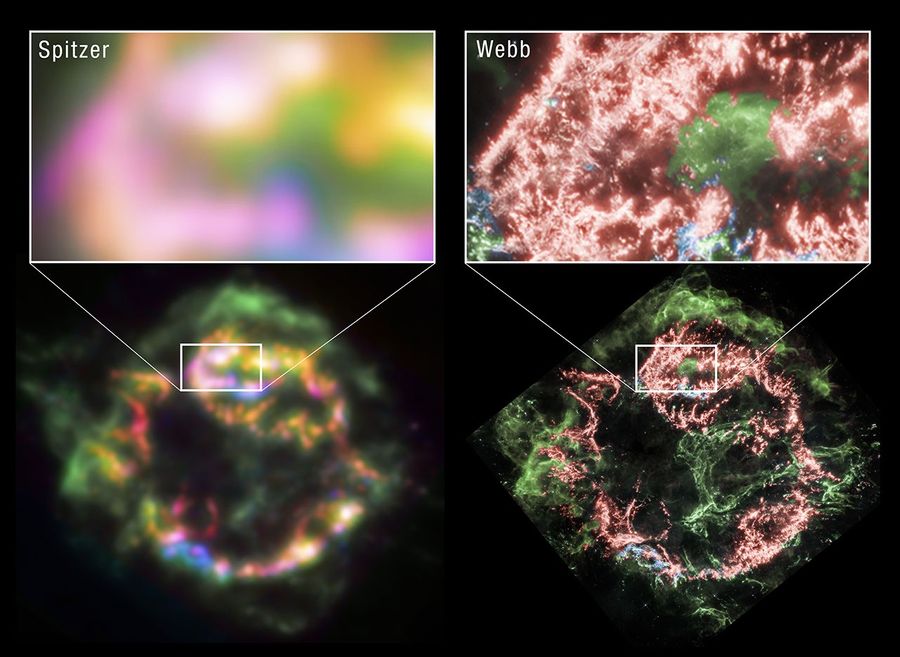
NASA’s retired Spitzer Space Telescope observed the supernova remnant Cassiopeia A, helping to identify key regions that NASA’s James Webb Space Telescope later examined. Webb’s higher resolution provides finer details into the chemistry of the remnant’s dust.
Image: NASA, ESA, CSA, STScI, Tea Temim (Columbia University), Rick Arendt (UMBC), Dan Milisavljevic (Purdue University); Image Processing: Joseph DePasquale (STScI), Alyssa Pagan (STScI)
Building on the X-ray observations of NASA’s Chandra X-ray Observatory and the JAXA-led XRISM, Webb mapped the dust composition of Cas A across the entire remnant, providing crucial insight into the shell merger phenomenon. Together, these observations indicate that the merger was underway very shortly before the supernova explosion.
“With Webb, the vast improvement in being able to resolve at the individual clump level helps us do more sophisticated dust chemistry,” said Dan Milisavljevic, associate professor and co-author of the study from Purdue University in West Lafayette, Indiana. “As a result, we can tie the explosion back to the makeup of the progenitor star hundreds of years afterward. It’s telling us about what was happening, we think, in the hours leading up to core collapse. Understanding this process is essential to explaining which elements the supernova explosion will release into the galaxy and how those elements enrich future generations of stars and planets.”
The dust map from Webb also reveals that the merger signatures are present throughout much of the supernova remnant. These efforts provide a new method for other astronomers who want to infer characteristics about an originating star’s structure by using the dust of a supernova remnant.
The James Webb Space Telescope is the largest and most powerful observatory ever sent to space, serving thousands of astronomers worldwide. Webb is solving mysteries in our solar system, looking beyond to distant worlds around other stars, and probing the mysterious structures and origins of our universe and our place in it. Webb is an international program led by NASA with its partners, ESA (European Space Agency) and CSA (Canadian Space Agency).
To learn more about Webb, visit:
The following sections contain links to download this article’s images and videos in all available resolutions followed by related information links, media contacts, and if available, research paper and Spanish translation links.
