


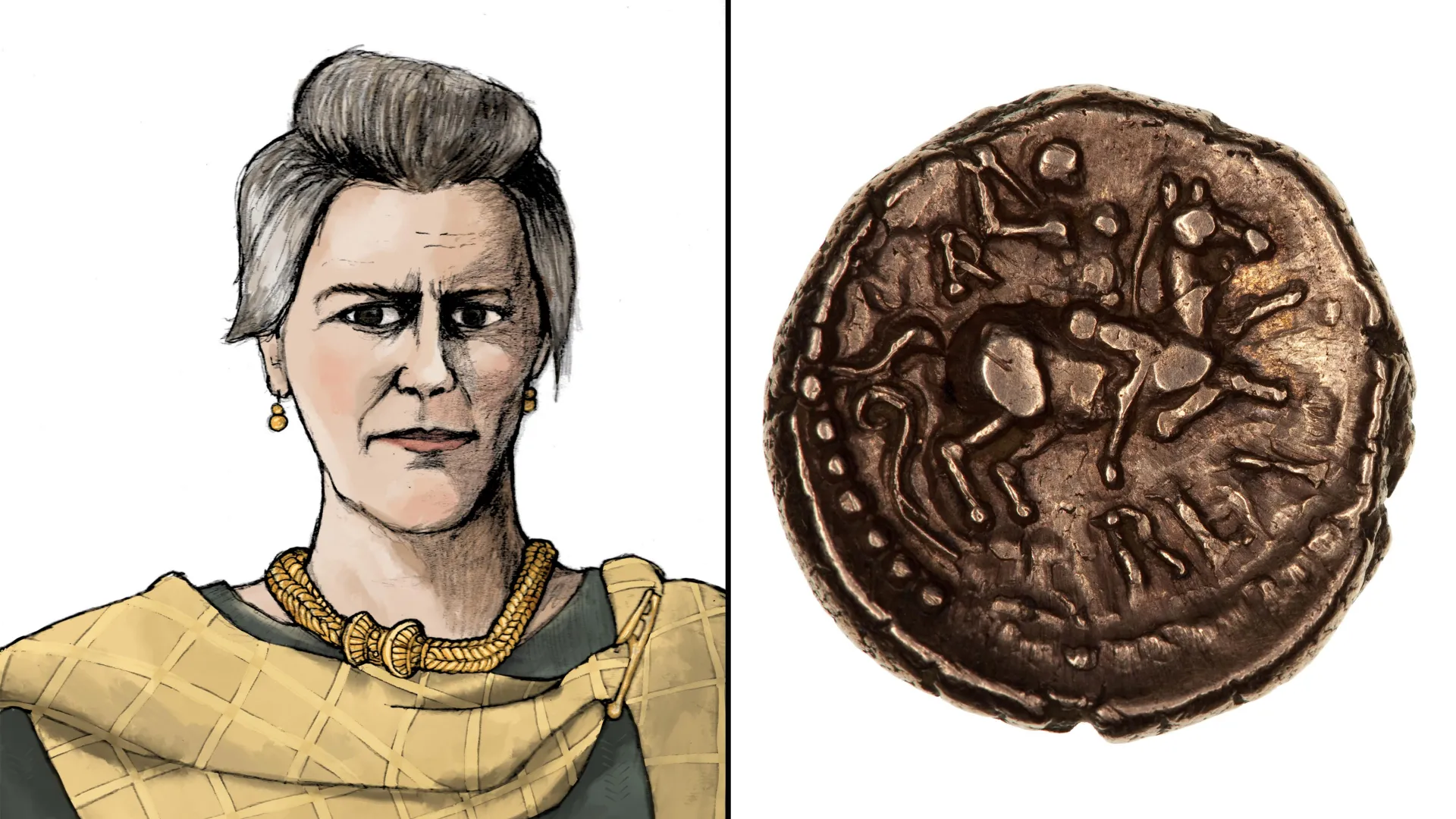
New archaeological research from Bournemouth University (BU) suggests that an influential Iron Age British ruler, long believed to have been a man, was actually a woman. The ruler, known as Verica, played a pivotal role in events leading to the Roman invasion of Britain in AD 43. The findings challenge longstanding assumptions about early British history and the political influence of women during this period.
Verica ruled the Atrebates, a powerful tribe whose lands extended across much of what is now Hampshire and West Sussex. Around AD 40, Verica was forced from power and escaped to Rome, where the exiled ruler sought assistance from Emperor Claudius.
The Roman historian Cassius Dio claimed that Verica’s appeal was the reason Claudius decided to invade Britain. If this account is accurate, Verica’s actions may have helped set in motion one of the most consequential events in British history.
Ancient Evidence Challenges an Iron Age King’s Identity
Dr. Miles Russell, Director of Archaeological Fieldwork at Bournemouth University, led the research and argues that earlier historians incorrectly identified Verica as male.
“Verica is assumed to have been male because of the patriarchal mindset of 19th-century classical historians. Verica was not only critical to the special relationship between Britain and Rome in the early first century AD but was indisputably female.”
Russell points to several pieces of evidence supporting this interpretation. One is the name Verica itself, which ends in the letter “a,” a feature common among female names of the time. Other prominent examples include Cartimandua, who ruled the Brigantes (in Yorkshire), and Boudica, leader of the Iceni (in Norfolk).
All three rulers lived during roughly the same period. Boudica is the best known because of her rebellion against Roman rule in AD 60. However, Russell argues that Verica may have held even greater political power and influence.
Another important clue comes from coins issued under Verica’s rule. These coins bear the Latin title “rex,” traditionally translated as “king,” which has contributed to the assumption that Verica was male. Russell explains that the title was not necessarily restricted to men.
“People also assume she was a ‘he’ because of the term ‘rex’ on coins, but rex is a non-gender-specific title; both male and female kings were recognized by Rome, Cleopatra of Egypt being the most famous.”
He continued: “The use of the Latin title rex on coins shows that Verica ruled with the full authorization of the emperor.”
The artwork on Verica’s coins provides another intriguing clue. Rather than depicting the masculine warriors commonly featured on coins produced by other British Iron Age rulers, Verica’s coins show a figure with distinctly feminine characteristics.
“Whilst other coin-producing British Iron Age leaders portray obviously male warriors, Verica is depicted as a slender, feminine, bare-breasted figure riding on horseback.”
The Forgotten Ruler Behind Rome’s Invasion of Britain
Russell believes Verica’s importance extended far beyond the ruler’s identity. He argues that Verica may have been instrumental in helping Claudius successfully invade Britain.
Ancient Roman writers frequently portrayed Claudius as an ineffective emperor who was easily influenced by women and formerly enslaved people who had gained their freedom. This reputation may have shaped how historians described Verica’s role in persuading him to invade.
Russell suggests that Cassius Dio’s account reinforced this negative portrayal by presenting the invasion as a decision made under the influence of a woman. In reality, he argues, Verica may have been a valuable political and military ally who supplied the Romans with intelligence and practical assistance.
“The story of Claudius committing to something only because a woman told him to fits the trope of this emperor as being submissive and henpecked. In effect, Dio was saying that the campaign was undertaken solely because of the whisperings of a barbarian femme fatale. Verica’s role was rather more central to the British expedition. Having her on board ensured the project was a success, as she provided tactical information and support on the ground.
“The invasion was Claudius’ great triumph — it being the only chance he had to prove he was a successful military leader. Verica provided the excuse for regime change, and the emperor seized it.”
For Claudius, the conquest of Britain offered an opportunity to establish his reputation as a successful military commander. Verica’s removal from power gave him a political justification for intervening, while the exiled ruler’s knowledge of Britain may have helped the Roman forces achieve their objectives.
Could Rome’s Conquest of Britain Have Been Avoided?
Although Verica was an important political figure in late Iron Age Britain, the ruler’s influence has received relatively little attention compared with that of other prominent leaders.
Russell believes the archaeological evidence supports recognizing Verica as one of Britain’s earliest and most significant female rulers. He also raises the possibility that the Roman invasion might never have occurred without Verica’s exile and subsequent appeal to Claudius.
“We should take the archaeological evidence at face value” says Russell “and remember Verica as a female-king and one of the earliest and most important of British female leaders. Had she not been deposed, fleeing to Claudius for military support, Rome may never have invaded Britain in the first place.”
New Insights Into Women in Iron Age Britain
The findings build on earlier Bournemouth University research exploring the position of women in ancient British society.
Last year, a study involving Russell and other BU researchers uncovered evidence of a matriarchal society in Iron Age Britain. The research indicated that husbands moved into their wives’ communities after marriage, suggesting that women occupied a central position in the social structure.
Together, these discoveries are prompting researchers to reconsider the influence women may have exercised in Iron Age Britain, both within their communities and in the political decisions that shaped the region’s future.
Russell’s research on Verica is presented in the new book Caratacus: Great king of Britain, published by Bloomsbury in January (ISBN 9781350477902). The findings are also discussed in the latest edition of Current Archaeology.
