


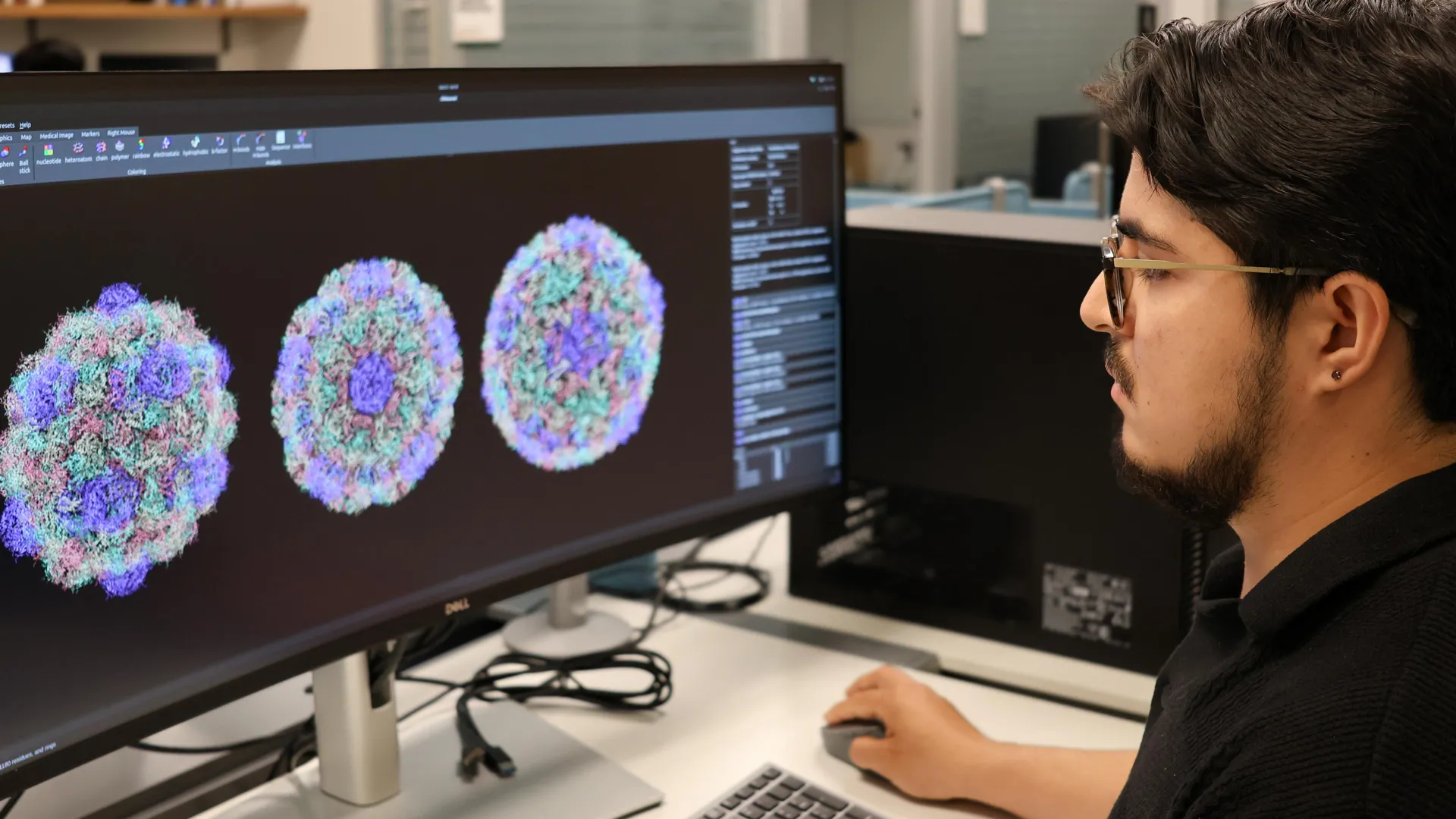
Researchers at the University of Miami have discovered a previously unknown group of viruses that could help explain a missing piece of evolutionary history. The finding reveals an unexpected connection between viruses and tiny protein compartments inside cells, offering new clues about how some of life’s earliest biological structures may have developed.
The research, published in Nature Communications, challenges the conventional explanation for the origins of cellular structures known as encapsulins. Scientists previously believed these compartments evolved from viruses. However, the new evidence suggests a more complicated evolutionary relationship in which viruses and encapsulins may have repeatedly evolved from one another over millions of years.
The discovery could have important implications for biotechnology and for understanding the origins and early evolution of life. It also raises the possibility that viruses have biological functions that scientists have largely overlooked.
Mysterious New Viruses Reveal an Evolutionary Connection
At the center of the discovery are proteins that fold into a distinctive three-dimensional structure known as the HK97-fold. These proteins can assemble into protective shells and are found in both viruses and encapsulins.
The newly identified viruses have smaller, simpler genomes than other viruses that produce HK97-fold protein shells. They also possess characteristics associated with both viruses and encapsulins, making them possible evolutionary intermediates between the two. Studying these unusual viruses could help researchers understand how increasingly complex biological systems first appeared.
“What makes the HK97-fold proteins so interesting is that they can form shells that enclose biochemical reactions in cellular lineages, archaea, and bacteria. But they also serve genetic purposes in viruses, storing and protecting their viral genome,” said Abelardo Aguilar, the study’s first author and a Ph.D. student in the Department of Biology at the University of Miami College of Arts and Sciences.
“These proteins build compartments with two different roles, which connects directly with the study of the origin of life and its early evolution because if you think about it, life at its core is about enclosing reactions and also enclosing information that can be inherited so those reactions can happen in the future.”
AI Helps Discover Hidden Viruses in Billions of DNA Sequences
To uncover these previously unknown viruses, Aguilar worked with Antoni Luque Santolaria, the study’s senior author and an associate professor in the Department of Biology. Luque also holds secondary appointments in the Department of Physics within the College of Arts and Sciences and the Department of Chemical, Environmental and Materials Engineering in the College of Engineering. The project brought together collaborators from multiple institutions.
Rather than relying on laboratory experiments to grow viruses, the team searched enormous genetic databases containing billions of DNA sequences. They combined bioinformatics, models of protein behavior, and artificial intelligence tools, including protein language models and AlphaFold, to investigate the structures encoded by these sequences.
The databases included IMG/M, a resource associated with the U.S. Department of Energy’s Joint Genome Institute and the University of California, Berkeley. Its genetic information comes from environmental samples collected around the world, including soil, seawater, wastewater, the human gut, and numerous other locations.
This approach allows scientists to investigate viruses that have never been successfully grown in a laboratory, greatly expanding the number of organisms and evolutionary relationships they can study.
“The majority of viruses cannot be grown in the lab. But now through sequencing, we have access to information on viruses for which we don’t know the host, that we can’t culture in the lab, but that are everywhere,” Luque explained. “That means there are multiple questions in relation to evolution and how viruses have adapted to the world that it’s now possible to explore bioinformatically.”
Viral Protein Shells May Have Unexpected Functions
Beyond identifying the new viruses, the researchers proposed a possible molecular explanation for how viruses and encapsulins could have evolved from one another.
Their model centers on procapsids, immature viral protein shells (capsids) that may provide a pathway between the two types of structures. These shells could potentially support both genetic functions, such as containing viral DNA, and metabolic functions involving chemical reactions.
This raises an intriguing possibility. Viral capsids are generally recognized for packaging and protecting genetic material, but certain forms might also help create environments where biochemical reactions can occur.
“One implication of this research is the possibility that viral capsids could also facilitate biochemical reactions, which would open up the potential roles that capsids have in environments as a whole,” Aguilar explained.
Although further research is needed to establish these potential functions, the findings suggest that scientists may need to look beyond the infectious stages of viruses to fully understand their roles in nature.
“When we’re looking at viruses, we tend to look only at the particles that are infective, and this study points out that we might need to start putting more emphasis on the non-infective versions of the virus and what other functions those viral-like particles may have that we have overlooked in the past.”
New AI Tools Open the Door to More Viral Discoveries
The research also demonstrates how artificial intelligence and computational biology are transforming the study of viruses. By combining powerful analytical tools with knowledge of protein structure and physical behavior, scientists can now investigate evolutionary questions that were previously difficult to explore.
Supported by the Gordon and Betty Moore Foundation and the U.S. National Science Foundation, the project provides a framework for studying other poorly understood viruses and their biological capabilities.
The researchers believe these methods could also be useful beyond evolutionary biology, including efforts to understand newly emerging viruses and pathogens.
“If you have the right question and you pair it with the right tools and physical insights, it gives researchers an opportunity to look at viruses in a way that we didn’t have an opportunity to do before,” Luque said. “There are evolution questions, but there are also questions about emerging pathogens or emerging viruses. The set of tools that we use can be moved forward in different contexts.”
