


- Plans to build a floating LNG storage facility off eastern Bali continue to attract opposition from affected communities on the Indonesian island.
- Civil society organizations have also criticized the planned development, pointing to tandem plans to develop vast solar energy capacity that have yet to be advanced.
- Local officials argue that higher demand for electricity necessitates building infrastructure to ensure reliable electricity, but campaigners say this will lock in greenhouse gas emissions in conflict with marketing efforts to portray the island as a green holiday destination.
DENPASAR, Indonesia — Customary leaders from Serangan village in Bali have renewed local opposition to a planned liquefied natural gas terminal off the east coast of the Indonesian island, saying the floating LNG site is too close to customary fishing grounds.
“We disagree with the 3.5-kilometer distance [2.2 miles] because the vessel is large, and very close to the village’s sacred point as well as our fishing routes,” said I Nyoman Gede Pariartha, the traditional leader in Serangan, at a meeting on Nov. 14.
Earlier this year Indonesia’s environment ministry issued an environmental permit for a Floating Storage and Regasification Unit (FSRU) off the eastern coast of Serangan island in Bali. The new infrastructure is intended to improve the reliability of Bali’s electricity supply by supplying gas-fired power plants amid rising electricity demand on the island.
Bali has a population of 4.5 million, but the island received almost 7 million tourism visits in 2025 and, since the pandemic, has increasingly been host to longer-term visitors.
Increasing electricity demand on the island is supplied by several power plants on Bali, including the gas-fired Pesanggaran power station, a 200 megawatt capacity facility next to a protected mangrove forest on the northern fringe of Benoa Bay.
In addition, up to 30% of the island’s electricity is supplied by cables from neighboring Java, the world’s most populous island.
The planned new FSRU site east of Bali will receive liquified natural gas offshore from tankers, and convert the fuel back into natural gas before supplying it through pipelines to Pesanggaran power station.
However, the new FSRU location has previously been moved from another site in Sidakarya village amid local opposition in an area with a history of grassroots resistance to large-scale development.
In 2013, a proposal backed by an oligarch to reclaim hundreds of hectares of the bay for luxury resorts, hotels and entertainment facilities met with opposition.
Artists, civil society, customary village leaders and students coalesced under a broad movement to protect Benoa Bay’s mangroves, marine ecosystems, livelihoods and sacred sites. The proposal was eventually shelved after years of campaigning.
Greenpeace action
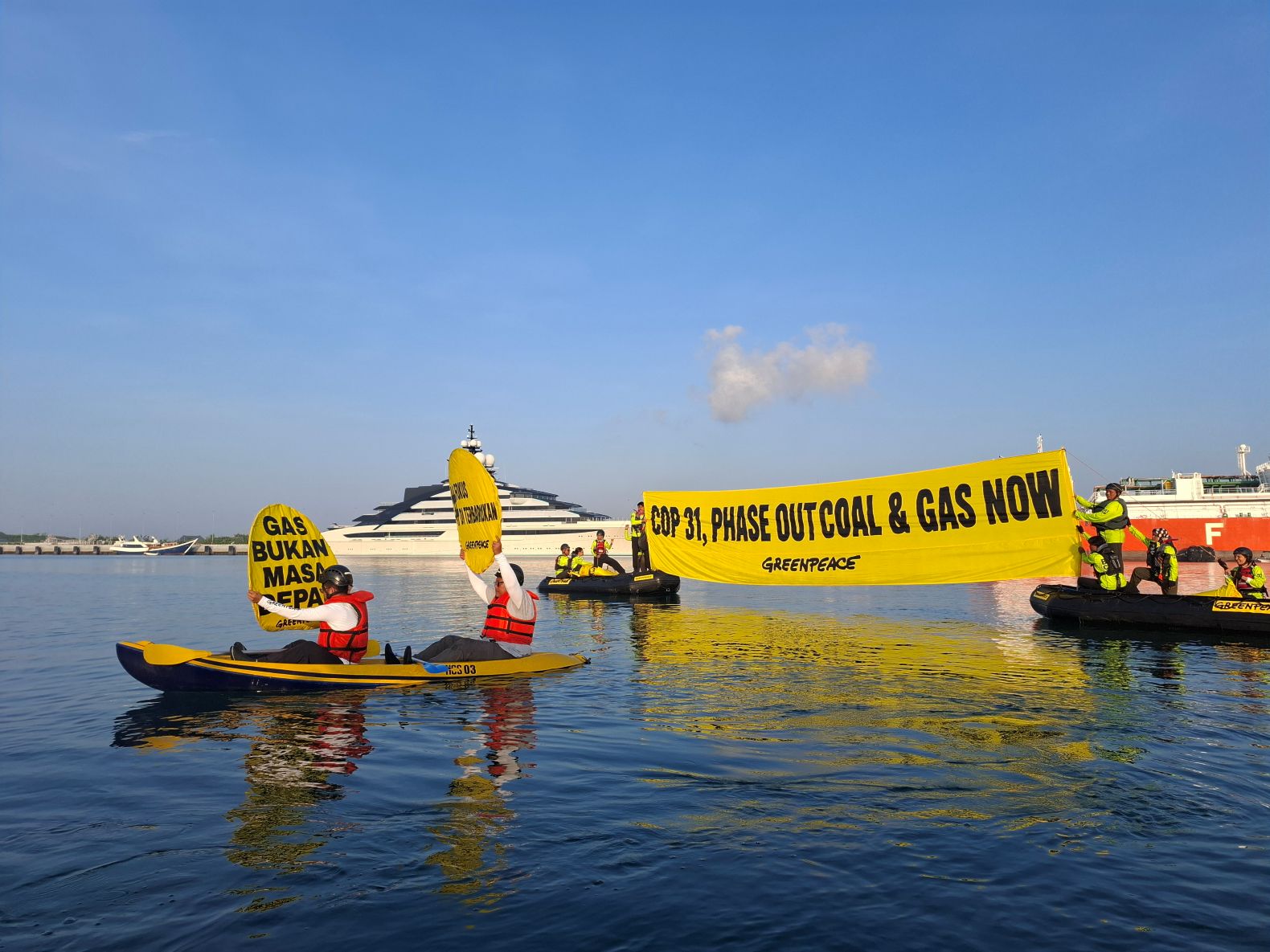
Greenpeace activists floated a banner in Benoa Bay in the shape of a sea turtle saying “No Fossil Gas in Paradise” ahead of COP31 in Turkey, which ended on Nov. 22 without a new agreement on fossil fuels to prevent breakdown of global climate.
“We are witnessing how the climate crisis is fueling disasters that are intensifying and worsening year after year,” said Iqbal Damanik, climate and energy manager at Greenpeace Indonesia. “All of these climate-related disasters are driven by the use of fossil fuels.”
“Adding LNG facilities in southern Bali will shrink fishing grounds, destroy mangrove ecosystems, and harm sea turtle habitats,” said Greenpeace Indonesia lead Yuyun Harmono. “Stop using fossil gas and shift focus immediately to renewables.”
Indonesia is struggling to overcome structural limitations to the energy transition due to a surplus of independent coal producers given lucrative take-or-pay contracts to supply the Java-Bali grid, which serves a majority of the population in the world’s fourth-largest country.
In effect, coal plants are paid to burn coal whether or not Indonesia’s national grid, PLN, buys the electricity.
The Institute Essential Services Reform, a think tank focused on energy, estimates total solar energy potential in Bali of up to 22 gigawatts, which is greater than the total installed capacity from all sources on Denmark’s national grid.
In 2025, Bali governor I Wayan Koster unveiled a new rooftop solar energy plan to help Bali achieve net zero emission by 2045, a target the governor announced in 2023. The government in Bali could not be reached for comment.
“Adding new fossil-fuel capacity will only prolong Indonesia’s entrapment in a fossil-fuel-dependent system and hinder the energy transition,” Yuyun said.
Banner image: A banner opposing the use of gas for power generation in Bali. Image by Luh De Suriyani/Mongabay Indonesia.
This story was first published here in Indonesian on Nov. 17, 2026.
Fossil fuel subsidies and high costs stall energy transition across rural Indonesia
US-Indonesia trade deal slammed as ‘extractive colonialism’ over mining, fossil fuels
