


If one form of energy becomes the cheapest, most secure and cleanest, you’d probably adjust your economy to use more of it, right?
That’s one of the ideas underpinning a report the International Energy Agency issued last week about the global move toward electrification. Fatih Birol, head of the IEA, discussed some of the concepts from the report the following day at the United Nations.
“Many, many years in the energy world, we had three choices in front of us. Shall I choose the most secure energy option? Shall I choose the most economic energy option? Or shall I choose the cleanest energy option?” he asked. “We have to make choices, we have to make trade-offs but when we look at the world today, for the first time in years, all of these three objectives are getting aligned.”
Birol’s referring to the “energy trilemma,” a concept in energy and economics research about the need to balance cost, security and environmental impact of sources and systems. He said those priorities are increasingly aligning in part because of the Iran war, which has driven up fuel prices and exacerbated concerns about energy security.
It’s notable that the leader of the world’s leading energy research organization is so optimistic about electrification. I reached out to energy researchers this week to get their reaction.
But first, some numbers:
With $100 worth of gasoline, an internal-combustion-engine car would go 862 miles; with $100 worth of electricity, an electric vehicle would go 2,310 miles—nearly a threefold advantage for the EV.
For home heating, $100 would buy enough fuel for a gas boiler to provide 30 days of heating; it would also fund enough electricity for a heat pump to provide 42 days of heating—a 40 percent edge for the heat pump.
The figures are 2025 global averages from the IEA report, and the gaps are probably larger today with gasoline and natural gas experiencing price spikes that exceed rising electricity costs.
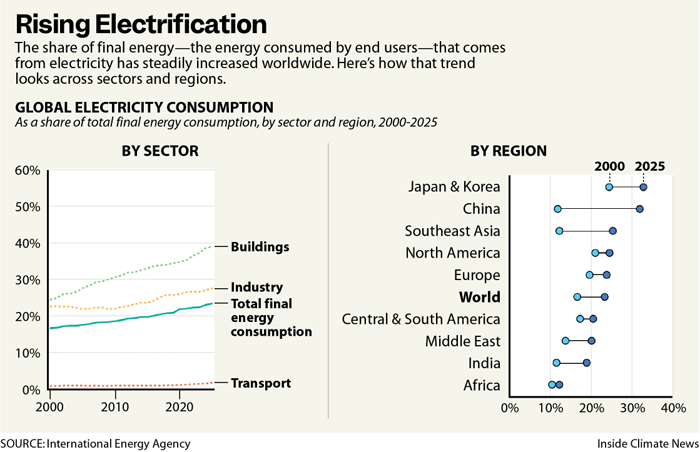
Global electrification trends also tell the story. The world used 16.7 percent of its final energy—meaning the energy consumed by the end user—from electricity in 2000, and that share rose to 23.4 percent in 2025, according to the IEA.
China has had the largest change, and North America was among the smallest in that period, a difference largely attributable to levels of renewable energy use and EV adoption.
But this doesn’t mean electrification is inevitable, according to energy-systems researchers.
“I see today’s energy system more as a Rorschach test,” said David Victor, a professor of innovation and public policy at the University of California, San Diego.
By that, he means different people see different things. He acknowledged it’s possible to view the trilemma as becoming aligned, but he still sees many obstacles.
For example, he doesn’t expect to see a rapid shift to electrification for heavy trucks, maritime transport and aircraft. He also thinks trade barriers may hinder electrification, with countries seeing benefits of producing goods at home rather than relying on imports such as Chinese solar panels.
“The tradeoffs are inescapable,” he said.
This story is funded by readers like you.
Our nonprofit newsroom provides award-winning climate coverage free of charge and advertising. We rely on donations from readers like you to keep going. Please donate now to support our work.
Some of the tradeoffs are political, with elected officials and entrenched industries seeking to slow electrification, said Emily Grubert, an energy systems researcher at the University of Notre Dame.
“I think [Birol is] basically correct, but the reason we’re not seeing transition happening rapidly and naturally is that the ‘we’ he’s referring to is not the ‘we’ that actually makes the decisions,” she said in an email.
Instead, some decision-makers are prioritizing the profits of certain industries, which often means favoring fuels such as coal, natural gas and oil, and slowing the transition to cleaner sources.
Grubert could be describing many countries in which fossil fuel industries hold political sway, including the United States.
Kenneth Medlock III, senior director for the Center for Energy Studies at Rice University’s Baker Institute for Public Policy, said it’s vital to fully evaluate the costs and benefits of electrification.
“In truth, the lesson from the current moment is to diversify energy choice and the supply chains of specific energy types, but at the lowest possible cost,” he said.
Medlock thinks arguments in favor of electrification don’t account enough for the high upfront costs of building the systems. A good example is how wind and solar have low operating costs but are expensive to build. Fossil-fuel power plants also are expensive to build, but his larger point is that the advantages of any option come with disadvantages
Outside the wealthiest economies, the case for electrification is tougher to make, said Chuks Okereke, professor of global climate governance and public policy at the University of Bristol in the United Kingdom.
“Sometimes in the bid for optimism, we oversimplify and ignore important contexts,” he said.
Okereke was lead author of a paper published in June in the journal Energy Economics that shows how fossil fuels and highly polluting development make short-term economic sense in Nigeria compared to cleaner alternatives. One reason is the high upfront cost of infrastructure.
For the energy transition to be a net-positive for the Nigerian economy, the world’s wealthy countries and international organizations would need to provide assistance.
Birol closed his UN speech by discussing the goal of getting to 35 percent electrification of final energy by 2035. The goal was part of discussions of climate policymakers in June in Bonn, Germany, and will be on the agenda at COP31 in November in Antalya, Turkey.
If the target is agreed to at the climate change conference, it will “give a very strong and unmistakable signal” to the world about the path forward, he said.
Birol isn’t saying the world has solved the problems of the energy transition. He’s saying this immense challenge becomes a bit easier when some of the competing priorities begin to align more closely than they did before.
This matters because electrification and decarbonization go hand in hand. It means shifting nearly everything that runs on coal, oil and gas to electricity, while simultaneously transforming the grid to run on carbon-free sources. None of this will be easy.
Other stories about the energy transition to take note of this week:
Trump Slashes Fuel-Economy Standards: The Trump administration this week finalized the rollback of fuel-economy standards for cars and light trucks, a move that stands out among the administration’s actions for its harm to the environment and human health and for how it reduces the urgency for automakers to ramp up EV sales. The rule change means automakers will have a much easier time meeting federal fuel-economy standards, as my colleague Dennis Pillion reports.
U.S. Senate Reaches Agreement on Permitting Reform: Senate Democrats and Republicans have reached a deal on a bill that would make it easier for energy projects to obtain federal permits, as Nico Portuondo and Anthony Cruz report for Politico. The agreement is a step toward Congress passing a bill on the subject, which would involve changes to energy and environmental laws. If enacted, the legislation would be significant for all types of energy companies, but this has been a challenging legislative process and there remain many opportunities for the bill to stall.
Next-Generation Geothermal Plant Goes Online in Utah: Fervo Energy has said it’s now selling electricity to the grid from its Cape Station project in Utah, a geothermal power plant that uses advanced drilling methods and other new approaches to expand where this kind of system can be built. The plant’s opening is a major milestone, but now Fervo and its industry need to reduce costs if advanced geothermal is going to reach its potential, as Maria Gallucci reports for Canary Media. Geothermal power uses the earth’s heat to produce electricity.
Longi Breaks Another Record for Solar Panel Efficiency: Longi, the Chinese manufacturer, has produced a solar cell with an efficiency of 28.29 percent, a new record for this type of solar cell, as Emiliano Bellini reports for PV Magazine. This is the third time Longi has broken this record in 2026. A solar panel has many solar cells, and higher cell efficiency means that a solar array can produce more electricity with each panel.
A New Colorado Neighborhood May Offer Glimpse into the Future of Home Energy Use: A geothermal energy startup has equipped about 100 houses in a new development with ground-source heat pumps, showing one approach to shifting home heating away from fossil fuels, as my colleague Phil McKenna reports.
Inside Clean Energy is ICN’s weekly bulletin of news and analysis about the energy transition. Send news tips and questions to [email protected].
About This Story
Perhaps you noticed: This story, like all the news we publish, is free to read. That’s because Inside Climate News is a 501c3 nonprofit organization. We do not charge a subscription fee, lock our news behind a paywall, or clutter our website with ads. We make our news on climate and the environment freely available to you and anyone who wants it.
That’s not all. We also share our news for free with scores of other media organizations around the country. Many of them can’t afford to do environmental journalism of their own. We’ve built bureaus from coast to coast to report local stories, collaborate with local newsrooms and co-publish articles so that this vital work is shared as widely as possible.
Two of us launched ICN in 2007. Six years later we earned a Pulitzer Prize for National Reporting, and now we run the oldest and largest dedicated climate newsroom in the nation. We tell the story in all its complexity. We hold polluters accountable. We expose environmental injustice. We debunk misinformation. We scrutinize solutions and inspire action.
Donations from readers like you fund every aspect of what we do. If you don’t already, will you support our ongoing work, our reporting on the biggest crisis facing our planet, and help us reach even more readers in more places?
Please take a moment to make a tax-deductible donation. Every one of them makes a difference.
Thank you,

Reporter, Clean Energy
Dan Gearino covers the business and policy of renewable energy and utilities, often with an emphasis on the midwestern United States. He is the main author of ICN’s Inside Clean Energy newsletter. He came to ICN in 2018 after a nine-year tenure at The Columbus Dispatch, where he covered the business of energy. Before that, he covered politics and business in Iowa and in New Hampshire. He grew up in Warren County, Iowa, just south of Des Moines, and lives in Columbus, Ohio.
