


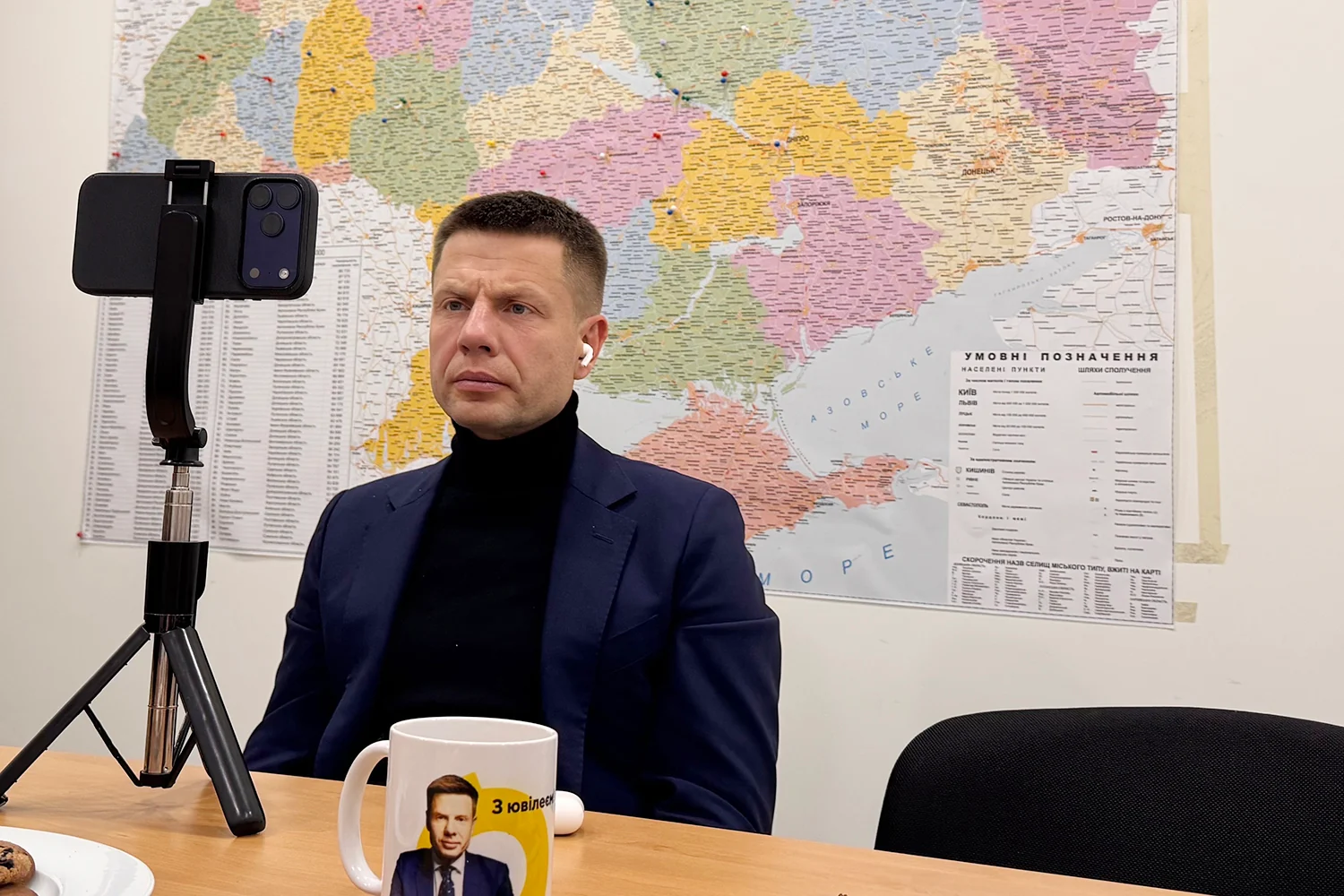
Ukrainian parliamentarian Oleksiy Goncharenko is deeply divisive in his country.
In October, he was expelled from his parliamentary faction over a statement advocating for peace negotiations, in which he wrote that Ukraine “cannot defeat Russia.” He proposed several possible compromises with Russia that are viewed as politically toxic in Ukraine, including legal protections for the Russian language. Critics slammed the plan as being based on a false premise that Russia is interested in anything less than Ukraine’s surrender.
Still, Goncharenko wields a measure of influence, thanks to his seat in parliament as well as the 1.43 million subscribers to his YouTube channel and his 200,000 subscribers on Telegram, the latter of which is particularly popular in Ukraine.
Goncharenko’s political message may also be increasingly attractive to some Ukrainians as they face yet another hard winter under Russian attack, an increasingly unstable economy, and social tension over the military draft, a topic on which he is also vocal. And the success of a recent cease-fire in the Ukrainian town of Oleshky looks a lot like what Goncharenko proposed as a potential model for negotiations.
Foreign Policy spoke to Goncharenko for a sit-down interview in Kyiv on Nov. 10—right as U.S.-mediated talks between Russia and Ukraine were taking place in Abu Dhabi, United Arab Emirates. He discussed his peace plan, the pushback that it received, and whether he thinks Ukrainians are ready to accept some compromises if it means ending the war.
This interview has been edited for clarity and length.
Foreign Policy: What do you think about U.S. President Donald Trump’s approach to peace negotiations?
Oleksiy Goncharenko: I think it’s the only one which exists. It’s difficult to criticize this or that because it is the only one. For the moment, there is no result. Nearly a month ago, I presented my peace plan. I think there are two problems. First is that we are trying to achieve a big deal, and now an even bigger deal. Now, they’re saying we are not speaking just about Ukraine; we’re speaking about the security architecture of Europe. So with time, it’s bigger and bigger and bigger.
But when you have such big things on the table, it’s quite hard to find any compromise solution. So my idea is, OK, if we can’t make a big deal now, a big and beautiful deal, let’s make a small, maybe not so beautiful, humble but realistic deal, like Oleshky, like the grain corridor.
And the second thing which is problematic is to have only one negotiator, which is the United States. With all respect, I want to see the United States at the table. But why can’t we have smaller negotiations on the Black Sea with Turkey and Egypt or India? Why is Brazil not involved? Why is the Vatican not involved?
FP: Why did you decide to come up with that proposal at this specific time?
AG: Every day of war gives us nothing except more suffering, and our position unfortunately is weakening every day. And what we could achieve in 2022, we couldn’t achieve in 2023, and the same [in] ’24, ’25, now ’26, and soon it will be ’27. So for a long time, I was pushing this agenda.
But when I was saying this, often I was asked, “OK, but what is your plan? How do you see this?” So I decided to answer this question. I’m not saying this is a perfect plan, but at least I try to propose some concrete steps, which I think can be done.
Because also what I see is that we have this escalation spiral. So it’s constant escalation, more and more. Half a year ago, vessels were moving in the Black Sea. The bridges were not attacked. Warehouses were OK, and so on and so on. Now every month, it’s worse and worse and worse.
So the idea was, “OK, let us try to have some de-escalation.” Our president [Volodymyr Zelensky], because he was an actor, understands the feelings of his audience very well. I think that it’s important for him to feel that there is a demand for a peace solution, and when he feels it, I hope maybe that will push him to be more active in this.
Definitely, there is no peace today because Russia doesn’t want it. But at the same time, I think Ukraine could do more too.
FP: What do you think about the reaction to the peace plan that you put forward?
AG: There were a lot of attacks against me, saying that I am a Russian agent, I am a MAGA agent, I am Trump’s agent. So it showed that part of society—a small part of society, but with active and loud voices—they don’t want any negotiations.
And that’s also [a problem]. Let us imagine that today or tomorrow in Abu Dhabi, they come out and say, “We have a deal.” [Russian President Vladimir] Putin is a dictator, so if he will agree, Russia will agree. But Ukraine is not a dictatorship. So they can come [out] with this decision, and part of society can say, “Fuck you.”
I think it’s a big problem that before my plan, we didn’t even have a discussion in the country about what is acceptable, what is not. The old idea was that there will be a complete surrender of Russia, which is unfortunately not realistic today. We are living like in this film, Don’t Look Up.
FP: What percent of Ukrainians do you think would be ready for negotiation?
AG: I think in society, it’s a big majority who are completely exhausted with the war, and they’re ready. But again, ready for what? So not for anything, not for leaving [the Donbas city of] Kramatorsk, for example. I think this is very unacceptable for the majority. But for some compromises about NATO, something else about freezing of the current line and so on, about softening of sanctions, if it’s the price of peace.
FP: Do you think there’s a difference between the maximalist aims Russia has stated publicly and what Moscow might be willing to agree to privately?
AG: It’s negotiation tactics. I’m absolutely sure that Russians are ready. One of the counterarguments against my plan was that all this is bullshit because Russians don’t want anything. It’s quite a strange argument. Because, OK, if they don’t want anything, and all I proposed will lead us to nothing, what will we lose?
Because I do not propose to stop the war, to stop fighting. I am saying that the only reason why we can have some negotiations with Russia is because the Ukrainian army is still successful. Because if it is not successful, there will be no negotiations at all.
The Ukrainian army is winning time—but for what? So this is our job, to at least try. And Oleshky and the grain corridor in 2022 and the Black Sea agreement showed that there is a possibility to have some deals with Russia. The idea that you can’t have any deal with Russia means the war will be eternal. But there were no eternal wars.
FP: Do you see yourself as having any other political allies?
AG: There are some others. But all of them are just speaking a little bit about what I was speaking about for more than a year. They don’t show any way to do this. They don’t discuss any compromises because it’s considered that to discuss any compromises is very toxic, and nobody wants to pay this price.
It’s interesting, because in the parliament, so many of my colleagues made statements that I am heavily mistaken. But in the parliament, in the hall, not one of them came to me saying, “OK, you’re not right.” Many of my colleagues came to me saying, “You are absolutely right,” or “you are mostly right.” But it’s very toxic. It’s dangerous.
FP: Dangerous in what sense?
AG: I don’t think in the physical sense, but in the political sense.
Listen, I can understand. From a psychological point of view, Ukrainian society is very traumatized. It’s clear why. The problem is that all this hate and negative energy, which is in society, you can’t channel it to Russians, unfortunately.
Soldiers at least can kill Russians, but people here can’t do anything. If you can’t channel your hatred to some enemies, you will start to look for these enemies [at home]. So, definitely, it is a very sensitive topic. Some people lost their children. Some people lost their homes. Some people lost their towns and cities.
FP: Would you create your own political party?
AG: It’s very possible that I will start my own party, but not right now, because there are no elections, unfortunately.
FP: Who do you think your electorate would be?
AG: I think the majority of Ukrainians who are patriots, but who are who are realistic.
FP: I’ve talked to people who say any open discussion of negotiations provides room for Russian propaganda. What do you think about that?
AG: I think it’s crazy. Unfortunately, I mean, if the Ukrainian army would advance now to Moscow, maybe we will be in a different situation from where we are. [But] this war will end with negotiations with Russia. And these negotiations will happen either with Ukraine or without. Without, it’s a much worse option.
Like, look at sanctions [on Russia]. Sanctions are easing. And it’s not just American diesel, but [also] British kerosene at the beginning of the year, [French] President [Emmanuel] Macron removing sanctions on [oligarchs] Alisher Usmanov and [Mikhail] Fridman, or Estonia [lifting sanctions] on some Russian firms, and so on. So sanctions are easing, but without anything for Ukraine.
Ukraine is absent there. It’s always like this: Either you are at the table, or you are on the menu. So that’s it. We don’t have any other option. So it’s crazy just to say, “Oh, we can’t have negotiations with Russia because Russians are bastards.” Yes, they are bastards. So what?
