


During the Troubles, Protestant unionists and Catholic nationalists clashed over whether Northern Ireland should remain in the United Kingdom or become part of a united Ireland. The conflict still permeates social and political life in the country, where efforts to confront its legacy are ongoing. In 2024, Northern Ireland established an independent inquiry to determine whether British state authorities could have prevented the carnage of the Omagh bombing. Two years later, the inquiry drags on, impeded by the difficulty of collecting evidence that is over a quarter of a century old, and the pain of dredging up historical grievances.
In Northern Irish author Jan Carson’s new novel, Few and Far Between, a young anthropologist named Alex sets out on another mission to examine a messy past when she visits the place where her mixed-religion parents raised her: a fictional island archipelago that once sheltered a utopian community from the Troubles. Through chapters from Alex’s ethnography and the narration of the book’s central characters, Carson explores the dynamics of memory, reconciliation, and accountability that continue to haunt Northern Ireland.
As in her previous work, Carson laces the novel with dark humor and magical realism, wielding absurdity to broach the lingering repercussions of the Troubles alongside the existential threats of our time. Balancing cynicism with charming earnestness, the book grapples with the dangers of melancholy and nostalgia in both personal and political life, prompting readers to consider what we lose when we paper over the past—and what further damage is possible when we drag that past back up again.
A satellite image of the island of Ireland. Lough Neagh is seen at upper right in Northern Ireland. Planet Observer/Universal Images Group via Getty Images
Few and Far Between imagines an alternate history in which an outlandish idea proposed in 1958 by Northern Irish leader Terence O’Neill to drain Lough Neagh, the largest lake in the British isles, came partly to fruition. (In reality, the scheme was quickly deemed unworkable.)
“For those readers calling themselves Northern Irish, Neagh’s the hole in the doughnut of your country,” Alex writes. “For those readers who are Irish, living both north and south of the six-county line, Lough Neagh’s the cyclops eye peering out of your country’s head.”
O’Neill had a vision of a new town springing up in the center of the former lake where Protestants and Catholics could work alongside one another—a proposal “more laughable than the concept of emptying out an enormous lake,” Alex writes.
The scheme was only half-delivered, resulting in a receded waterline and the emergence of an archipelago known as the “Ark.” When the Troubles began in the late 1960s, the Ark offered “asylum,” quickly becoming populated by people in mixed Catholic/Protestant marriages or who otherwise faced discrimination on the mainland.
A small utopian community sprang up, “[f]ueled by some kind of heady optimism,” and it actively integrated “without a thought for the traditional sectarian divide currently devastating the North.” Fascinated by the Ark as “both a victim of the ongoing conflict and an act of embodied protest,” famed anthropologist RJ Connolly brought his wife and three children to set up their home on one of the islands, where he began to study the community.
The novel bounces between timelines: the 1970s, when RJ’s children—Marion, Robert-John, and Rosemary—are kids; and 2017, when Alex visits the islands to find Marion and Robert-John still living there as the Ark’s caretakers, even though both of their parents are dead, and the vast majority of the Ark’s inhabitants left after the Good Friday Agreement.

A girl is seen near a roadblock in Belfast’s Catholic area on June 29, 1974.AFP via Getty Images
Yet despite the peace process, Carson makes it clear that the North “remains traumatized.” No formal truth and reconciliation process followed the Troubles, and without a real outlet to address trauma, the state left society-wide wounds to fester with an almost willful blindness. Although Marion concedes that children, or “weans,” as she calls them, “deserve a future unsullied by the past,” liberation from that past is almost impossible to come by for those who lived through it.
This culture of silence has shaped Northern Ireland’s political and social landscape, functioning as a deliberate strategy to facilitate the transition of suspected former IRA members from paramilitaries to legitimate political actors, and enable negotiations with the British government. It also had deadly consequences. IRA members often justified their violence by rationalizing it as a way to reach their end goal of a united Ireland. When IRA leadership abandoned that goal in exchange for peace, many of its members felt left behind. That resentment contributed to the continuation of extremist violence during peacetime, as exhibited by the Omagh bombing.
In Carson’s timeline, just as in ours, jurisdictional and cultural frictions were resurfaced by the 2016 Brexit referendum, making peace “wobblier with each passing year.” Brexit threatened, among other things, the stability of the Irish border, where no physical checkpoints have existed since the Good Friday Agreement, and European Union market rules allowed the free flow of goods. Over 10 years after the referendum (in which a majority of Northern Irish voted to stay in the EU), British leaders still have not fully solved the messy task of regulating trade on the border without imposing security checks reminiscent of the Troubles.
Carson symbolizes these tensions through the functions and magical properties of the Ark’s islands, which, over time, became “a repository for all the shite that was meant to get sorted but never did.”
After the exodus of the Ark’s residents, the island called Eglish Flat becomes a dumping ground for illegal or unwanted items, including the weapons of ex-paramilitaries. The Good Friday Agreement required all paramilitary groups in Northern Ireland to fully disarm within two years; as a result, “you could’ve paved the road to Dublin with all the firearms that found their way to Eglish Flat.”
But while “[a] buried gun’s not killing anybody,” as one ex-combatant claims in an interview cited by Alex, the state’s failure to address deeper, more systemic issues manifested in other ways. As of 2017, nearly 4,000 people had died by suicide in Northern Ireland since the Good Friday Agreement—more than were killed during the entire duration of the Troubles. Tom’s Hard, another island in the Ark, is a popular destination for those attempting suicide.

Mourners carry the coffin of a civilian woman killed in crossfire between the IRA and the British Army in Belfast, in May 1972. Leif Skoogfors/Corbis via Getty Images
Church Flat, meanwhile, is occupied by “Almost-Deads,” spirits of people in limbo between life and death. The Almost-Deads appeared on Church Flat in great numbers toward the end of the Troubles, an “apt metaphor for the liminal state in which the North currently finds itself,” Alex writes; an “island caught in a temporary stasis between the present and what is yet to come.”
Finally, Middle Flat houses “traumatized comatose individuals” known as “Sleepers.” They are almost exclusively women, a fact that one fictional official finds unsurprising given that “women bore the brunt of the Troubles,” caring for and protecting their communities during the worst of the conflict. Nearly two decades after the first Sleeper arrived, the rehabilitation rate remains close to zero. Fewer people seemed to be afflicted by the phenomenon for a time, until “Brexit reared its ugly head, dredging up old hurts and fears.”
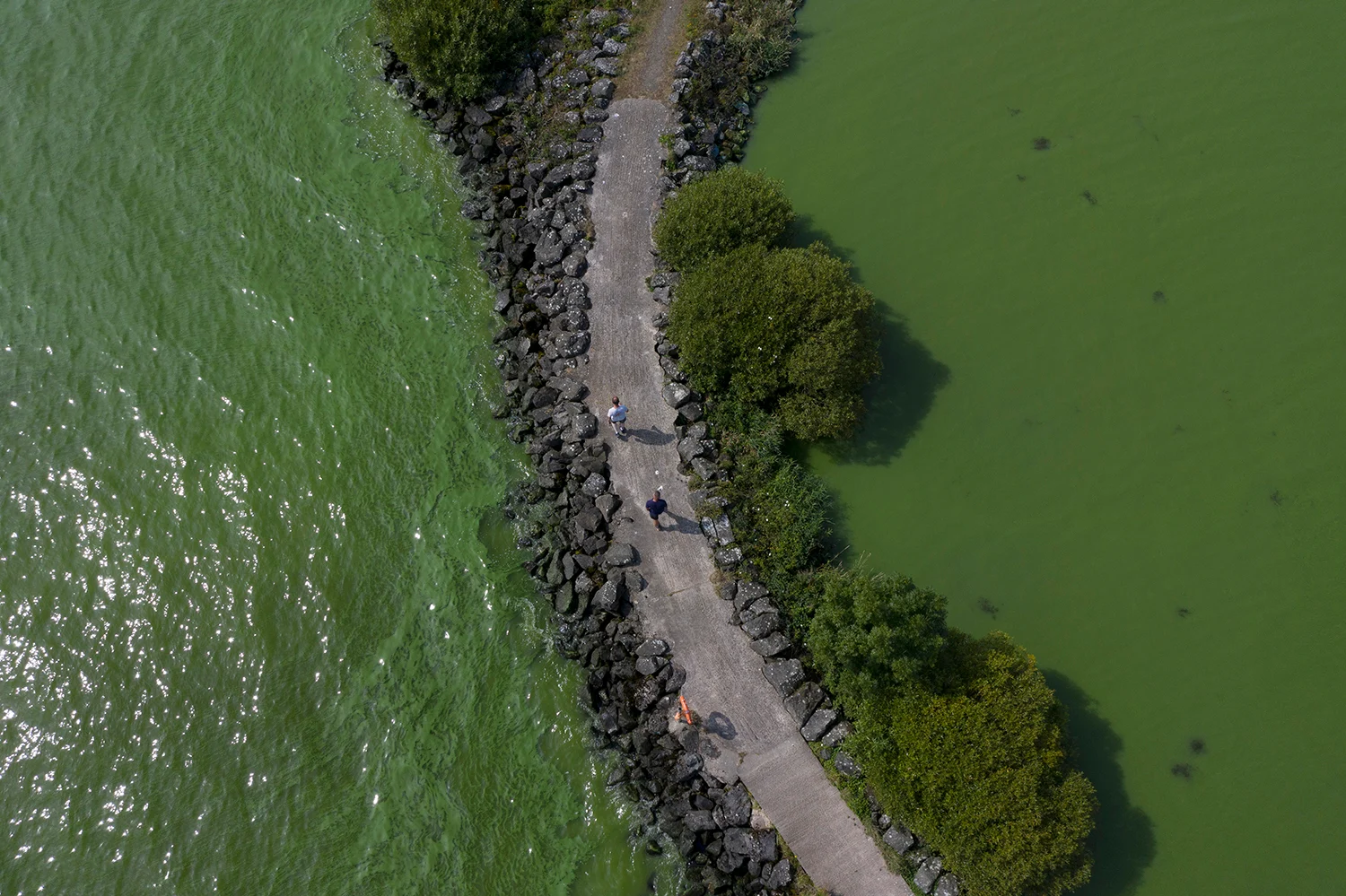
The novel’s post-referendum plot is driven by an existential threat to the islands. A result of global warming, toxic algae “troubles the water,” blooming up throughout the lake and slowly destroying the Ark’s landscape. The government proposes a plan to flood the Ark. It’s a standard policy: Cover everything up and hope it goes away. But a flood would only postpone the environmental impacts of the algae bloom. It would also displace Marion and Robert-John and force them to relocate to the mainland.
When Alex arrives, Marion and Robert-John see her as a potential savior. Hoping her future book will convince the devolved government in Stormont not to proceed with its plan to flood the islands, they attempt to paint the Ark in a positive light for Alex, concealing its uglier aspects and their own painful pasts—which include abuse from their otherwise-revered anthropologist father—to the best of their abilities.
But in Few and Far Between, what goes down must come up. The islands seem to know what’s in store. They fight their destruction. The Sleepers get restless. Buried things start to reappear.
When Marion discovers one particularly shocking truth, her version of reality is rent apart. But though this nearly destroys her at first, it eventually drags her out of a dangerous melancholy. Revelation can be painful, Carson suggests. It can also be liberatory.

A man looks out at the green algae on Lough Neagh on Aug. 18, 2025.Charles McQuillan/Getty Images)
Although political violence between Catholics and Protestants is rare in Northern Ireland today, the country’s lingering divisions aren’t far from view. Belfast, for example, is still full of towering “peace walls” separating the two communities, street art staking claims to identity, and Palestinian and Israeli flags projecting local tensions onto global conflicts.
“When they scratch the surface—which they frequently do, mostly with words but sometimes with fists—there is still a deep divide running through the heart of the place,” Marion notes of those living in Northern Ireland. That divide has also manifested in rising anti-immigrant sentiment today, especially among Protestant loyalists.
Few and Far Between pushes readers to face these tensions head-on, and to consider how grievances might be addressed. Is it better to reopen old wounds, or let bygones be bygones? Though that question does not project neatly onto Northern Ireland’s fractured present, it’s clear that attempts to simply cover things up never turn out the way we’d like to imagine.
In the novel’s epilogue, set in 2018, onlookers and news crews observe as lost items and souls bubble up from the depths of the lake, including ghosts of those who died by suicide on Tom’s Flat. “Sad-faced, cloudy-looking creatures … hung like mist on the water’s surface, eyeing the heavens jealously. They clapped their cold eyes on the camera and did not flinch or look away, as if to say, Do not ignore us. Don’t pretend we’re not here.”
