


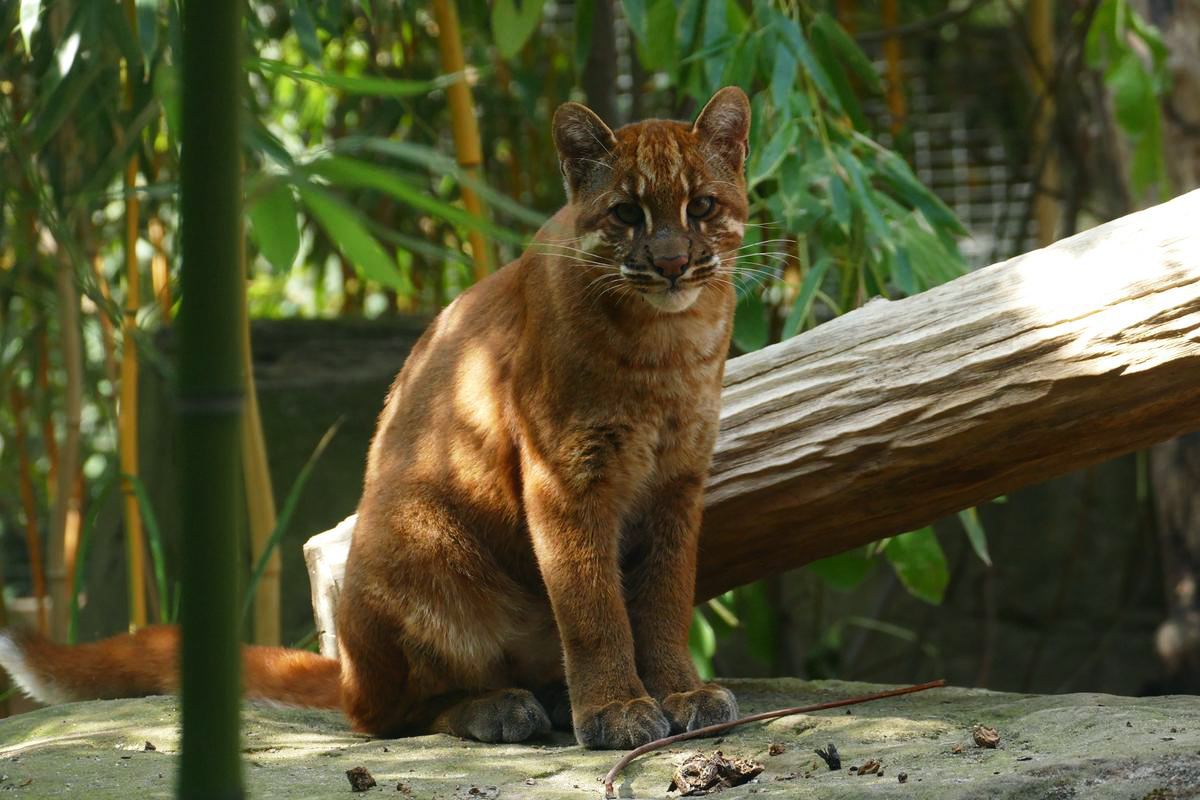
An Indonesian company has sought to register a captive-breeding facility with the Secretariat of CITES, the global wildlife trade treaty, to commercially breed and export rare Asian golden cats as pets, report Mongabay’s Spoorthy Raman and Fernanda Wenzel.
If approved, PT Alam Nusantara Jayatama would become the first facility in the world to commercially breed Asian golden cats (Catopuma temminckii) in captivity for the international pet market. On behalf of Indonesia, the CITES Secretariat issued a public notification in August, granting signatory countries until Nov. 10 to object before the facility is added to the registry of commercial breeding facilities.
Classified as vulnerable on the IUCN Red List, an estimated 7,000 Asian golden cats remain in the wild, threatened by habitat loss, as well as poaching for their skins and bones.
While wild-caught individuals are protected under CITES Appendix I — which bans international commercial trade — captive-bred animals from registered facilities can be legally sold with export permits. According to documents from Indonesia’s Ministry of Forestry to the CITES Secretariat, the facility initiated its breeding program in 2013 using four legally acquired wild-caught Asian golden cats. By 2025, the facility reported its population had grown to 36 individuals across three generations.
This rapid reproduction rate and animal welfare standards have come under scrutiny. “They are super challenging to breed,” said Mike Brocklehurst, a carnivore specialist who ran a conservation breeding program for Asian golden cats at Melbourne Zoo in Australia. “A lot of times in captivity, the males kill the female when they’re introduced.”
Brocklehurst said achieving the high breeding rate claimed by Alam Nusantara Jayatama likely relies on hand-rearing kittens pulled early from their mothers, a “speed-breeding” technique that forces females back into estrus sooner.
Sandra Reichler, curator for mammals at Heidelberg Zoo in Germany and head of the European Association of Zoos and Aquariums (EAZA) species breeding program, said early separation causes behavioral deficits and that the company’s 9-square-meter (97-square-feet) enclosures, as shown in photographs, fall far short of EAZA’s recommended 150-m2 (1,615-ft2) minimum. “A commercial breeding centre that only produces golden cats for the private pet market doesn’t help the species in the wild,” Reichler said.
Chris Shepherd, senior conservation advocate at the U.S.-based Center for Biological Diversity, said commercial captive breeding rarely reduces wild demand and often hinders conservation efforts. “The idea that Asian golden cats can be bred in commercial numbers, where profit is actually made … should be investigated. It seems very suspicious,” he said.
Neither Alam Nusantara Jayatama nor owner Danny Gunalen responded to Mongabay’s inquiries by the time the story was published.
Mongabay contacted the CITES Secretariat to confirm whether it has received any objections, but hasn’t received a response. The CITES register of captive breeding facilities does not yet list PT Alam Nusantara Jayatama for Asian golden cats.
Read the full story by Spoorthy Raman and Fernanda Wezel here.
Banner image of an Asian golden cat. Image courtesy of @Zoo Heidelberg.
