


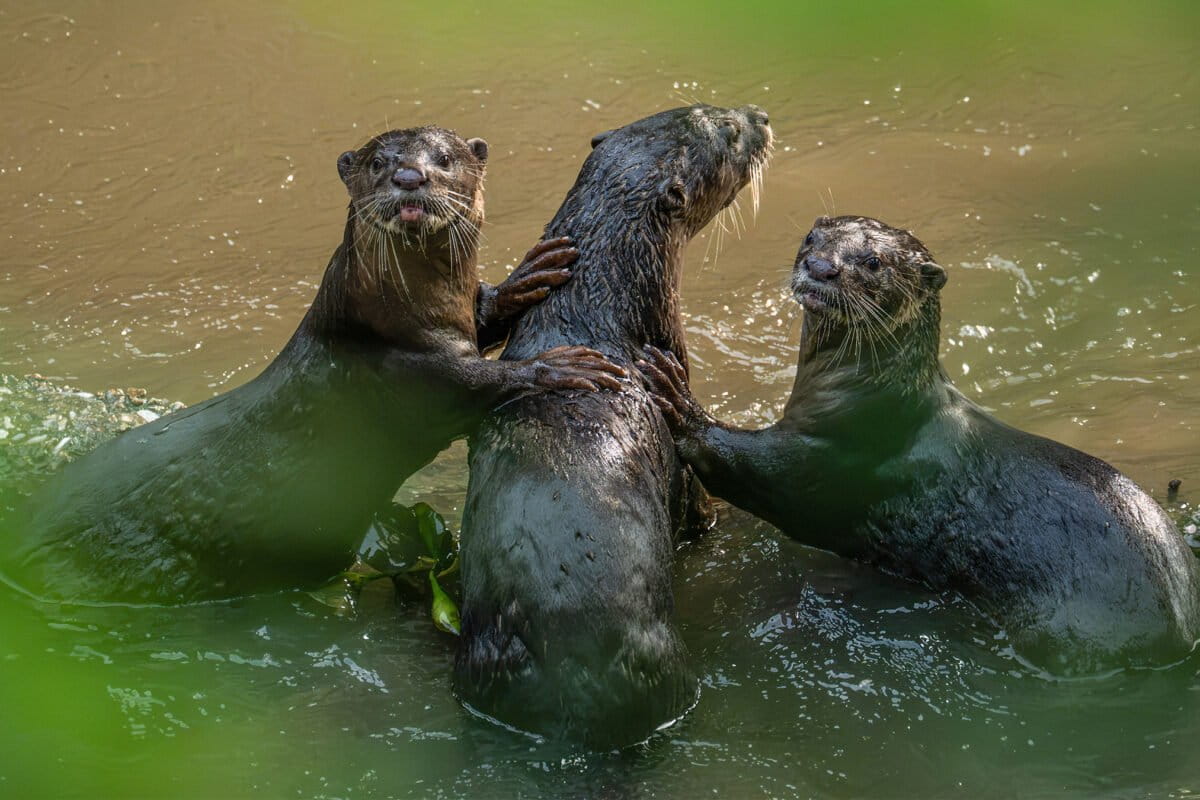
- Smooth-coated otters are increasingly being spotted along Kuala Lumpur’s Klang River, raising hopes that years of cleanup efforts are improving water quality and restoring urban wildlife habitat.
- The otters’ growing presence is not without conflict: habitat loss from development has driven some into residential areas, where they’ve raided fish ponds, prompting calls for residents to adapt rather than harm the protected animals.
- Conservationists and city officials say they hope the otters can galvanize further efforts to clean up the Klang, reduce waste entering the river, and restore more natural riverbanks.
KUALA LUMPUR — Beneath a tangle of highway in the Malaysian capital, a family of otters rolls around in a patch of riverside sand, delighting the few passersby who notice them.
Small groups of otters are now being seen regularly in parts of the city, including along the once heavily polluted Klang River.
Theories vary on whether the smooth-coated otters (Lutrogale perspicillata), classed as vulnerable on the Red List of the IUCN, the global wildlife conservation authority, have returned to the city or were hiding in plain sight all along.
But their presence has raised hopes that efforts to clean up the Klang may be bearing fruit, and could inspire further improvement.

The Klang was once one of the world’s dirtiest waterways, designated a Class 5 severely polluted river under Malaysia’s rankings, the worst possible rating.
Years of work improved it to Class 3, or moderately polluted, which seems to have encouraged the otters to move in, said Malaysian wildlife ecologist Woo Chee Yoong.

“Wherever there are otters, there are fish. Wherever there are fish it means the whole river system [is] clean, it’s healthy for all the communities around. So that’s one of the importance of otters,” he said.
In recent years, the animals have been filmed sunbathing on the river’s concrete banks and swimming in front of elevated metro stations, winning viral fame.

Retired soldier Hasan Ujang, who lives in a riverside apartment, said he enjoys watching their antics.
“We feel really happy when we watch them playing and playing, like kids swimming,” he said.
‘They have to survive’
But unlike otters in neighboring Singapore, which are closely monitored by a network of citizen scientists, little is known about Kuala Lumpur’s otters.
Woo said he learned about them from local media reports on sightings in 2019, and the following year co-founded the Malaysian Otter Network (MON) conservation group.
“We don’t know how many groups are there, we don’t know how actually the otters are moving around,” Woo said.

Even the question of whether the otters have returned to the capital or were simply in less visible city environments before remains a “mystery.”
MON says it hopes to set up a citizen science system for people to report sightings.
Different groups of otters have been spotted elsewhere in the city, including at the Tropicana Golf & Country Resort, a high-end housing estate where they are less welcome visitors.
They are accused of raiding at least 12 houses there in the past year. Their target: fish ponds.
Resident Yee Sze Mun, 89, said otters killed the beloved — and expensive — arowana fish he had nurtured for 15 years.

“They are a nuisance, but I can’t blame them, because they are just like us, they have to survive,” he said.
Residents say the incursions began last year after a company backed by Malaysia’s biggest pension fund, the EPF, began clearing forest next door for Kwasa Damansara, a new township project.
“We have an issue because they’re losing their habitat,” said residents’ association president Joy Appukuttan, who called the otter attacks a “grave concern.”

Alfyan Mohd Adnan, who manages communications for Kwasa Damansara developer, declined to comment.
According to Tropicana’s security team, there are around 25 otters in the forest. The estate has brought in Woo to teach residents how to deal with them.
The species is protected in Malaysia, so Woo urges residents to block entry points to their yards and install fences or netting over ponds.
‘An asset’
Maimunah Mohd Sharif, a former Kuala Lumpur mayor and now adviser to the city on sustainable urbanization, called the otters an “asset.”
“Otters are one of the benchmarks for clean cities,” she said.

Like others, she said she hopes a growing awareness of the Klang River otters can be harnessed to help improve the river further.
Hundreds of garbage traps were installed as part of the government’s River of Life project, and solar-powered “interceptors” deployed by a Dutch NGO have collected tens of thousands of tons of waste.
Now, Maimunah said she wants to see more done to stop waste entering the river in the first place, and efforts to raise the Klang to Class 2B status, clean enough for body contact.
“One day, I want to swim in the Klang River,” she said.

Scarlett Koon Si Qi, a community architect and co-organizer of the annual Klang River Festival, said she hopes the waterway can be restored to its natural banks without concrete lining.
“Some parts, maybe yes, you do need concrete to kind of protect and control for floods,” she said.
“But I think wherever we can, we should leave it as natural as possible.”
That would further benefit the otters, which need some vegetation and natural crevices to hide in, experts said.
The otters are already shifting public views about the river, said Faith Foo, who runs the festival.
Growing up, “the teachers would always say that this is a very unsanitary place,” he said.
But seeing the otters, “it’s a reminder that that is a river.”
Banner image: Smooth-coated otters play on the shore of the Klang River in Kuala Lumpur. Image by Mohd Rasfan / AFP.
This article is part of a reporting project between Mongabay and Agence France-Presse (AFP).

