


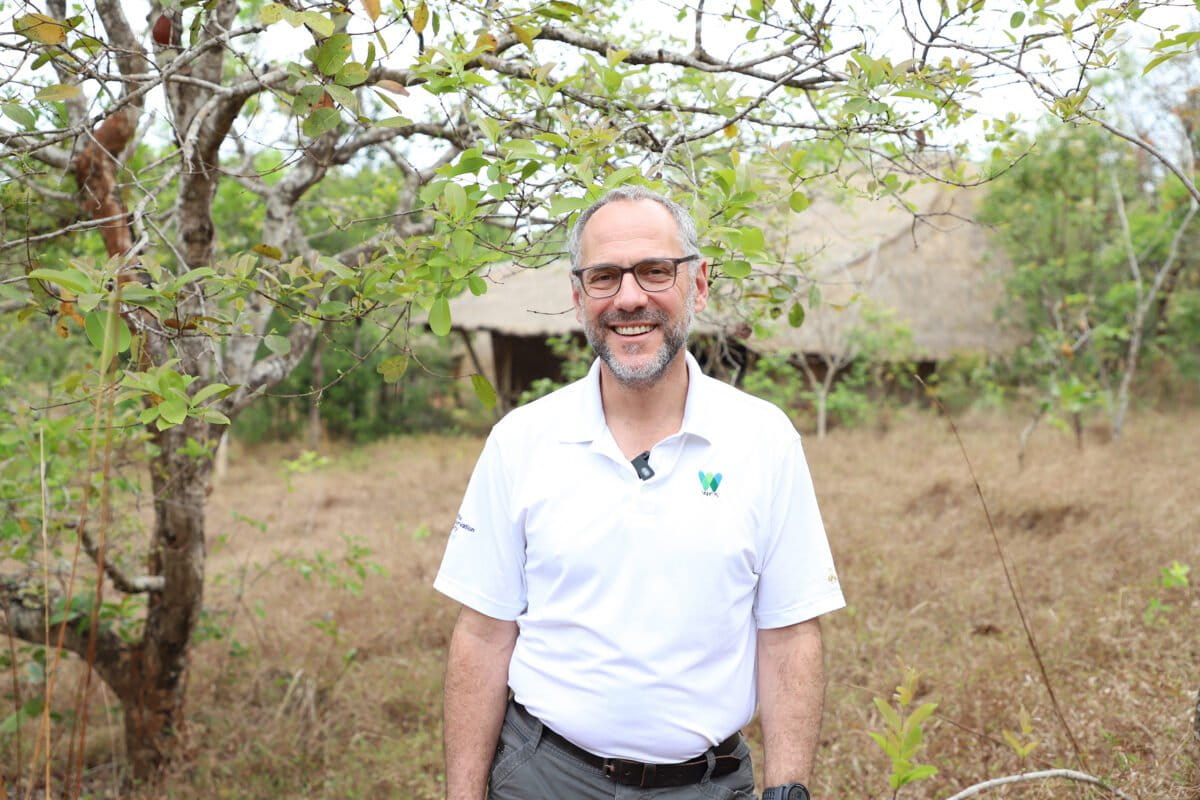
- In July 2026, WCS president and CEO Adam Falk spoke with Mongabay founder and CEO Rhett Ayers Butler about his first year leading the organization.
- Falk said conservation depends as much on relationships with Indigenous peoples, local communities, governments, and funders as it does on protecting wildlife.
- He supports “30 by 30,” but argues that where areas are protected, how they are managed, and their ecological integrity matter as much as acreage.
- Falk also discussed the collapse in U.S. government funding for WCS, the need for long-term philanthropy, and closer cooperation among conservation organizations.
Soon after becoming president and chief executive of the Wildlife Conservation Society, Adam Falk visited the giraffe keeper at the Bronx Zoo. What struck Falk was the source of the keeper’s commitment. If a giraffe needed help in the middle of the night, he said, the keeper would come in because of his bond with the animal.
Falk recognized something familiar. Before joining WCS, he had been a theoretical physicist, a professor at Johns Hopkins University, president of Williams College, and president of the Alfred P. Sloan Foundation. Academics often pursue highly specialized work that matters deeply to them. A university leader has to support those individual efforts while helping the institution work toward shared goals. Falk found much the same challenge at WCS: leading people whose motivation is rooted in the work itself.
He took over WCS in July 2025 without professional experience in zoology or conservation. That was unusual for the head of an institution founded in 1895, which now operates four zoos and an aquarium in New York alongside conservation programs in more than 50 countries. His first year gave him an outsider’s view of a field with its own history and assumptions.
One of his early observations was that conservation work involves people as much as animals. Public campaigns often focus on wildlife, especially large and familiar species. Field programs depend on relationships with Indigenous peoples, local communities, government officials, and funders. Decisions about land boundaries, access to natural resources, law enforcement, tourism, and development can determine whether conservation efforts endure.
That observation also led him toward difficult questions about conservation’s history. Falk describes an earlier model built around creating protected areas and restricting human access, with colonialism and racism embedded in parts of that history. WCS has also faced more recent allegations involving rangers associated with conservation programs, including claims of violence and restrictions on local people’s access to resources. Falk says he is too new to address individual historical cases in detail, but points to changes WCS has made in response to a broader recognition that conservation organizations needed to work differently.
Those changes include a Rights and Communities program established in 2020, grievance mechanisms, efforts to direct resources to Indigenous peoples and local communities, and processes for free, prior, and informed consent when new protected areas are created. Falk spent much of his first year visiting WCS programs. In Cambodia, he saw work with Indigenous communities on ecotourism. In the Republic of Congo, he examined questions around bushmeat, forestry, and local access to natural resources. In Guatemala and elsewhere, he met teams that had spent years working in particular landscapes. He came away emphasizing the importance of long-term relationships rather than treating conservation as a succession of projects.

He also examined how WCS’s New York institutions fit into its global work. The four zoos and New York Aquarium are public attractions, but Falk sees them as part of the same conservation system as WCS’s field programs. The zoos can provide veterinary knowledge, breeding expertise, education, and direct encounters with animals. Field teams contribute experience from ecosystems where conditions can change with elections, conflict, development pressures, and shifts in funding. WCS says half a million children visit on school trips each year, while its educational programs reach 1.5 million students and teachers. Falk wants the connections between the New York and international sides of WCS to become stronger.
He also supports the global goal of conserving 30% of the planet’s land and oceans by 2030, while cautioning against treating acreage as the main measure of progress. Which places are protected and their ecological integrity matter as much as the headline number. Conservation also requires maintaining existing protected areas, he argues, rather than concentrating only on places where new designations are easier. His definition extends beyond national parks to other conserved landscapes, including “sustainably managed” forests and marine areas.
Money runs through many of these questions. Before President Donald Trump took office in January 2025, Falk says the federal government provided about 20% of WCS’s global conservation program funding. That support has fallen close to zero, much of it following the dismantling of USAID. Finding replacement funding is now among his main priorities.
His experience at the Sloan Foundation shapes how he approaches that task. Conservation organizations often need support that continues for decades. Many donors prefer projects with defined time frames, measurable results, and the prospect of rapid expansion. Falk believes this preference partly reflects how newer fortunes were created.
Earlier industrial philanthropists, including Carnegie, Rockefeller, Ford, and Sloan, made their money by building large institutions. Their giving often supported universities, foundations, and other organizations intended to last. Much of today’s wealth has come from software and finance, where products and capital can expand rapidly. Falk says some donors carry those expectations into philanthropy and look for interventions that can be tested and scaled within a few years.
Conservation rarely fits that model neatly. Managing a forest or marine reserve requires a continuing presence. Relationships with governments and communities take time to establish and maintain. A short project may contribute to that work, but it cannot substitute for long-term institutional support. Falk argues that conservation organizations need to explain this more clearly to new donors, particularly as cuts in government funding increase their reliance on philanthropy.
He also believes conservation groups should cooperate more, despite competing for limited funding. He recalls that colleges often compared themselves with close rivals even though each served a relatively small number of students. From his current position, he sees conservation organizations facing a shared problem and thinks closer coordination would improve their collective results.
In a July 2026 conversation, Falk discusses WCS’s response to allegations of abuse, the role of Indigenous peoples and local communities, “30 by 30,” and why the location of protected areas matters as much as acreage. He explains why zoos remain relevant to conservation, how cuts in U.S. funding are affecting WCS, and what his experience in physics, higher education, and philanthropy has brought to conservation.

An interview with Adam Falk
Rhett Ayers Butler for Mongabay: You began your career as a theoretical physicist and then became a college president. How did you end up in conservation?
Adam Falk: Yeah, so I had a somewhat unusual background to be in the role that I’m in now. Again, my scientific background was in theoretical physics. I spent time as a professor at Johns Hopkins, moved into higher education, and then became a college president.
Part of that arc was really about finding leadership roles in mission-driven organizations where I care deeply about the mission. That was work that was rewarding for me and that I wanted to do. There’s a way in which you make a shift from being a scientist—where it’s all about the thing you do—to this kind of academic and non-profit leadership, where the job is not to do the things yourself, but to create conditions where many other people can do really great work. You’re a small part of other people’s success instead of being the only part of your own success. I loved that, and I found that was the way I felt about doing higher administration.
I spent seven and a half years as the president of the Alfred P. Sloan Foundation between Williams College and WCS, which is another version of the same thing. You’re using your philanthropy to make all sorts of research better in science and economics. So, although I didn’t have a background in conservation or zoos, WCS was the kind of organization that has always meant a lot to me to lead.
When the opportunity came to be in a conversation with the folks finding the next president for WCS, it was easy for me to feel that. The combination of an institution that is involved in one of the challenges of our age—which is having us not destroy the only planet we live on—and at the same time is an incredibly important cultural institution in a city that I’ve come to love, felt very natural to me. It grew out of a single mission about saving wildlife and wild places.
The fact that I didn’t have an intellectual background in that area was something you learn, and you can fix those things. But the fact that I was passionate for the work WCS does, and that I’ve led non-profit organizations… you want to wake up every day feeling like the mission is something to get you out of bed. Gosh, that’s as true for WCS as anything I’ve ever done in my life.
Mongabay: And so now you’ve been there for just over a year. What has surprised you the most about either the organization or the conservation field?
Adam Falk: Because I didn’t have a background in conservation, I’ve had the opportunity to be surprised by all sorts of things that people who have been in conservation aren’t surprised by. When you are on the outside of this field, you’re very focused on the aspect around the animals. In fact, when we talk about conservation, we talk so much—as we should—about the importance of saving wildlife, iconic species, and charismatic megafauna, the key species that motivate people toward conservation.
When you start to do the work, you discover how much of the actual work is about people. It’s about Indigenous people and local communities around protected areas. It’s about policy people in the countries in which you are working. It’s about policies in the global environment context—the big international meetings—and how many people are really thinking about how they’re going to deal with people, not just how they’re going to deal with animals. Of course, that’s obvious to anyone who is in conservation, but from the outside, that dimension was something that I hadn’t anticipated and now see as totally natural.
Mongabay: What has your first year at WCS taught you about what conservationists need to do to succeed?
Adam Falk: There are a couple of ways in which you can read that question: what they need to succeed versus what they need to do to succeed. I’ll answer both.
What they need to succeed is resources. That sounds really trivial, but it’s incredibly important. This is true of all non-profits: non-profits that are going to do something of ecological importance need the ongoing, long-term support of people who believe in it. Conservation is not a series of projects; conservation is a relationship to the natural world. What we need are philanthropic partners and other funders who are in it for the long run and don’t see our work as a series of one-off projects. Conservation isn’t a thing that gets “done” the way a scientific research project might get done. It’s an ongoing thing, and we need partners who understand that.
As for the things we need to do: there are many, but I would point to building enduring relationships with the landscapes, communities, and societies where we’re doing the work. I know you’re going to want to talk more about that, and I’d love to, but when I come to any new organization, I try to learn the history. How did we get to be who we are?

We have a 125-year-old history here at WCS that goes back to Teddy Roosevelt and when conservation was an idea. Conservation has changed tremendously in the intervening century and a quarter, thank God. If you go back to Teddy Roosevelt, it was about putting up a big fence, keeping people out, and keeping animals in. There’s all sorts of colonial history to that, including the reasons people were thinking that way—the racism and all these characteristics of how people thought about the natural world and the people living in it.
Here we are a hundred years later, and I think the most important evolution of conservation is seeing itself as a partnership. Institutions—which still mostly come from outside the countries where conservation work is done—need to see themselves in partnership with those countries. The most important thing for conservation to do is to recognize the centrality of that relationship to enduring, successful conservation work. As I look at the historical trajectory, I see movement along that path, and we absolutely have to continue to center and embrace that aspect of doing conservation work.
Mongabay: On your point the history of conservation, more recently, WCS has faced criticism in some places where rangers associated with programs have been accused of using excessive force against local people or depriving them of access to resources they traditionally relied on. You weren’t at WCS when this was happening, but what’s your understanding of how WCS has been responding to those allegations? How has it changed to help prevent those kinds of issues in the future? Taking a broader look as well, what have you learned about how WCS or conservation generally can best work with Indigenous peoples and local communities in the countries where WCS operates?
Adam Falk: You’re quite right: I’m not in a position to speak in detail about some of the specific historical things you’re referring to simply because I’m new here. But I do see the response in the things we do today. I know of initiatives we undertake today that are directly in response not just to those allegations, but to a collective recognition that we needed to do better. This isn’t driven by one or two isolated incidents; it’s driven by a larger arc in how we work with communities.
In 2020, WCS established a dedicated Rights and Communities program. Its purpose is twofold: first, at the institutional level, to center community rights as a core aspect of our work; and second, to bring in expertise that can be deployed into the field. That means putting people on the ground who know how to work with Indigenous peoples and local communities, who bring both expertise and commitment to that work, and who have the resources to set up grievance mechanisms so there are structured ways to adjudicate conflicts that naturally arise in any human situation.
We also look for opportunities to direct resources straight to Indigenous peoples and local communities. An example of that would be the work we do around ecotourism. I was just in Cambodia and saw how we were working with local Indigenous communities to help them set up their own ecotourism ventures. Rather than working merely on behalf of people, these are true partnerships with those living within or near protected areas to align the incentives for conservation with authentic social and economic incentives in those communities. It’s not about imposing ideas, but working together to align those goals.
When new protected areas are established, it’s about setting up processes for free, prior, and informed consent—FPIC.
Setting up these FPIC processes brings people in from the very beginning to ask questions like: What are the boundaries of this protected area? How should they be managed? What kinds of local resource extraction are essential for these communities so they can continue living in ways consistent with preserving the landscapes they themselves depend on?
One dynamic I’ve observed visiting sites in Cambodia and the Republic of Congo is that the primary problem is typically not local communities unsustainably extracting resources for themselves—whether that’s bushmeat, non-timber forest products, or small-scale logging. The problem arises when those communities end up connected to an extractive, external commercial economy.
When I was in Bomassa, near Nouabalé-Ndoki National Park in the Republic of Congo, the local community extracted bushmeat as an essential part of their culture and protein source. That in itself is not the threat. The threat emerges when that extraction expands to feed a commercial restaurant industry in Ouesso or Brazzaville. We have to work with communities around their legitimate, generational needs for resource access. If we do that in partnership, we can ensure it is sustainable while meeting their needs. If we instead arrive from the outside with rigid preconceptions, we risk cutting them off from traditional resources, which creates an unsustainable situation in its own right.
So, to give a long answer to what I’ve seen since coming to WCS: when I go into the field, I see the impact of these systemic changes—changes made, at least in part, in response to past allegations of violent or unproductive relationships between conservationists and Indigenous communities.
From our perspective as an organization, if an act of violence occurs, it matters deeply whether the perpetrator was a WCS employee or not. In a specific moment, we might clarify, “Look, that was a terrible event, but that individual was not our staff.” But that distinction doesn’t lessen the pain for people suffering abuse. It is not enough to say a particular event wasn’t our fault—even if factually true—because we are part of a larger system that must treat neighboring park communities with fundamental respect.
At times, we have to work alongside difficult government authorities; that’s a reality, and we can’t simply walk away from every challenging government if we want to do the work. But we must be—and increasingly are—exceptionally clear about who we are working with, what we are directly responsible for, and what lines we will not cross. We have to maintain clarity, particularly around law enforcement or controls that could lead to armed conflict. It simply isn’t enough for us to say, “It’s not our fault.”
Mongabay: I want to go back to another point you made: WCS combines a massive field-based conservation program with a major network of zoos and an aquarium based in one of the world’s largest cities. Why do you see that as such a powerful combination?
Adam Falk: WCS is absolutely unique in the world for having this combination, and I think it is immensely powerful in both directions.
In New York City, we have the Bronx Zoo—the preeminent urban zoo in the world and the largest in the U.S. in terms of species representation—along with the New York Aquarium and three local zoos. Zookeeping has transformed over the last 125 years, and I am incredibly proud of the care the animals receive here.
Their purpose, however, is much larger than offering a fun afternoon outing for kids in New York. Their purpose is fundamentally educational and about inspiring a deep care for the natural world and conservation. I feel strongly that a true passion for preserving species cannot be cultivated in people purely through pictures and videos. We need embodied, real contact with living animals that touches our hearts and minds in ways essential to driving action. That is foundational to the power of urban zoos and aquariums to inspire conservation. We have half a million kids visit on school field trips every year, and 1.5 million teachers and students touched by our educational programming. That is a powerful complement to field conservation work.
Conversely, our conservation work is resolutely grounded in field sites. Having the zoos and aquariums grounded in New York City reinforces that work. One of the many things I love about WCS is this deep commitment to remaining in these field locations for the long haul.

There is a temptation today to think the only solutions that matter are those that scale rapidly through high-level finance, innovative climate instruments, or similar mechanisms. Those are important tools, but if they don’t ultimately fund conservation that takes place in real places, in real landscapes, with real people who stay there for years, they accomplish nothing. Our institutional focus on hands-on field work is the heart of what we do and what makes us strong. Returning to our roots in New York—where I can look out my office window right now at the sea lions or the tortoises—reminds us every day what the real work of conservation is.
I often say we have a single mission: to preserve wild animals and wild places. We express that single mission through two complementary endeavors—our zoos and aquarium, and our global field conservation program.
Mongabay: You mentioned scaling up. The ultimate global scale in conservation right now is the “30 by 30” target—protecting 30 percent of the planet’s land and oceans by 2030, which is fast approaching. Do you think the world is on track to achieve that target? What needs to happen now to make that target meaningful, even if we fall short of the exact number?
Adam Falk: I don’t know whether we will hit the exact target or not by 2030. But the importance of targets like 30 by 30 is that they compel us to get serious. There’s nothing inherently magical about the number 30 or the year 2030, just as there wasn’t a magical line at 1.5 degrees Celsius. What these targets do is force us to move urgently toward ambitious goals, and 30 by 30 has been vital in driving that momentum.
The challenge with sweeping targets is that they reduce a complex reality into a simple metric. I fully support the 30 by 30 ambition, but it matters enormously which 30 percent you are protecting. When you translate that to on-the-ground work, quality is paramount.
Looking at our own metrics, WCS is advancing work across more than 500 protected and conserved areas, spanning both marine and terrestrial ecosystems—covering over a million square kilometers. We aren’t just looking at barren areas that happen to contain a few species, but intact places where the whole ecosystem works—where hydrology, vegetation, wildlife, and air quality are healthy and functional. Those are the high-integrity landscapes truly worth protecting.
We must continue to aggressively identify and secure new opportunities to protect lands and seas, working with governments to set them aside. At the same time, we have to ensure we are safeguarding the right places.
For instance, roughly half of WCS’s work is concentrated in Africa because of the critical importance of those landscapes and the reality that rapid development over the next decade could bring irreversible changes if we don’t act now. On the other hand, if you look at our contributions toward new 30 by 30 designations, a huge portion is in South America, where the political and spatial opportunities to establish entirely new protected areas currently exist.
The fact that our work in Africa focuses heavily on sustaining existing protected areas rather than creating new ones shouldn’t be seen as conflicting with 30 by 30 priorities. We need to do both: create new protected areas where possible, while rigorously sustaining existing ones everywhere else, rather than being driven solely by where it is easiest to add raw acreage to a target. We work in different places for different strategic reasons.
Mongabay: You mentioned protected areas here. Do you also think about other effective area-based conservation measures—OECMs? Not just traditional national parks, but other types of conserved areas?
Adam Falk: One hundred percent. I use “protected area” in a broad sense, not strictly meaning formal national parks, but conserved landscapes broadly.
When I was in the Republic of Congo near Nouabalé-Ndoki National Park—which is a formal, gazetted national park near the borders of Cameroon and CAR—where we work with forestry concessions helping to ensure sustainable timber harvesting, as we have for 20 years. That surrounding area isn’t a national park, yet it turns out to be terrific gorilla habitat. Selective logging that removes just one tree per hectare every ten years opens up forest light gaps that gorillas actually prefer over dense, closed-canopy core zones.
Our work is certainly not limited to formally gazetted national parks. Many of the Indigenous peoples and local communities we partner with live adjacent to formal parks rather than inside them. So I definitely view conservation through that broader landscape lens.
A lot of the rights and communities work that we’re doing is not in the gazetted areas themselves. This is certainly true of marine protected areas. We work with a lot of communities on sustainable fishing and other issues that affect marine protected areas, but these communities live on the land, while the protected areas are in the water. So the adjacency there is manifest.
Mongabay: Going back to something you said as part of your previous response: you’re an outsider to conservation, which clearly gives you a different perspective than an insider. Looking out to the future, are there any obvious things you would change—or that conservation needs to change—especially in the next decade to respond more effectively to biodiversity loss?
Adam Falk: I hesitate to offer blanket criticisms of conservation, so I won’t do that. But what I will say is that when you come from the outside to a new field, one of the things that is sometimes clearer to you than to the people inside is that we are all working to solve the same problem across all the different organizations.

I remember this from my days in higher education when I was running Williams College. I would talk to my board, and we would ask, “Are we better than Amherst? Are we better than Swarthmore? How are we competing?” That’s a very natural conversation, partly because you’re competing for students, but partly it was just a sense of competition.
When I left, I thought, Well, that was ridiculous. Williams educates 550 kids a year, and Amherst can do just as good a job educating their 500 kids a year. We’re all trying to persuade people that we need resources, and maybe we’re the ones they should choose to give those resources to. But everything we can do to work together, and to see ourselves as working together, will be helpful to the larger project that we’re all involved in.
Mongabay: You mentioned resources, and part of scaling is having resources. You come from a background where you worked for seven years at the Sloan Foundation, so I’m interested in your take on conservation philanthropy. When you look at this space, what do you see as the greatest opportunities or gaps?
Adam Falk: One of the hard things in philanthropy is that as a philanthropist, you’re very often aware that while you’re interested in a very big problem, you bring relatively small resources relative to the size of that problem. That could be conservation, or it could be cancer research.
The strategy philanthropies often adopt is to find an area where they can have a disproportionate impact. They then get very concerned with moving their money from place to place over time so they can have an impact here, then an impact there, and then an impact somewhere else. If you’re funding scientific research, that can make some sense in the long run. There are great philanthropies that do that.
However, on the whole, philanthropy—not just conservation philanthropy—is moving in the direction of less investment in institutions and more investment in short-term projects. But we’re not doing a series of isolated projects in conservation; we’re doing long-term work. We in conservation have to double down on educating philanthropists—particularly new philanthropists—about what conservation work really looks like.
That’s my worry about the shape of philanthropy as a whole. Philanthropy needs to take a long-term view—the kind of long-term view it often has in the past—which is really essential for supporting sustainable conservation work.
Rhett Butler: Given your philanthropy background, I’d like to ask about two macro trends in the philanthropic space. One is pullback on climate. The other is the massive amounts of new wealth being generated in the technology realm. There is potentially going to be a lot more money coming into the philanthropic ecosystem. How do you think about what that could drive for conservation outcomes, and how do you convince this “new money” that work at the intersection of people and nature is what they should support?
Adam Falk: That is a great question and one we think about constantly. Let me first say something about a challenge I thought a lot about when I was at the Sloan Foundation. This is my own idiosyncratic comment about the arc of philanthropy before I answer your question directly.
If you go back 100 years and look at Carnegie, Rockefeller, Ford, and Sloan—the big fortunes made 100 to 150 years ago—they were made by people who built massive physical institutions with factories and steel mills. The engines of wealth creation were institutions. So when those philanthropists wanted to take their wealth and do something for society, they looked to build and support institutions—organizations that persist over a long period. If you endow a university, you aren’t doing it for what’s going to happen tomorrow or five years from now; you’re doing it for what’s going to happen long after you’re gone. Those donors believed in the power of institutions to shape society.

The money made in the last few decades, however, has been generated more through financial transactions and software production. Those sectors move much faster. You can move fast, break things, and build quickly. If you’ve been successful making your money by buying and selling assets or writing software that scales up instantly just by copying and distributing it, you’ve succeeded outside traditional institutional models, often working around institutional weaknesses.
Consequently, philanthropy from people who made their money this way is less likely to be institutionally oriented. In my experience, they are much more drawn to discrete projects: How do you take this project and scale it by a factor of 10? They are often only interested if the philanthropic effort fits their model for how their business was successful. That is a totally understandable psychological state.
The challenge is that there is probably no field that is a poorer fit for that approach than conservation. Conservation doesn’t work like software development, IT, or finance. They are fundamentally different models.
That doesn’t mean it’s hopeless; it just means there is more educational work we have to do explicitly about what it actually takes to support our work. Many of the people we want to reach care deeply about the Earth, wildlife, and planetary warming. But with the solutions they are drawn to, we have to help them understand that these aren’t problems with two- to three-year quick fixes. You can’t just try a whole bunch of move-fast experiments to see what sticks, because you are playing with actual landscapes and real people’s lives.
It frames the work we have to do with these new philanthropists differently than how it would have been framed 100 years ago. There can be a mismatch between how we achieve real-world impact in conservation and how these donors achieved success through their own business creation, but recognizing that allows us to engage them effectively.
Mongabay: Changing direction a bit, are there lessons from your background in physics, philanthropy, and university leadership that have been especially useful as you’ve transitioned into your role at WCS?
Adam Falk: WCS feels more like a university than you might think, and leadership here is very similar to university leadership.
One way to characterize a university is that it’s full of people whose motivation for doing their work is intrinsic to the work itself—their research, their teaching. Of course, people in a university are employees who need to make a living, but many aren’t doing the work simply because they’re being paid to do it; they’re doing it because it’s the thing that matters most to them. That is both the great joy and the great challenge of leading a university: you have to bring all that energy—pointing in so many different directions—together into something coherent that moves everyone’s work forward while honoring their individual motivations.
If all the faculty worked strictly to rule, the university would fall apart. When you work with faculty, you have to honor their individual idiosyncrasies and personal motivations. You have to love the fact that even if I was a theoretical physicist, I have to hire and support someone doing 17th-century English literature. That diversity of interests is a great strength that you lead by honoring.

That is very similar to zoos and conservation. When I go into the field and visit our team in Guatemala—which was the first trip I made—they aren’t working for me. They don’t think they work for me, and I don’t think they work for me! Yes, I’m the CEO, but they are there because they’ve been there for a long time and care deeply about the work in front of them. My job is to support them in that work. The institution has to ensure people perform well, but fundamentally, it’s about supporting people whose motivation is intrinsic. Leading thousands of people like that is a particular form of leadership that I find deeply energizing.
It’s true at the zoo as well. One of the first things I did was visit the giraffe keeper. He gets up every day and loves those giraffes. He may work for the Bronx Zoo, but his deepest loyalty is to those giraffes. If they need him in the middle of the night, he will get up and do whatever it takes for them—not because he’s an employee of WCS, but because of his bond with them. It is such a joy to be around people whose relationship between their work and their identity is like that. In that way, I really brought something from my time in higher education that has been immensely valuable here.
Mongabay: What did you focus on during your first year as head of WCS, and looking forward, what are your main priorities?
Adam Falk: My first year at WCS was about learning—going into the field to see the work there, visiting our zoos and aquarium, and spending as much time as possible with as many people as I could to find out what they do, why they do it, and how they do it. It was a real learning adventure that continues today, but that was my highest priority.
Looking forward, an immediate priority is securing the resources we need to do our conservation work. Before the current U.S. administration came in, about 20% of our global conservation program was supported by the U.S. government. That number dropped very close to zero very quickly, and we’ve had to adjust. We’ve worked with our board to secure additional resources, but at the end of the day, we can no longer count on having that level of U.S. government support—a lot of which came through USAID, which was completely obliterated. The question of how we support our work is a very pressing one, so that is a high priority for me.
Another major focus is making sure that as an institution, we see ourselves as a unified entity—a single global conservation program that fully includes the zoos, the aquarium, and all our work in New York. As I said before, we are a single organization with a single mission expressed in complementary ways. We need to seize every opportunity to connect our field work with our New York City work—whether that’s deploying the expertise of New York veterinarians to animal health questions in the field, restoring wild populations through NYC breeding programs, or using the zoos to educate the public about field conservation. Showing ourselves and the outside world that we are a unified organization is very important to me.
Mongabay: My last question: what gives you hope, especially given the current environmental context, USAID cuts, and all these other headwinds?
Adam Falk: The people I work with give me hope. There’s a famous quote—often attributed to Margaret Mead—that a small group of thoughtful, committed citizens can change the world; indeed, it’s the only thing that ever has. I work with extraordinary people who care profoundly about their conservation work, situated within a broader community of conservation organizations filled with people who care just as deeply. That gives me great hope.
As a scientist, I believe deeply that science is about looking at the world, learning humbly from it, and choosing our next actions based on what we’ve learned. Although humans aren’t always great at this, I believe we will face the reality of the challenges in front of us and take necessary action. We need a more universal understanding of what that reality is, but I think that is coming. I have great faith in people. In the end, we’re imperfect, but I think we’re good. I see that goodness every single day, and that gives me real hope.
Banner image: Adam Falk at Jahoo Gibbon Camp within Keo Seima Sanctuary in Cambodia. Photo courtesy of WCS.
Cite this article
Rhett Ayers Butler (2026). What conservation looks like from the outside: A conversation with Adam Falk after his first year as CEO of WCS. Mongabay Conservation news. DOI: https://doi.org/10.66709/news-325685

