


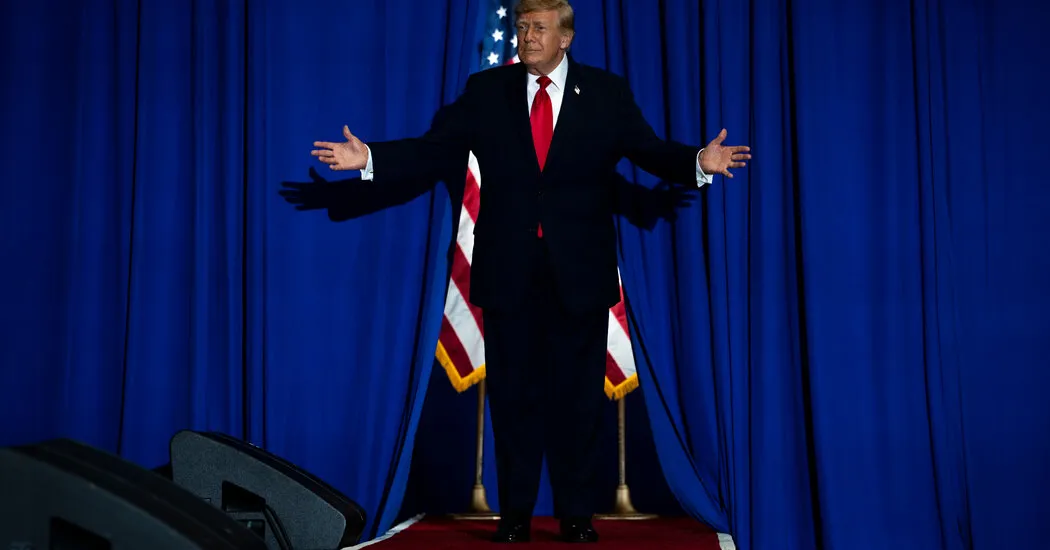
During the first political rally of his monthlong midterm campaign season, President Trump dangled the promise of cash, played news clips, introduced the former professional basketball player Dennis Rodman, presented infographics on his endorsement success rate, pulled supporters onstage, including one of his White House aides — all while asking his most faithful supporters to pretend that he is on that ballot in November.
It was over the top, even for a showman.
At stake, the president told the rapt crowd, was Republican control of Congress, a secure border and economic stability. Something else was at risk, too: “Pretend I’m running, please. If we don’t win, they’ll end up impeaching me,” Mr. Trump said shortly after taking the stage at a casino event center in Durant, Okla., on Thursday evening.
Mr. Trump served up reliable red meat, warning the crowd about socialists, open borders and rising crime if Democrats take majority control of either chamber of Congress in November. But he was largely preaching to his most fervent fans, not the voters he will need to elect or re-elect a slate of Republicans fighting in states from Alaska to Maine. He knew it.
“It’s sort of about 35 races if you want to know the truth,” Mr. Trump said of the key House and Senate elections that will decide control of Congress this fall. “I’m here in Oklahoma and I’m really here because I love you people. I had to get here! I feel a little foolish, you know? I’m saying, ‘Go out and vote, go out and vote,’ but they’re going to win in a landslide.”
Still, Mr. Trump offered support to several of the state’s Republican candidates, including Mike Mazzei, whom Mr. Trump has endorsed for governor, but who has distanced himself from Mr. Trump’s decision to import beef from other countries.
Mostly, the president wanted to talk to the news cameras stationed at the back of the room. Mr. Trump again offered a cash prize of $5,000 to every American adult if his party keeps control, earning some of the loudest applause of the evening.
“Republicans can do it and Democrats can’t,” Mr. Trump said. “We’re taking in massive amounts of money through tariffs and record-setting economic success. Democrat policies won’t allow this to happen.”
In reality, the proposal for the $5,000 checks would be prohibitively costly, at more than $1.3 trillion. But Mr. Trump rarely concerns himself with details on the rally stage. He suggested that the money could come from investment revenue.
When confronting the matter of political survival, Mr. Trump has always returned to his political rallies, drinking in applause from an adoring audience like spiritual Red Bull. Mr. Trump hasn’t done these events much lately. He has been preoccupied for much of his second term with foreign conflicts and building a White House ballroom, and his advisers have said that there has been no need for him to rally, because there are no more races for him to run.
But Mr. Trump understands that the political landscape looks challenging for Republicans in the midterms, even as he rages against polling that shows his deepening unpopularity. Several candidates have distanced themselves from his decisions in recent weeks, voting to rein in his ability to continue the war in Iran without congressional approval. Others have criticized immigration enforcement policies that have separated families. Mr. Trump has responded by lashing out, accusing the news media of not reporting his accomplishments, and seeking to bar reporters from the White House.
During his rally in Durant, and during an earlier visit on Thursday to an auto parts manufacturer outside of Dallas, Mr. Trump relished not having to play defense. In Texas, he focused on the economy before administering a backhanded compliment to Ken Paxton, the state’s attorney general and embattled Republican Senate candidate, who was caught telling a group of donors and lobbyists that Mr. Trump’s midterm convention might have been a drag on his campaign.
So Mr. Trump called Mr. Paxton “one of the most loyal people,” and also a “pain in the ass.”
Normally, an infraction like Mr. Paxton’s would result in a Truth Social tirade or set off a slow-motion excising from the Republican Party. But Mr. Trump needs Mr. Paxton to win. In Durant, just to show Mr. Paxton’s private comments didn’t bother him too much, Mr. Trump played a clip by the conservative site Newsmax. It featured two attendees saying that Mr. Paxton’s comments didn’t matter to them. Then he invited the two “studs” onstage.
“I’m here to thank you for being so loyal to me,” Mr. Trump told the crowd. They got to their feet. They waved their hands and their signs and shouted at him, and for him. “Who would have thought that we could have this kind of love in the room, like the two guys that came up here?”
He wasn’t done: “You want to give them a big kiss — and I’m not at all physically attracted — though they’re very handsome people.”
Later, he coaxed a young aide onstage, praising her attractiveness, loyalty and kindness. He also gazed over at her mother and father: “I see why she’s good looking,” Mr. Trump said. “I believe in the racehorse theory. Fast horses, right?”
Beneath the variety-show veneer was a more serious warning from Mr. Trump: all of this fun would be over if Democrats control Congress.
“The last time the radical-left Democrats had power, they gave you the worst inflation in American history, the highest energy prices in American history, the worst trade deficit in American history,” Mr. Trump said. “We’ve not forgotten the disasters they created and we’re never going back.”
Other politicians, speaking before Mr. Trump in Durant, kept their remarks focused on the threat of socialism and downplayed the administration’s tactics involving some of the most politically toxic issues of this election season.
Markwayne Mullin, a native Oklahoman and secretary of the Department of Homeland Security, told the (mostly white) crowd that the Democratic Party was trying to destroy the version of the country he loved by allowing immigrants inside.
“What is so controversial about what the Department of Homeland Security, when our all job is — what? — to protect our homeland?” Mr. Mullin said. He offered a theory: Democrats “have to create chaos” and “change the demographics” of the United States.
“That’s how you end up with a communist country,” Mr. Mullin said.
Even some Republicans are warning the administration that its huge deportation campaign has gone too far. A New York Times/Siena poll said a majority of likely midterm voters, including 64 percent of independent voters, said they disapproved of the president’s handling of immigration. Nearly half of all likely voters in the poll said they strongly disapproved. And 52 percent of voters said they trusted Democrats more on the issue.
Several people said they trusted Mr. Trump to continue to lead his party. Teri Tulane, a 60-year-old retired teacher from Asher, Okla., arrived at 7:30 in the morning and stood in the rain until midafternoon before she was finally admitted to the Choctaw Event Center.
Ms. Tulane, who was wearing a T-shirt that said “TRUMP GIRL,” is paying more for certain grocery items, like beef, but she is glad the price of eggs is down. She said she is a Republican voter because she is fearful of “the way the world is going,” with Democrats embracing socialist policies, including free health care. In her mind, people should have to work for the American dream.
She said she also wants Mr. Trump to stop negotiating with Iran: “Wipe ’em out,” she said. “Sometimes you just can’t be nice.”
Onstage, Mr. Trump praised the U.S. military for “knocking the hell out of Iran,” and said that the war would be over soon. He also praised himself for giving members of the military $1,776 checks. That money, with a price tag of about $2.6 billion, came from military housing funds.
“I never fail people,” Mr. Trump said. “I always come through.”
The most faithful of the faithful stood up and cheered.
