


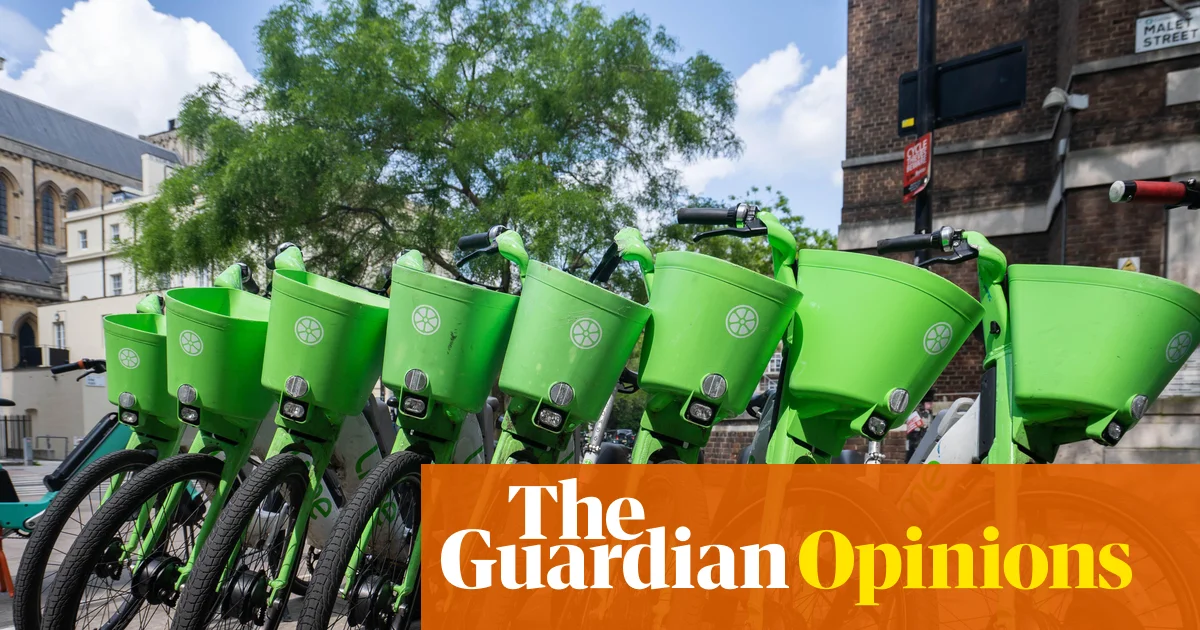
The night belongs to Lime bikes in the capital this summer. Buses and tube carriages are boiling, cars crawl between low traffic neighbourhoods and Thames Water roadworks, and pedestrians plod through the sticky heat. But Lime riders exist in a different, breezier realm: whirring along, chatting in pairs or blissfully alone, weaving through the city’s tree-lined maze, choosing impulsively between destinations, rarely stopping for anything or anyone.
“My favourite part of a night out is Lime biking home,” writes Annie Lord, a dating columnist and author, in Freewheeling: Essays on Cycling. “As I ride up a hill, the bike’s electrics click … And, for a little while, I’m free.”
According to the confidently expansive Californian company that owns Lime, Neutron Holdings Inc, the average age of its London riders is 34. With the capital’s weather becoming warmer and drier, and social media and other online sources making more information about things riders could do instantly available, rented e-bikes seem a perfect tool to unlock the city’s possibilities. Across the globe, they are changing urban life: speeding it up, connecting previously out-of-the-way places, and making many women feel safer at night. Where I live in Hackney, once one of the capital’s more isolated boroughs and now one of the busiest Lime markets, many pubs are enjoying a bike-driven boom on summer nights, with the bright green bikes glowing outside like lurid cocktails before their riders wobble home.
Yet since Limes became available in London and other British cities in 2018, the narrative has focused on their negative impacts. The way their riders often run red lights and cycle on pavements. How bikes are often dumped in pedestrian spaces after use, blocking entrances and vulnerable people’s safe routes. The fact that riders sometimes don’t share space considerately with traditional cyclists, and take over footpaths in parks. The strong sense that some Lime users can barely cycle at all. A 2023 report commissioned by Lime found that “20% of Lime riders in London had never cycled before”. That is not as straightforwardly positive a statistic as the company likes to think.
Other data about Lime usage is hard to come by, as the company considers it commercially sensitive. But information from Transport for London suggests Limes are disproportionately responsible for injuries to pedestrians. It estimates that in 2024 about 12% of the city’s cycling journeys were made on rented e-bikes, of which Lime is by far the biggest provider, yet rented bikes were reportedly responsible for almost a third of cyclist collisions with pedestrians that required police intervention. As anyone who walks much in London knows, Limes have changed the experience of crossing a road.
In truth, the Lime phenomenon is both an imposition and a liberation; an improvement to city life, and a sign of its sometimes alienating intensification; an expression of a certain kind of urban privilege (a half-hour London ride can cost over £10), and evidence of its diminution. It shows how the relationship has changed between mobility and property, especially among the young.
In 1975, Peter Ambrose and Bob Colenutt, two far-sighted British analysts of urban places, wrote in their book The Property Machine: “The city is a zone of conflict between competing claims for land.” In today’s London, as in other cities where space is sought-after and expensive, many Lime riders are young professionals, who in the past would have owned or rented homes close to the best public transport. Nowadays, that’s unaffordable for most of them, as is property ownership of any kind – as shown by the fact that the age of the average London first-time buyer has recently overtaken that of the average Lime rider, at 35.
E-bike rental, whether for commuting or pleasure, is a solution to the scattering of these people to less-connected suburbs. Young Lime riders in a hurry, you could say, represent the revenge of a generation priced out of living near tube stations. Meanwhile, some of those who complain about Lime users are older Londoners who were able to buy properties in more convenient locations. They say Lime bikes are starting to dominate the city, but late-20th-century homebuyers have a much deeper hold on the capital.
Tensions between the two groups can be reduced. This year, Hackney council says it has “worked with Lime … to install a high density of dedicated parking bays for the bikes, and compliance [by riders] is generally good”. To discourage riders from running red lights – a practice Lime’s critics claim is encouraged by its policy of charging by the minute – the council has also agreed with Lime a flat fee for local residents: £1.75 for trips of up to 25 minutes that start in the borough, the same price as a bus fare, and the lowest Lime rate in London. Amid all the acrimony about rental bikes, it’s often forgotten – deliberately so by the much more powerful motoring lobby – that in polluted cities with unequal public health, more cycling is good.
Yet a collaborative, responsible bike rental culture involving Lime, its customers and the overworked local authorities tasked with regulating both is some way off. Partly, this is because of commercial pressures: despite having big investors such as Uber, Lime is heavily in debt and not yet profitable. Meanwhile, as with many tech-enabled enterprises, key aspects of its business model have social costs. “People love the flexibility of being able to start and end their journey anywhere” said one of Lime’s senior executives, Andrew Savage, last year. What he would not – could not – acknowledge was that absolute convenience for his customers can mean inconvenience for everyone else. As usual last night, despite Hackney’s ban on leaving Lime bikes anywhere but official parking bays, someone left one blocking some of my road.
after newsletter promotion
Unless divided, expensive cities such as London build more affordable homes, provide more widely available public transport, and make bicycle ownership less vulnerable to criminals – in other words, make mobility and housing less competitive and hierarchical – the sometimes petty, sometimes dangerous rental bike wars are likely to carry on. But at least we won’t all be stuck in cars.
