


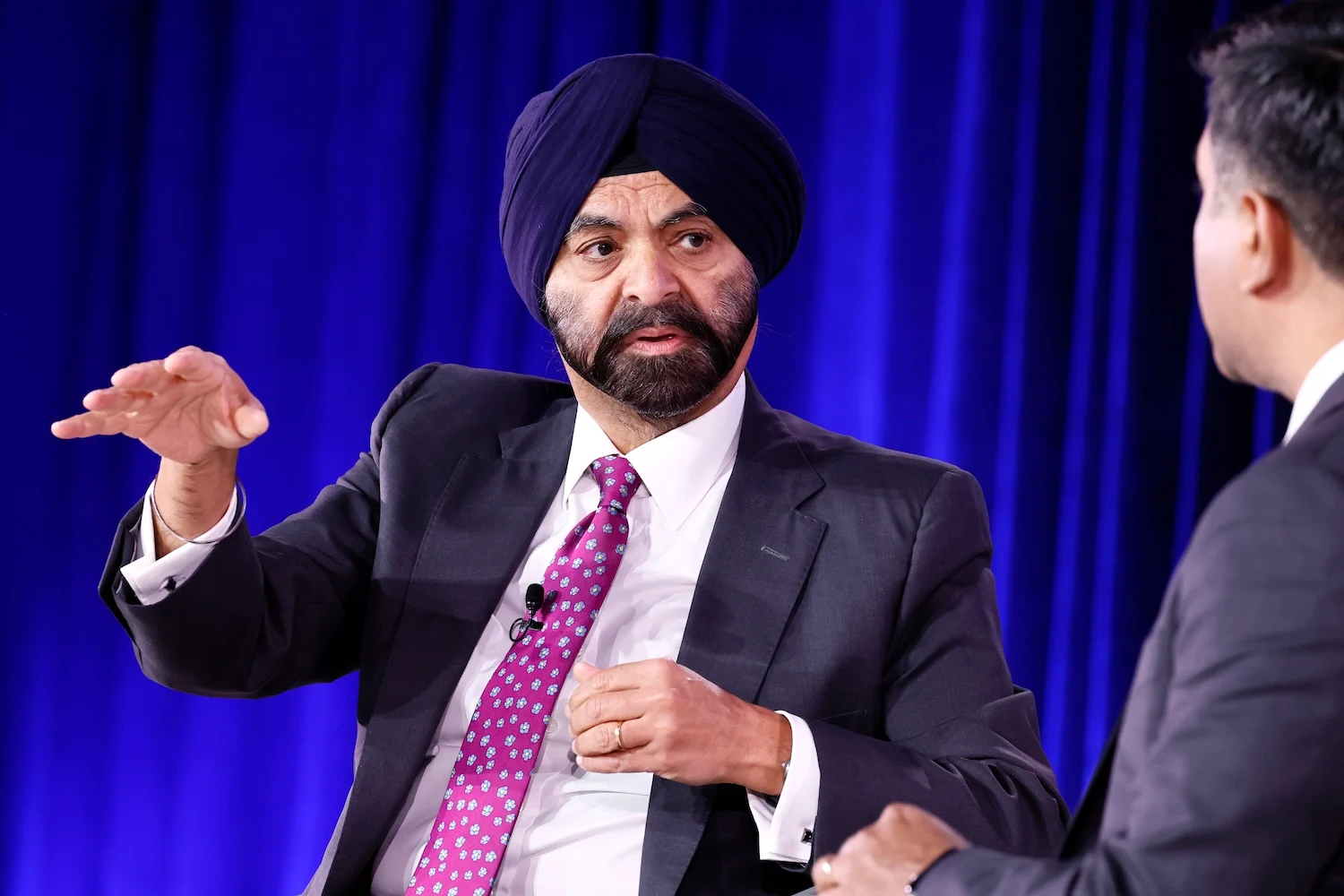
Ajay Banga has a simple north star as he runs the World Bank: jobs, jobs, jobs. As a corporate executive who worked at Nestle and Citigroup before he became CEO of Mastercard and grew its market value more than tenfold, Banga knows a thing or two about what makes the private sector tick—and why companies might want to invest in particular industries or countries. Banga was nominated by then-U.S. President Joe Biden to become the World Bank’s 14th president. He has stayed in the role through the Trump years and prides himself on working with a wide range of world leaders.
What’s his plan for creating a billion jobs globally? I spoke with Banga on the main stage of the annual Concordia summit on the sidelines of the United Nations General Assembly. The full discussion will air on FP Live, which is available on this website and on Apple, Spotify, or YouTube. What follows here is a lightly edited transcript of our discussion.
Ravi Agrawal: It’s very clear you’ve made job creation your highest priority at the World Bank. Why?
Ajay Banga: It’s basically got to do with two things. One is the demographics of the emerging markets, where 1.2 billion young people are coming through the pipe. They’ll be 18 years of age in the coming 12 to 15 years. That’s the time when they’re going to need to have the chance to have a job. “Job,” by the way, doesn’t mean working for a big company only—it could be a small farmer with a better chance to be productive, or an entrepreneur, or a small enterprise; whatever is appropriate. But that’s the idea: a chance to get a job to earn, but also to have a chance for dignity and opportunity. We’re in the business of removing poverty, and the best way to put a nail in the coffin of poverty is to give somebody a job, because poverty is both a state of mind and a state of being. A state of being is something you can fix with handouts, but changing a state of mind requires optimism and hope. Working for somebody, working for yourself, is the best way to do this.
RA: I guess the question then is, how? How do you help countries create jobs?
AB: Jobs are created in the private sector—overwhelmingly so—and within that, overwhelmingly so by micro, medium, and small enterprises. If you keep that at the back of your mind, the government enables, and the private sector creates those jobs; that’s the way the flywheel should work.
To make that work properly, you need infrastructure—that’s the first pillar. The obvious things are bridges, roads, airports, digitization, water, and electrification; a lot of the programs we’ve announced are in that area. Last year, we put about 40 percent of our money into infrastructure of different types. But there’s also human infrastructure, which is skilling, education, a healthy labor force, and healthcare delivery.
The second pillar is private-sector money, which goes where the environment is conducive to opening businesses: managing them, the rule of law, the role of governance, bankruptcy law, labor law, land law, mobile collateral guarantee law, the ability to start a firm and close down a firm.
The third pillar is de-risking private capital. Even if private capital investors were to believe that the opportunity in a country fits in terms of having the infrastructure and the rules, it still has risks. There is a way for institutions like ours and others to help de-risk some of that, so you change the risk-reward equation and enable private capital to flow in. That’s the logic of the three pillars.
RA: The first two pillars are either quite difficult to measure, or they might take years to pay off. The third pillar about capital, however, is quite easy to measure. And am I right in thinking you’ve more than tripled the amount of private capital coming in?
AB: You’re absolutely correct; we have. Our fiscal year closes on June 30, and this year, we mobilized $112 billion in private capital. Just three years back, that was more in the tune of $30-odd billion. So yes, it’s three times the amount, and we’re on a pathway where we can see more multiples of that coming into a range of countries.
RA: What’s the case you make to the private markets to raise this kind of money? I’ll note here there is also a common criticism that sometimes this kind of fundraising, which has been called “billions to trillions,” can be seen as privatizing capital, but socializing the risks.
AB: Those are all great thoughts; there’s nothing perfect in this system. But you should never let the naysayers get in the way of making progress, because then we’ll do nothing. Based on my many years of experience in the private sector, if I don’t have regulatory clarity in a country, I will choose to invest elsewhere, because I need to be able to give a certain kind of return to my shareholders. I tend to go where I get better clarity on the kind of business I’m getting into.
The second thing you need is political risk insurance, because you may be in a condition where a government says, “I’ll do XYZ for you, but including how much money you can repatriate as your profits after five years, et cetera.” And then they don’t live up to it at that time, and you as an investor made that baseline of coming in, but now you’ve got to figure out how to deal with that so we actually can get you political risk insurance. That has more than quadrupled in these four years.
RA: Wow. And who ends up paying for things if they go south?
AB: There’s a premium we collect from these companies, and then we lay off this insurance, if it’s of a certain quality, into the reinsurance markets. The reinsurance markets are insurance companies who are experts at underwriting this kind of risk, and they’re the ones who would pay off if it went south.
We’re now at about 35 percent of our financing in local currency. We’re trying to get to 40, and we’re working with 80 countries and creating local capital markets. That’s the longer-term issue, but the 35 to 40 percent local currency financing is real. Then they said, even if you do all this, how about you take the first loss—meaning, “Help me change my risk-reward equation by taking the first loss so I feel more secure.” First loss means that’s not what I want to do—but I did launch a fund using our retained earnings called the Frontier Opportunities Market Fund. The idea there is we take capped returns.
Let’s say you’re investing and I’m giving you $50 million. I’ll say, “On my $50 million, I’m OK with an 8 percent return. You make 12 percent, even on my $50 million. The extra 4 percent is yours.” In effect, I’m giving you a way to rebalance your risk and reward. A combination of these four strategies at different stages of wet paint are what’s getting us to the $112 billion in private capital mobilization. The reason why I have confidence in going further is that as we complete all the work on these, it gets better.
RA: Give me an example of something that the World Bank has been able to do to create jobs that you feel might be lasting. Let’s take India, which I imagine has the biggest market of those 1.2 billion potential jobs that will be required in the next decade.
AB: India is already doing an enormous amount of work on infrastructure on its own. They don’t really need our help today. They’re building tens of thousands of kilometers of roads a year. They’ve renovated 280 airports, ports, and bridges, and they’re improving digitization. You know well India’s success story of digitizing bank accounts. That’s not work in the first pillar of physical infrastructure. They want to work with us on the availability of water—getting drinking water piped to people’s homes, clean water, clean air, and so on. But they also work with us on energy. The Delhi Metro, for example, is powered by work we did with them a few years ago to build solar energy plants. Fast forward to today, and India’s state budget doesn’t need that kind of work from us. That’s how it should be. We don’t want to be the job creator everywhere.
Where they do need our help is in regulatory policy. In the beginning, we had people embedded in their ministries to help them rewrite policies. We’re still doing a lot of work on that front to attract private capital. Private capital mobilization has been one of the biggest markets for us in the last year or two. Last year, we mobilized close to $13 billion of private capital in India for all kinds of projects, ranging from minerals and metals to batteries, energy, and water.
Another example is Argentina, which has lithium deposits in the underdeveloped northwest corner of the country. To be able to mine those deposits and create local jobs and value-added processing, Rio Tinto mining group was very interested in going there. But you have to get from there to the ports, which requires roads, port modernization, customs facilitation, and documentation. You also need skilling institutes and people trained to work in these mines and factories. Typically, you would have one part of the bank talking to the government and another part talking to Rio Tinto. Hopefully, they’re all talking to each other and one day—kumbaya!—some project will happen. That’s not a strategy; hope is not a strategy. So we’ve sat them all down together and worked out the channels with the public side of the bank and the public part of the Argentinian government. We worked out what we could do with Rio Tinto through the International Finance Corporation and the Multilateral Investment Guarantee Agency, giving them guarantees and risk reduction. Lo and behold, the project’s ready to go. So it’s a mix of things coming together; the money and knowledge sides of the bank; the public, private, and guarantee sides.
RA: So you have all these data points globally, and as you can see—we have a packed audience here—one of the fears many people have is whether artificial intelligence is coming for everyone’s jobs. How do you create jobs that feel AI-proof? What kinds of conversations are you having with leaders?
AB: My remit is the emerging markets, not the developed world. If you step back and look at large language models (LLMs), studies find that up to one-third of jobs in the developed world, depending on who you listen to, could be exposed. It’s unclear when or how quickly. For middle-income countries, that number is down to single digits; for lower-income countries, that number is negligible or zero. I would argue that in the developing world, applications of AI can look like helping to make an illiterate farmer more productive. We’ve done this in different countries, including in the Indian state of Uttar Pradesh, where illiterate women farmers can point an old phone at the back of a diseased leaf, and it tells them which insecticide they can buy from their cooperative for how many rupees. They all have bank accounts, thanks to the Indian government’s work. This is facilitated by that kind of backbone being built.
RA: And by the way, if they’re illiterate, they can still use a phone because they can speak to it.
AB: So you need to think about predictive AI rather than LLMs being used, adopted, and then adapted for languages, which is what this example requires. Over a period of time, you can build new applications on it.
Healthcare is another obvious example. If you walk into a primary healthcare clinic in Indonesia, we have clinics set up with a nurse, a medical diagnostic technician, and a midwife, so you can cater to the typical needs of non-communicable diseases in a dispersed population. If you walk in and say, “I’ve got a rash on my neck,” and that nurse doesn’t know exactly what it is, they could photograph it and send it to a doctor shared by 20 clinics, who can then run it through a local AI model and say, “This is eczema, tell Ajay to put this on and it will go away,” or, “I don’t like what I see, he needs to come to the regional hospital in 14 days, here’s an appointment.” We’re also rolling that technology out across El Salvador. In models like this, whether for healthcare, farming, skilling, or education, this kind of AI is a huge productivity enhancer for emerging markets.
We’ve chosen five sectors to focus on for job creation, where the impact of the standard way of thinking about AI probably comes in later. First is infrastructure itself—it’s construction, but then what it enables. Construction is a hands-on, manual type of intervention. Second is agriculture for small farmers—such as the example of Uttar Pradesh—which enables them to be more productive and connect to cooperatives; to have better outputs and better pricing for their outputs; better seeds, water, fertilizer, forecasts, and so on. Third is primary healthcare. The Indonesian example offers a huge employment opportunity in addition to health benefits. Fourth is tourism, and fifth is value-added manufacturing: minerals, metals, fashion, et cetera. In that sector, automation would have an impact over time more so than AI.
RA: I see where you’re going with this.
AB: We’re busy supporting entrepreneurial centers in countries and creating small venture-capital funds to help people get access to capital there. My point is, yes, there’s a lot to worry about, but there’s also a lot that you can do to move the needle forward. We are trying to do that.
RA: You have this can-do approach that I think is refreshing and rare in the kind of job you have today. I’m curious how you deal with a vast cross-section of world leaders as you talk to them about these initiatives. As we can see in a week like this one, there is more that they disagree on than they agree on.
AB: Yes, but everybody thinks that of their time in these jobs. My attitude is, the truth will set you free. I just tell them exactly what I’m telling you: This is what I do, and this is how I’m benefited. Across its groups—other than the part that goes to the poorest countries, which is called the International Development Association (IDA)—most of the bank makes small amounts of profits. We’re not in the profit business. We’re certainly not in a loss business. We can therefore add retained earnings all the time. We have a triple-A rating, so we can leverage up 10 times from the bond markets, and that enables us to do the financial engineering magic that we do. That’s the money bank.
IDA, which goes to the 78 poorest countries in the world, gives away one-third of everything we do, every year, without any repayment. That’s a melting ice cream cone, and every three, four years, you have to go back and get replenished. So when you talk about private capital mobilization, I’m not doing it by not putting our own balance sheet to work. Our own balance sheet work has also gone up over these three years, but it’s gone up by much less than the private capital has gone up, because I don’t think there’s enough money in the public sector to manage the kinds of challenges we have. Explaining this in English, or whichever language anyone understands, is all I try to do. I’m trying to make the bank a better partner, and a faster, simpler place to work with. Thus far, things are going fine, so I’m not complaining.
RA: Are you going to serve again after your term?
AB: I have no idea. It’s not about me, right? They also need to want me around them. Who knows? We’ll see.
