


- As Earth warms, greenhouse gases released by thawing permafrost, wetlands, wildfires, and freshwaters could cause 0.2°-0.4°C (0.4°-0.7°F) of additional warming by 2100, a new study estimates.
- That would amplify human-caused warming since 2020 by 20-30%, with methane accounting for roughly half of the added warming.
- Most climate models leave these natural feedbacks out, so projections of future warming are likely too low and remaining carbon budgets too generous, the authors say.
- Cutting human emissions remains essential, but because some natural sources have no off switch, researchers are exploring ways to remove methane from the atmosphere.
As frozen ground thaws in the Arctic, dead plants and animals locked in soils for thousands of years start to decay, releasing methane and carbon dioxide. Those gases trap heat from the sun and warm the planet. And the more the planet warms, the more Arctic permafrost thaws. This is just one feedback loop among many that most climate modeling has largely overlooked.
A recent study published in the journal Environmental Research Letters examined four sources of greenhouse gases from natural systems: permafrost, wetlands, freshwater, and wildfires.
The authors estimate that greenhouse gases released by these natural systems could add another 0.2°-0.4° Celsius (0.4°-0.7° Fahrenheit) of warming by 2100. That would amplify human-caused warming since 2020 by 20-30%. Methane accounts for roughly half that warming.
Natural systems such as wetlands, permafrost, and forests have always released some greenhouse gases. This study tracks only the extra emissions released after 2020, as humanity keeps heating the planet by burning fossil fuels, clearing forests, and other activities. As this increased heat revs up these natural systems, thawing permafrost exposes additional ancient organic matter to decay. Warmer wetlands and freshwater lakes speed up the growth of the microbes that make methane. Drier forests burn more often, releasing planet-warming gases.
The study was the first to pull all four sources together and “quantify this amplification of anthropogenic global warming,” lead author Sam Abernethy, a climate scientist at U.S.-based nonprofit Spark Climate Solutions, told Mongabay.
Of the 11 Earth system models the U.N. Intergovernmental Panel on Climate Change (IPCC) used to assess feedbacks in its most recent report, none included warming-induced emissions from wetlands or freshwaters; only two included permafrost, and just five included wildfires, the study found.
This means that projections of future warming are likely too low, the authors warn, and the remaining carbon budget — the amount humanity can still emit before blowing past temperature targets — is likely too generous. The study authors are working to improve modeling of these emissions so they can be incorporated into the next IPCC assessment, due in 2029.
“We have warmed the planet,” Euan Nisbet, an emeritus professor of Earth sciences at Royal Holloway, University of London, who wasn’t involved in the research, told Mongabay via email. Echoing the late ecologist George Woodwell, he added that “warming may feed the warming.”
Nisbet called the study “important” and said there’s now “strong evidence” of rising methane emissions from living things, “especially from tropical wetlands, which are increasing in response to human-driven climate change.”
That rise, he added, is a major reason the world is falling behind the pathway laid out in the 2015 Paris Agreement, in which nearly 200 countries pledged to hold warming well below 2°C (3.6°F). The United States, the world’s second-largest greenhouse gas emitter, withdrew from the agreement in January 2026, for the second time.
Every added fraction of a degree matters: The IPCC notes that each additional half-degree of warming brings more frequent and intense heat waves, rainfall, flooding, and drought around the planet.
Abernethy’s research team is up-front about the limits of its estimates, noting that real-world results could be higher or lower. The authors say their study may overestimate warming because it left out processes that might offset some of it, such as vegetation regrowth after permafrost thaw and fire.
However, the study could also underestimate warming. In one comparison, the authors cite a separate study that put methane released by wetlands per degree of warming at nearly twice the figure they used. The 0.2°-0.4°C warming estimate in the Abernethy study could also be an underestimate because it leaves out other emission sources such as rice farming and forest die-back.

Part of the uncertainty comes from how little these natural emissions have been measured to date. Arctic permafrost and tropical wetlands are difficult places to put measurement towers, Abernethy said. “These natural sources are a bit of a blind spot for observations, which then means it’s really tough to put them into models, which then means it’s really tough to build policy around them.”
Even if society makes rapid, drastic emissions cuts, the added warming from natural sources will keep rising through 2100, the authors found. Near-term cuts shrink future natural emissions, they write, but can’t undo the warming from gases already released. “The larger reason warming from natural sources continues to rise is that CO2 emissions accumulate in the atmosphere, so the warming they cause keeps growing as long as those emissions continue,” Abernethy said.
He emphasized that cutting human-caused methane emissions remains a priority, since methane is more than 28 times as potent as carbon dioxide at trapping heat. Those emissions can be reduced today, for example by plugging natural gas leaks along the fossil fuel supply chain.
But some natural methane sources, once triggered by high rates of warming, have no obvious off switch. “If permafrost starts emitting way more methane than we expected, we won’t be able to solve that [problem] with the known … technologies,” Abernethy said.
That’s why researchers are looking for novel approaches to reduce these emissions or potentially pull methane back out of the air, he said.
Methods to remove atmospheric methane fall into a few categories, including efforts to help ecosystems absorb more methane, reactors that oxidize methane, and chemical strategies to boost the natural processes that destroy it.

One advantage of removing methane rather than carbon dioxide from the atmosphere is that it doesn’t have to be stored. “For carbon dioxide removal, you need to somehow grab the carbon dioxide molecule and put it somewhere deep underground or sequester it,” Abernethy said. “Whereas for methane, all you need to do is the chemical reaction of oxidation.”
Some of the most promising options already exist in nature. Soils in upland forests host methane-eating microbes called methanotrophs, which together form the largest biological methane sink on Earth. Clearing forests weakens that sink. In Kenya’s Mau Forest, converting native forest to farms and plantations cut soil methane uptake to less than half. In Brazil, researchers found that land-use change suppressed the microbes more than fertilizer did, and they concluded that protecting these natural ecosystems is key to keeping the sink working.
A 2024 study in Nature found that microbes living in tree bark pull methane from the air starting a couple of meters above the ground. The authors estimated that the world’s trees remove 25 million to 50 million metric tons of methane a year, roughly as much as soils. The team plans to study whether that uptake can be boosted.
A recent opinion paper in the journal Trends in Microbiology that Abernethy co-authored proposes an unusual methane reduction candidate: Caves, where methane-eating microbes consume the gas several times faster than forest soils do. Could pushing more air through these systems provide a natural methane transformer? More research is needed.
“We have lots of ideas for these solutions, but we don’t know what’s going to work,” Abernethy said, “and we don’t know how much we’re going to need.”
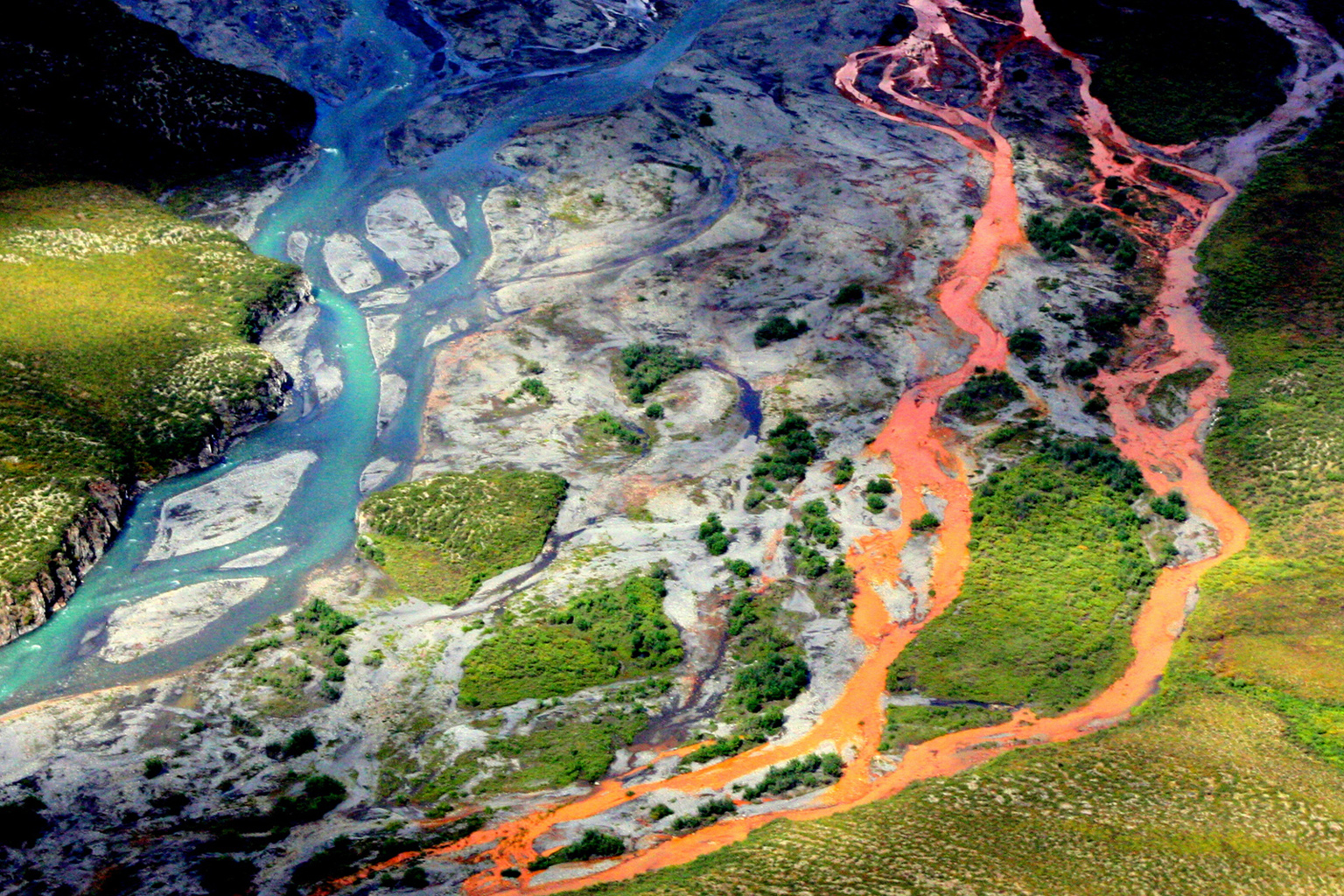
Banner image: The Kutuk River in Gates of the Arctic National Park, Alaska. Researchers say they believe thawing permafrost can change riverine ecosystems, with some turning orange due to increased iron-cycling. Image by Ken Hill / National Park Service.
Earth life support systems are flashing red, warns 2026 Planetary Health Check
Liz Kimbrough is a staff writer for Mongabay and holds a Ph.D. in ecology and evolutionary biology from Tulane University, where she studied the microbiomes of trees. View more of her reporting here.
FEEDBACK: Use this form to send a message directly to the author of this post. If you want to post a public comment, you can do that at the bottom of the page.
Citations:
Abernethy, S., Monteverde, D., Schädel, C., Buma, B., Duffy, P. B., Jackson, R. B., … Poulter, B. (2026). Projected amplification of global warming by warming-induced greenhouse gas emissions. Environmental Research Letters, 21(17), 174022. doi:10.1088/1748-9326/ae9e24
Kleinen, T., Gromov, S., Steil, B., & Brovkin, V. (2021). Atmospheric methane underestimated in future climate projections. Environmental Research Letters, 16(9), 094006. doi:10.1088/1748-9326/ac1814
Qian, H., Zhu, X., Huang, S., Linquist, B., Kuzyakov, Y., Wassmann, R., … Jiang, Y. (2023). Greenhouse gas emissions and mitigation in rice agriculture. Nature Reviews Earth & Environment, 4(10), 716-732. doi:10.1038/s43017-023-00482-1
Ripple, W. J., Wolf, C., Lenton, T. M., Gregg, J. W., Natali, S. M., Duffy, P. B., … Schellnhuber, H. J. (2023). Many risky feedback loops amplify the need for climate action. One Earth, 6(2), 86-91. doi:10.1016/j.oneear.2023.01.004
Changey, F., Aissaoui, G., Plain, C., Ranger, J., Legout, A., Zeller, B., … Lerch, T. Z. (2022). Prolonged effect of forest soil compaction on methanogen and methanotroph seasonal dynamics. Microbial Ecology, 86(2), 1447-1452. doi:10.1007/s00248-022-02149-8
Wanyama, I., Pelster, D. E., Butterbach-Bahl, K., Verchot, L. V., Martius, C., & Rufino, M. C. (2019). Soil carbon dioxide and methane fluxes from forests and other land use types in an African tropical montane region. Biogeochemistry, 143(2), 171-190. doi:10.1007/s10533-019-00555-8
Pitombo, L. M., Quevedo, H. D., Signor, D., Teixeira-Gandra, C. F., Taniwaki, R. H., Bayer, C., … Do Carmo, J. B. (2026). Land use change affects soil methane sink capacity of Brazilian biomes. Discover Soil, 3(1). doi:10.1007/s44378-026-00164-6
Gauci, V., Pangala, S. R., Shenkin, A., Barba, J., Bastviken, D., Figueiredo, V., … Malhi, Y. (2024). Global atmospheric methane uptake by upland tree woody surfaces. Nature, 631(8022), 796-800. doi:10.1038/s41586-024-07592-w
Bay, S. K., Reginato, P., Stubbusch, A. K., Abernethy, S., & Leung, P. M. (2026). Microbial methane oxidation in aerated subterranean ecosystems: An upscaling and intervention framework for climate change mitigation. Trends in Microbiology. doi:10.1016/j.tim.2026.07.006
Cite this article
Liz Kimbrough (2026). Permafrost, wetland, wildfire and freshwater emissions could amplify climate change by up to 30%, study finds. Mongabay Conservation news. DOI: https://doi.org/10.66709/news-331476

