


- A new field study found that two treatments of beneficial bacteria each protected reef corals from bleaching during a heat wave in the Red Sea.
- A heat-killed version of one of the bacterial treatments also protected the corals and may provide a cheaper, more shelf-stable alternative to live probiotics.
- Future studies are needed to determine whether the treatments also help corals stay alive over longer periods of time.
- Though wider implementation of probiotics faces barriers, researchers say many approaches are needed to protect corals in the long term.
As a heat wave settled on the Red Sea in 2022, a patch of corals in a reef 15 kilometers (9.3 miles) off the coast of Saudi Arabia reacted differently than other corals. They’d been treated with probiotics, beneficial bacteria isolated from healthy corals, and those treatments prevented the corals from bleaching, scientists now report.
Corals provide habitat for about one-third of marine species but are declining at an unprecedented rate, according to the latest report from the Global Coral Reef Monitoring Network. Rising temperatures lead to coral bleaching, a breakdown of the beneficial symbiosis between corals and algae that can result in coral death. Scientists estimate that if global temperatures rise by 1.5°Celsius (2.7°Fahrenheit) above pre-industrial levels, 70-90% of corals will be at risk of severe degradation worldwide by 2100.
“Corals can acclimate and adapt, but only if they are alive,” principal investigator of the new study Raquel Peixoto, a microbial ecologist at the King Abdullah University of Science and Technology (KAUST) in Saudi Arabia, told Mongabay in a video call. She and other researchers around the world are investigating how manipulating the microscopic bacteria that live on corals can help them respond to threats ranging from oil spills to infectious disease. Though Peixoto previously showed that probiotics could stave off bleaching and keep corals alive in tanks, the new results, published Sept. 3 in Cell Reports, are the first to indicate that probiotics may help protect corals in the wild from marine heat waves.
“It’s one thing to do experiments in tanks and to say, ‘Look, it helps mitigate coral bleaching effects,’ or ‘it helps corals be healthier.’ And it’s a whole other thing to demonstrate that on the reef,” Andrea Grottoli, a marine scientist at Ohio State University in the U.S. who was not involved in the study, told Mongabay by phone.
“Demonstrating that the [treatments] actually mitigate heat stress in situ, in a real reef situation, is fantastic,” Grottoli said.
From the lab to the sea
In 2021, Peixoto, then a new professor at KAUST, established the underwater lab she’d long dreamed of: A sheltered area within an existing reef composed of different coral species, where she and her colleagues could test the restoration tools they’d been developing. They dubbed it the “Coral Probiotic Village.” Three years later, their results showed that probiotics successfully changed the microbiome of corals in the underwater lab, increasing the presence of some beneficial bacteria and reducing potential coral pathogens without also changing the bacterial composition of the surrounding seawater and sediment. But the findings documented how probiotics affected healthy corals, not those experiencing stress.
In the new study, the researchers wanted to see whether they could use probiotics to protect corals from a heat wave in the underwater lab located in the Red Sea, as they had in tanks. They also wanted to know if they could achieve similar effects using postbiotics, a version of probiotics that have been killed with heat. Postbiotics work by triggering an immune or other protective response in an organism, and can be a cheaper and more shelf-stable alternative to probiotics.
In 2022, when a heat wave struck the Red Sea, Peixoto’s lab moved quickly. The researchers prepared two probiotic treatments with a mix of bacteria they suspected would have beneficial functions (various species from the Cobetia, Halomonas, Sutcliffiella and Pseudoalteromonas genera), which they’d previously isolated from local healthy coral (Pocillopora favosa, Stylophora pistillata, Galaxea fascicularis and species from the genus Acropora). They prepared additional treatments with the probiotics’ postbiotic counterparts.
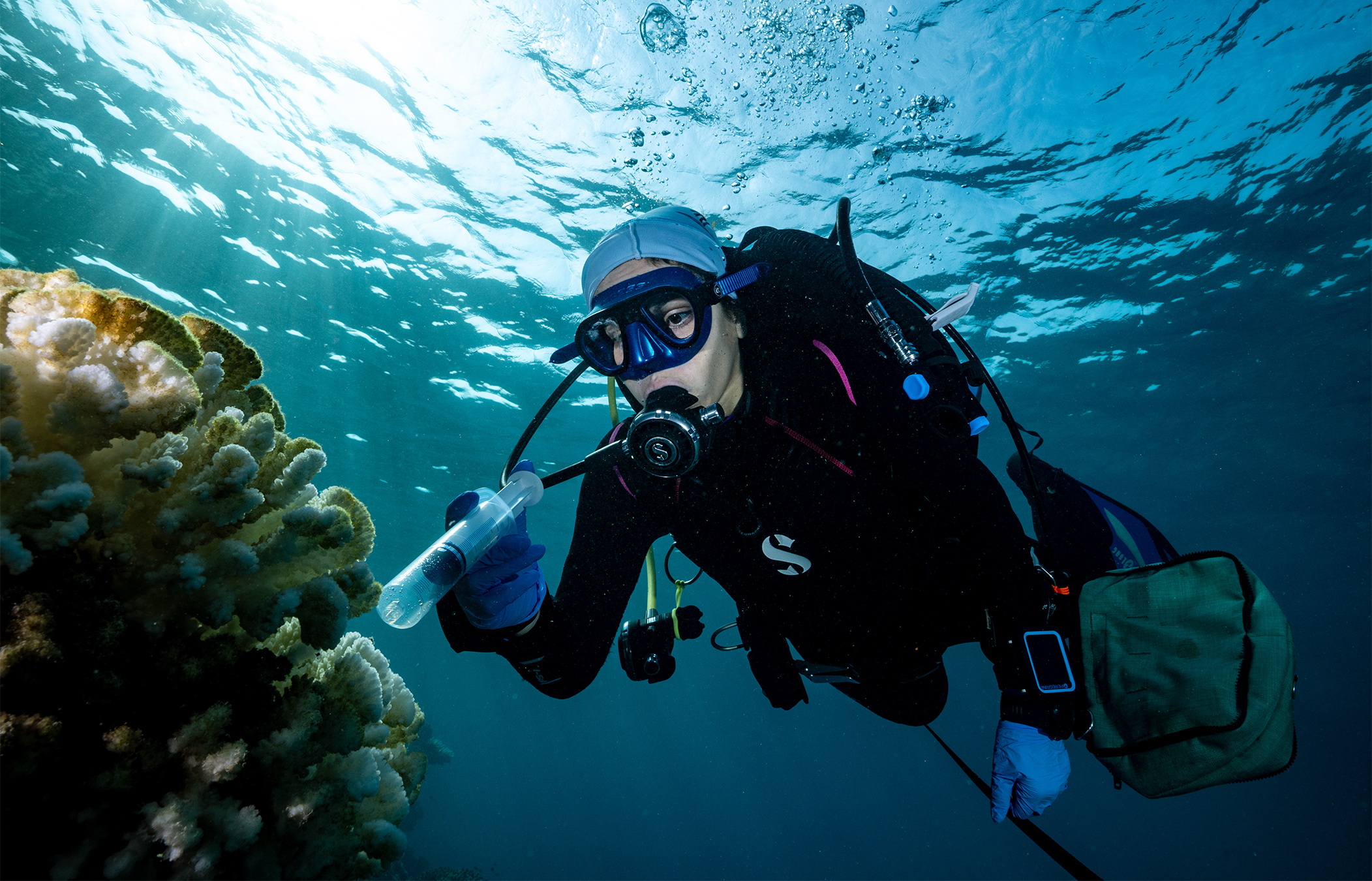
During the heat wave, water temperatures in their underwater lab fluctuated between 30.9°C and 32°C (87.6°F to 89.6°F) — about 1.2°C (about 2.2°F) above the local summer average, which can harm corals when sustained, Peixoto said. Over 15 days, lead author Erika Santoro and her colleagues dove down to the reefs eight times and used syringes to administer the treatments into the water near A. valida corals. They also monitored the corals’ health, recording both color — a measure of bleaching — and the efficiency with which symbiotic algae inside the corals’ tissue performed photosynthesis and produced nutrients.
Even though the heat wave had already started before they treated the corals, those administered the probiotic treatments and one of the postbiotic treatments maintained their photosynthetic efficiency and color, while the health of the untreated control corals declined.
Using genetic sequencing, the researchers found that the microbiomes of the corals had changed after treatment. In those treated with the postbiotics, for example, the presence of Cobetia bacteria, thought to help corals resist heat, increased. Each treatment also provoked a different metabolic response in the corals. “That’s very interesting, because it says there are different ways to protect these corals,” Peixoto said.

‘Building the plane as we fly’
There are several issues to address before pro- or postbiotics could be deployed to protect corals more widely. The researchers only treated one species of coral, and say it’s likely that other species will need their own distinct cocktail of protective microbes. Treating reefs with pro- or postbiotics is time- and labor-intensive. There’s also the matter of scale, since reefs can cover large areas. Since conducting the field study in 2022, the researchers have been developing beads composed of the biodegradable gel alginate that can keep probiotics stable for longer in the fridge and release them slowly on reefs, but they don’t yet know just how long those beads keep bacteria alive.
Grottoli also said that although the pigmentation and photosynthesis results are promising, a longer-term study would be needed to demonstrate the treatments actually improve coral growth and survival.
“We are building the plane as we fly,” Peixoto said, working on feasibility, scaling and understanding protective mechanisms all at once, because “corals don’t have a lot of time.”
She acknowledged, too, that probiotics will never be a silver bullet, and that scientists will likely need multiple approaches in different locations to protect corals from heat waves.

Grottoli has developed her own technology to improve coral health by improving their feeding. But she said all of these approaches are “short-term band-aids” that buy time to address the factors driving coral stress, such as climate change, along with overfishing and coastal pollution.
“The technologies kind of fight against a declining landscape,” she said. But they “can’t be a panacea for coral reef survival by the end of this century.”
Banner image: Researcher Raquel Peixoto inoculating probiotics on bleached coral during a 2022 heat wave in the Red Sea. Image courtesy of Morgan Benett-Smith.
Probiotics slow a deadly disease in Florida coral, study finds
Even the Gulf of Aqaba’s ‘supercorals’ bleached during 2024 heat wave
Citations:
Hoegh-Guldberg, O., Kennedy, E. V., Beyer, H. L., McClennen, C., … Possingham, H. P. (2018). Securing a long-term future for coral reefs. Trends in Ecology & Evolution, 33(12), 936-944. doi:10.1016/j.tree.2018.09.006
Schleussner, C., Lissner, T. K., Fischer, E. M., Wohland, J., Perrette, M., Golly, A., … Schaeffer, M. (2016). Differential climate impacts for policy-relevant limits to global warming: The case of 1.5 °C and 2 °C. Earth System Dynamics, 7(2), 327-351. doi:10.5194/esd-7-327-2016
Rosado, P. M., Leite, D. C., Duarte, G. A., Chaloub, R. M., Jospin, G., Nunes da Rocha, U., … Peixoto, R. S. (2018). Marine probiotics: Increasing coral resistance to bleaching through microbiome manipulation. The ISME Journal, 13(4), 921-936. doi:10.1038/s41396-018-0323-6
Santoro, E. P., Borges, R. M., Espinoza, J. L., Freire, M., Messias, C. S., Villela, H. D., … Peixoto, R. S. (2021). Coral microbiome manipulation elicits metabolic and genetic restructuring to mitigate heat stress and evade mortality. Science Advances, 7(33). doi:10.1126/sciadv.abg3088
Garcias-Bonet, N., Villela, H., García, F., Duarte, G., Delgadillo-Ordoñez, N., Raimundo, I., … Peixoto, R. (2025). The coral probiotics village: An underwater laboratory to tackle the coral reefs crisis. Ecology and Evolution, 15(7), e71558. doi:10.22541/au.172511515.58013062/v1
Voolstra, C. R., Peixoto, R. S., … Ferrier‐Pagès, C. (2023). Mitigating the ecological collapse of coral reef ecosystems: Effective strategies to preserve coral reef ecosystem. EMBO Reports, 24(4). EMBR202356826. doi:10.15252/embr.202356826
Delgadillo-Ordoñez, N., Garcias-Bonet, N., Raimundo, I., García, F. C., Villela, H., Osman, E. O., … Peixoto, R. S. (2024). Probiotics reshape the coral microbiome in situ without detectable off-target effects in the surrounding environment. Communications Biology, 7(1). 434. doi:10.1038/s42003-024-06135-3
Cardoso, P. M., Hill, L. J., Villela, H. D., Vilela, C. L., Assis, J. M., Rosado, P. M., … Peixoto, R. S. (2024). Localization and symbiotic status of probiotics in the coral holobiont. mSystems, 9(5). e00261-24. doi:10.1128/msystems.00261-24
Peixoto, R. S., Sweet, M., Villela, H. D., Cardoso, P., Thomas, T., Voolstra, C. R., … Bourne, D. G. (2021). Coral probiotics: Premise, promise, prospects. Annual Review of Animal Biosciences, 9(1), 265-288. doi:10.1146/annurev-animal-090120-115444
Barno, A. R., Villela, H. D., Cardoso, P. M., García, F. C., Cui, G., Delgadillo-Ordoñez, N., … Peixoto, R. S. (2026). Bacterial inoculation elicits changes to the coral epigenome. Nature Communications. doi:10.1038/s41467-026-77646-2

