


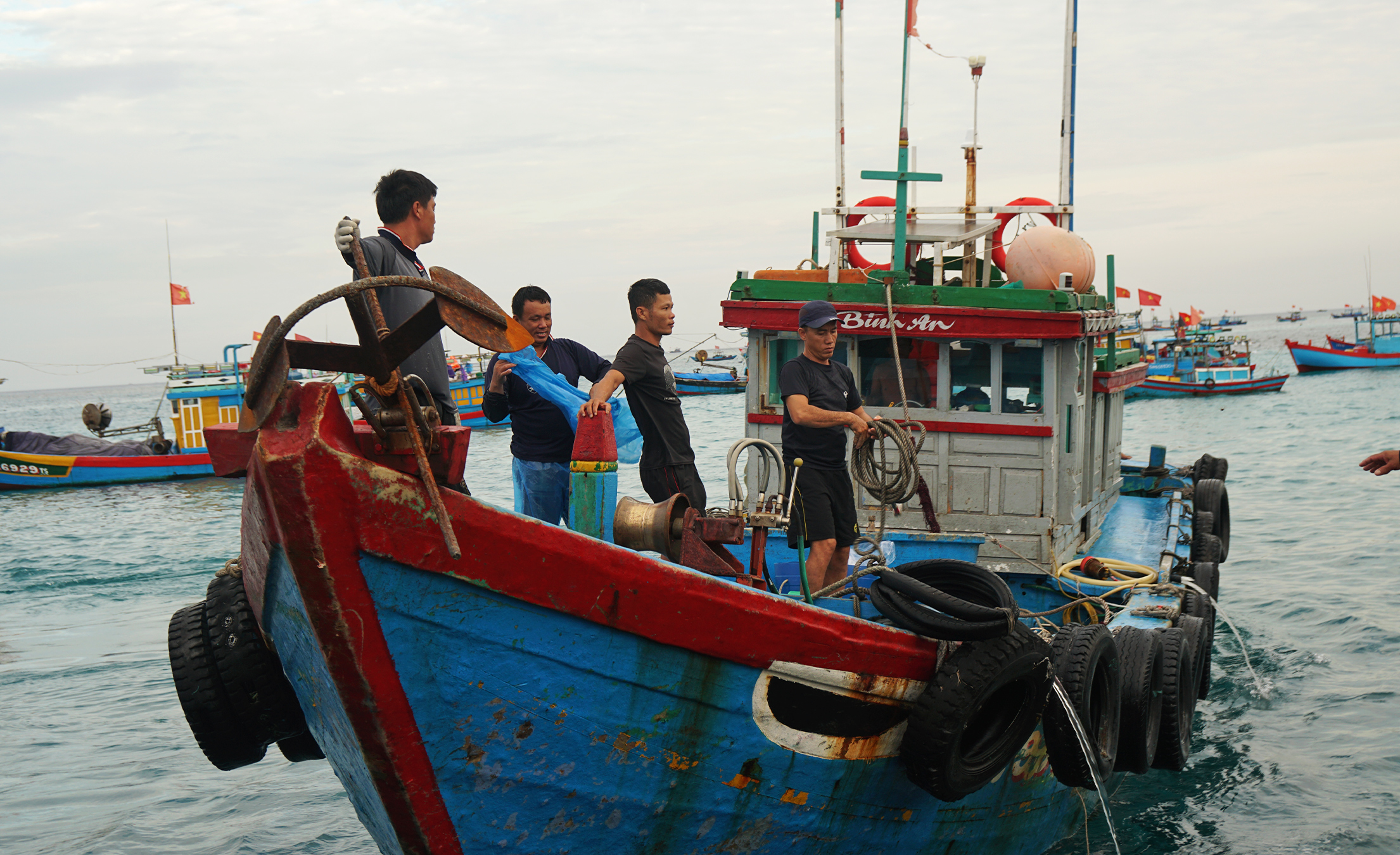
- As Hanoi leans on fishers to hold the line in contested waters, a distant war and a demanding European compliance regime are squeezing the same boats from opposite directions.
- The fuel crisis caused by the Iran War adds to the pressure.
- Data shows a nearly-19% year-on-year drop in fishing activity during March and April 2026, the height of the fuel crisis.
QUANG NGAI, Vietnam — When diesel prices in Vietnam hit an all-time high in March, Vo Huu Viet, a fisherman with more than 30 years at sea in Quang Ngai province in Central Vietnam, did something he rarely does. He stayed on shore.
“The catch is simply not enough to make up for the labor of four men,” Viet said.
Docking the aging wooden boat he inherited from his father means he, his wife, his crew and their families had to do other work, such as hauling heavy goods for other people, to make ends meet.
Viet was hardly alone.
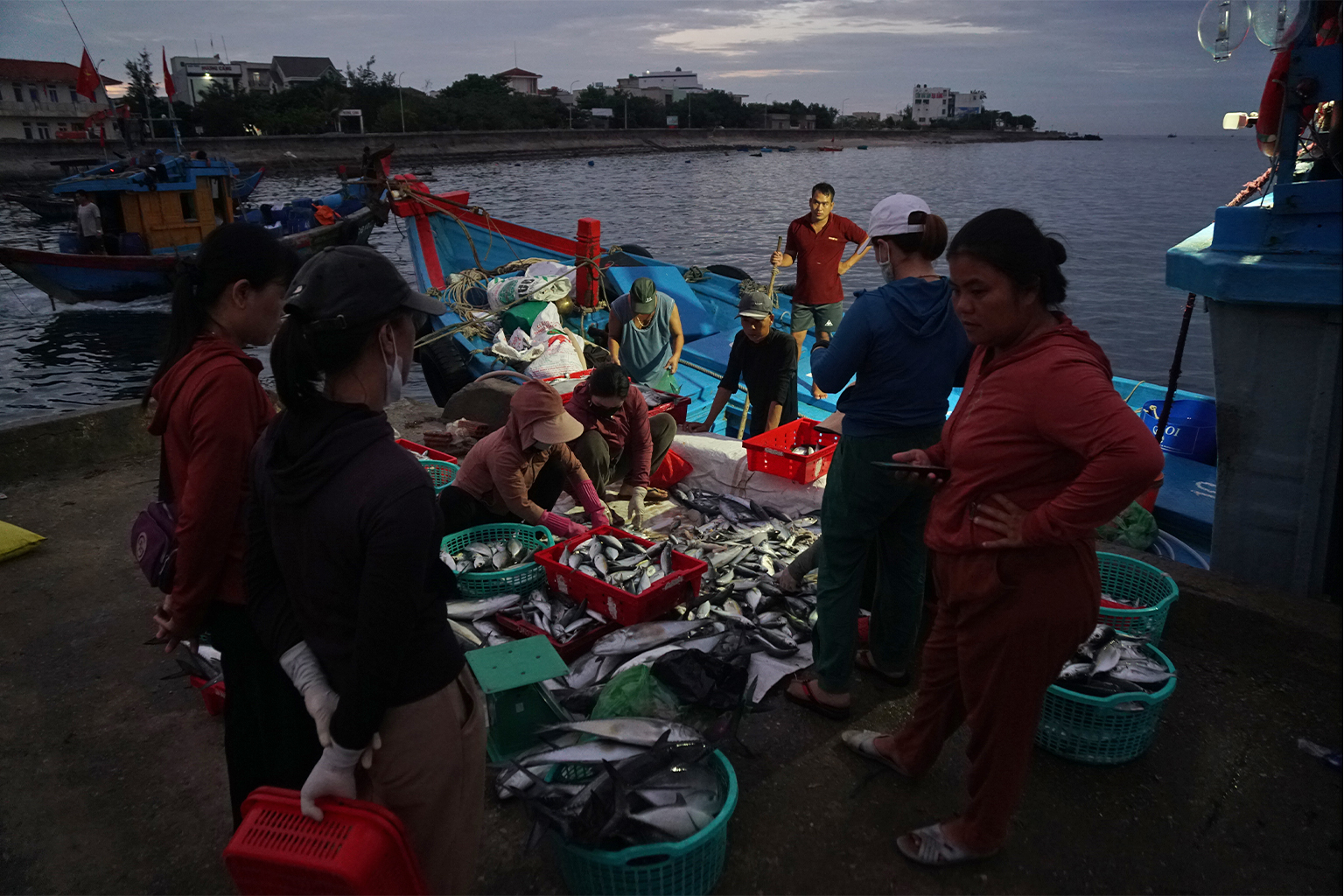
In fishing ports around Vietnam, thousands of boats stayed docked for months as the fuel crisis made sea-bound trips unprofitable. The hike in fuel prices, fishers told Mongabay, didn’t just raise the cost of diesel — it raised the cost of everything else that supports a fishing boat, from ice to food.
From March 1 to April 21 of this year, fishing activities around Vietnam fell 18.9% compared with the same time last year, from the nonprofit vessel-tracking platform Global Fishing Watch. For energy-intensive trawlers, the drop was 31%.
Fuel is not the only pressure. Declining fish stocks — the result of years of unsustainable and illegal fishing, compounded by climate change — along with international pressures to tighten fishing enforcement and the growing presence of Chinese vessels add to the strain. The toll is economic, mental and, for some, brutally physical.
Meanwhile, directives from the Vietnamese government are often contradictory. On one hand, Hanoi relies on the fleet to hold the country’s territorial claims, subsidizing boats to trawl in contested, depleted waters. On the other, it is working to tighten monitoring and regulations in order to protect the country’s exports.
In 2017, the European Commission issued Vietnam a “yellow card,” a formal warning that a country’s fisheries oversight fails to meet the European Union’s criteria on illegal, unreported and unregulated (IUU) fishing. A yellow card acts as an immediate non-tariff barrier that, research shows, is equivalent to a 5% tariff rate and slashes fishery exports to the EU by an average of 23%. A red card is an outright import ban on marine fish.
Since then, the commission has worked with Vietnamese authorities to improve fisheries control policy, a commission spokesperson said in an email response to Mongabay.
For Hanoi, this means an across-the-board fisheries reform to tighten regulations, boost monitoring and enforcement, and implement conservation and sustainability measures.
Removing the yellow card to boost the $11.34-billion fisheries export industry has been a stated goal of Hanoi’s central government for years, across leadership changes. Almost a decade later, it remains in place.
Vietnamese fishers, caught in the middle of clashing goals, stand to absorb the cost.

The yellow card
When the European Commission issued Vietnam’s yellow card in October 2017, it cited a long list of serious failures. At the time, the commission wrote, the country’s fisheries law did not apply to boats fishing beyond Vietnam’s own waters, required no catch logbooks, and set penalties too small to be a deterrent. Of the roughly 33,000 Vietnamese vessels fishing within Vietnam’s exclusive economic zone, but more than 24 nautical miles (45 kilometers) offshore, only about one in 10 carried a working vessel monitoring system (VMS), and none were legally required to keep it switched on, according to the commission.
The heightened scrutiny has cost Vietnam economically.
In 2017, the EU overtook the U.S. for the first time to become the largest buyer of Vietnamese seafood, with purchases worth $1.4 billion, up 22% from the year before. By 2019, exports to the EU had fallen by 12% compared with 2017, a loss of $183.5 million.

Vietnamese officials have warned that an upgrade from yellow card to red card could cost the industry an estimated $500 million.
Vietnam has responded with new laws, tighter enforcement and international cooperation. Weeks after the yellow card was issued, the National Assembly passed the landmark Fisheries Law incorporating the commission’s recommendations. In 2019, a follow-up decree set fines of 800 million to 1 billion Vietnamese dong (roughly $35,000-$43,700) for fishing in another country’s waters without a license — a sum that can exceed the entire catch value of a single long trip with a crew of a dozen or more.
Most fishers Mongabay spoke with knew little about the exact fine amounts. But they understood the consequences well.
“We cannot fish outside Vietnam’s waters anymore. The machine knows everything,” said Xanh, a fisherman in his 50s from the fishing village of Tinh Ky, referring to the GPS trackers now required on larger boats.
“They fine harshly. If they catch you doing that, they put you in jail.”
The money Vietnam has spent chasing compliance, however, has gone disproportionately toward enforcement rather than fisheries management or ecological restoration, said Carolyn Gruber, a fisheries expert at the Stimson Center, a Washington, D.C., think tank. “It’s more of what we would call securitization. So we are transforming fishing management into like military enforcement actions.”


A fleet of purposes
The South China Sea has long been a contested body of water, with regional claimants fighting over sovereignty in this strategic, resource-rich stretch of ocean.
Beijing has been the biggest and most forceful claimant. China’s nine-dash line demarcates a claim to roughly 90% of the South China Sea, and the country backs it with large-scale artificial island building and militarization, and a patrolling fleet of coast guard vessels and fishing militia.
“From what we see of their ships, China very much treats the [nine-dash line] as some type of boundary,” said Harrison Prétat, deputy director of the Center for Strategic and International Studies’ (CSIS) Asia Maritime Transparency Initiative.
Chinese vessels, he said, station inside the line, wait for foreign boats to cross it, then maneuver to push them back out.
The Embassy of China in Hanoi did not respond to an emailed request for comment by the time of this publication.
In the contested South China Sea, Vietnam’s fishing fleet does double duty — catching seafood and staking territorial claims.
It’s no secret that Vietnam has an official fishing militia. Since a 2009 law formalized the force, its members have received government training and a modest allowance. But the militia itself is small: As of 2016, it made up just 0.08% of Vietnam’s total militia force and just 1.22% of the country’s maritime labor force, with an estimated 8,000 vessels.
Beyond the formal militia, a far larger number of ordinary commercial boats are encouraged to operate in contested waters through a fuel, insurance and navigation-equipment subsidy program that the prime minister authorized in 2010. The program even provides support for fishers captured by foreign countries.
Fishers colloquially call these subsidized trips “island protecting.”
“How can we abandon it?” Xanh said of the Paracel Islands, the nearest disputed archipelago to Quang Ngai. He and his peers have had run-ins with Chinese coast guard vessels over the years, including — in what used to be a common occurrence — being hosed down with water cannons powerful enough to damage a wooden hull.
“It’s our historical fishing ground,” he said.

As Vietnam’s fishing fleet expands, it has run into an overcapacity issue.
Over the past decade, Vietnam’s fishing fleet grew more than 3.5 times over, from just over 4 million combined horsepower to more than 14.4 million HP in 2023. However, marine fish catches only grew by less than 1.7 times over the same period, according to the General Statistics Office of Vietnam.
A depleted ocean has pushed fishing boats to go further out, fishers in Quang Ngai told Mongabay, which the government once encouraged.

The fuel crunch
Fishers say the subsidy is appreciated, but it doesn’t go very far. This has been particularly true since the fuel crisis.
The payout scales with the boat. A mid-sized vessel of around 400 horsepower can receive roughly 35 million dong (about $1,330) per qualifying trip. A larger boat of over 700 HP can receive up to 100 million dong (about $3,810) per trip, usually lasting two to three weeks at sea, with a maximum of four subsidized trips allowed per year.
Diesel in Vietnam has floated around 25,000 dong a liter (about $3.60 a gallon) in recent years. But after war broke out in Iran in late February, sending oil markets into a spiral, Vietnamese diesel prices hit an all-time high in March at 43,000 dong a liter, or roughly $6.20 a gallon.

An “island protecting” trip usually lasts two to three weeks and burns through up to 5,000 l (1,320 gal) of fuel — close to $8,200 worth, at March prices. Adding bait, food for a crew at sea for over two weeks, maintenance, and wages, a Paracel-bound trip needs to earn at least $27,000 just to break even.
“The pressure is high because you’re not only thinking about breaking even, but also the wage of your ‘brothers’ and their families,” one boat owner told Mongabay. Many captains and owners, especially those already in debt, did not want to take the risk.
While Vietnamese boats sat docked throughout the March and April fuel spike, the Chinese fleet showed no comparable pullback. Chinese militia activity in the South China Sea has kept expanding in recent years, according to CSIS.
“We haven’t seen less militia, and we certainly haven’t seen less coast guard activity,” Harrison Prétat said.
For Beijing, he argued, a fuel shock that raises the cost of maintaining a presence in the South China Sea might not be bad news. “This is going to be way more expensive for the Philippines and Vietnam,” he said, describing what he sees as the likely calculation in Beijing.
The largest Vietnamese fishing boats in an “island protecting” trip would receive a maximum of $3,810 of fuel subsidy for a month. The largest Chinese fishing vessels receive roughly the same amount for a day, about $3,740, according to a 2021 CSIS report on China’s maritime militia.

Bleaker future ahead
“Going to sea has been so hard these past two years,” a fisher at Tinh Ky fishing port, who asked not to be named, told Mongabay. “Coast guard and fisheries officers check everything, at the port, again at the river gate, and out in the sea.”
“Sometimes they check the boat, then demand a million dong for ‘beer money,’” he half-laughingly added.
Tighter IUU enforcement has added layers of bureaucracy and, fishers said, more opportunities for petty corruption along the way.
For fishing communities in Quang Ngai that have considered the Paracel Islands as traditional fishing ground, Chinese vessels have pushed the line closer to the Vietnamese shore each year.
While outright violence has become less common — fishers say the water-cannon attacks that were once routine have largely stopped — confrontations still happen. In 2024, more than 40 Chinese fishers boarded a Vietnamese vessel near the contested Paracels, attacked the crew with iron pipes, and confiscated the entire catch.
“They used to let us go 110 nautical miles [207 km] out from the port,” Xanh said. “Now, sometimes they start chasing around 90 nautical miles [167 km].”
Underlying all of it, Gruber said, is a problem no single country can fix on its own.
“It just seems like a pretty classic case of a tragedy of the commons,” Gruber said. “While this is supposed to be a shared space, it’s just sort of mired in these contested boundary issues where resource extraction is being used as a proxy for just gaining more territory.”
The lack of regional co-management and the impacts of climate change — warming waters and changes in circulation — will strain the fishing resources in the South China Sea further, he added.

Hanoi, in recent years, has recognized the unsustainability of an ever-expanding fleet. In 2024, the government approved a plan to conserve fisheries resources that sets a target of reducing the national fishing fleet to 83,600 vessels by 2030, and requires provinces to cut their vessel count by at least 12% from 2020 levels.
Small near-shore boats, like Viet’s, are among the ones targeted. Yet, he has no intention of giving his up, he said. Like many fishers in the area, going out to sea is all he knows.
His income, he said he expects, will keep shrinking, squeezed between rising costs and an already exhausted coastal fishery.
After filling his tank, at dusk, Viet and his three crewmen headed out to sea. He would spend four days on the water, and he said he expected to come home with a total profit of 3-4 million dong — $115 to $153 — to be split between the four of them.
Banner image: Vietnamese fishers take to uncertain waters in a distinctive, blue-painted boat. Image by Minh Tran for Mongabay.
Philippine Supreme Court rules monitoring commercial fishing vessels is unconstitutional
FEEDBACK: Use this form to send a message to the editor responsible for this story. If you want to post a public comment, you can do that at the bottom of the page.
Cite this article
Minh L Tran (2026). Vietnam’s fishers face rising costs, declining catches and a contested sea. Mongabay Conservation news. DOI: https://doi.org/10.66709/news-331508

