


- Across Amazonia, extreme temperatures have risen faster than mean annual temperatures between 1981-2023, according to a recent study.
- The central-northern Amazon, which overlaps many protected areas and Indigenous territories in Brazil, has experienced the greatest increases in extreme temperatures and water deficit, the study found, despite being outside the arc of deforestation.
- The causes of this regional increase remain unclear. The study’s authors suggested global climate phenomena — from the collapse of ocean currents to El Niño — may be responsible.
- Climate experts interviewed by Mongabay said the work re-emphasizes the need to reduce emissions globally and continue limiting deforestation locally.
A small team of scientists was counting plants for a forest census near Manaus in northern Brazil when fire season started in October 2023. Some days the smoke was too thick to see; on other days it was too hot to wear conventional masks, so Aretha Guimarães, a biologist with Brazil’s National Institute of Amazonian Research (INPA) and her colleagues covered their faces with wet bandages in order to breathe. Even through the bandages and smoke, the smell of dead, rotting sloths was overpowering, Guimarães remembers.
“Animals just kept showing up dead,” she told Mongabay over a video call. “I’ve never seen such mortality. We were shocked.” Over the following months, Guimarães and her team found dead sloths in every part of the forest they studied; some still hanging from branches. Most, they assumed, could not move quickly enough to find water when temperatures started to rise. “I can’t explain what happened, because I’ve never seen such a thing.”
For decades, research has highlighted southern Amazonia, thousands of kilometers away, as the region’s climate change hotspot, where average temperatures are increasing faster than the north, exacerbated by deforestation and sweeping forest fires. Recent research published in September in Nature, however, identifies the central-north part of the Amazon Basin as the vanguard of an “alarming” increase in temperatures and dry conditions.
Analyzing satellite, aircraft and observation station data between 1981-2023, the researchers found that across all of Amazonia, extreme temperatures increased more than twice as quickly as annual mean temperatures. Extreme dry conditions also worsened more quickly than mean changes, while rainfall did not significantly change across Amazonia over the time period.
The central-northern part of the region saw the greatest changes, with 10% of the biome seeing extreme temperatures. The top 5% highest temperatures measured rose by 0.75°Celsius (1.35°Fahrenheit) per decade or by more than 3.22°C (5.80°F) across the 43 years analyzed — more than three and half times the average rate of increase across the region.
“It was a big surprise,” Nathália S. Carvalho, a post-doctoral research associate at Lancaster University in the United Kingdom who led the study’s mapping. “When we think about the impact of climate change in the Amazon, the first region that comes to mind is the south. But these results for extremes are very clear.”
The authors say their findings could help explain several climate impacts in northern Amazonia, which they see as a “new region of climate concern — from bird die-offs and the dead sloths Guimarães documented, to forest fires, severe droughts, and increased hospitalizations for heat and smoke exposure in the nearby city of Manaus.

The study challenges significant assumptions underpinning previous studies of climate change in the Amazon, according to co-author Jos Barlow, a conservation science professor at Lancaster University. “Often people talk about Amazonia as a single place. Biogeographically, culturally, climatically, it is not; there are many Amazons,” Barlow told Mongabay over a video call.
In several past studies, researchers have modeled Amazonia as if the entire region has the same dry and wet seasons. In reality, the months typically drier in southern Amazonia (July to October) are some of the wettest in the north. For this study, Barlow says they looked not only at extremes, but analyzed the region by splitting it in 11-kilometer (6.8-mile)-wide grid cells and identified when the dry season occurred in each area.
In order to track extremes, the researchers used a relatively new statistics package released by the University of Bristol in 2021, called qgam. Matteo Fasiolo, an associate professor in statistical science who wrote qgam, reviewed the paper and said that while the exact figures for warming had “a lot of uncertainty,” the data clearly showed that extreme temperatures had worsened more quickly than average. “It’s nice to see that [qgam] has been used in an impactful application,” he told Mongabay in an email.
North-central Amazonia faces worrying dryness
The region experiencing the fastest changes covers about 700,000 square kilometers (270,000 square miles), mostly in the northernmost Brazilian state of Roraima and is relatively undeveloped compared to the southern and eastern parts of the Amazon. “It’s probably one of the areas with the highest protected area density coverage in the Amazon,” Barlow said. “You’re mostly either in a federal or state reserve, or Indigenous land.”
That makes the impacts of climate change especially clear, according to Jose Antonio Marengo, a meteorologist who has authored eight Intergovernmental Panel on Climate Change reports and now leads research and development at the Brazilian government’s National Center for Monitoring and Early Warning of Natural Disasters (CEMADEN).

“The results do not come as a surprise, but they are interesting,” Marengo, who was not involved in the study, told Mongabay over a video call. Historically, deforestation has concentrated in south-eastern Amazonian states, with about a third of all forest loss in the Amazon since 1988 happening in Mato Grosso, on the border with Bolivia. In Roraima, that loss represents about 2% of all forest loss in the same period, according to data from Brazil’s National Institute for Space Research.
Deforestation in the southeast has driven changes in climate by disrupting the water cycle. But in the central-north, Marengo said, this recent study shows that climate change alone is responsible for changes in dryness. “That is the opposite of what has happened in the southern and eastern Amazon.”
While the study’s authors say it remains unclear what exactly is causing the rise in extreme climate events in central-north Amazonia, they suggested it may be some combination of global climate phenomena, including El Niño conditions and cloud cover concentrating around the equator. At least one study modeling the climate-driven collapse of the Atlantic Meridional Overturning Circulation (AMOC) ocean current suggests that the northern Amazon might be more affected by drought as a result. This would not explain extremes outpacing general changes, however, Barlow said.
“The attribution for this would be difficult, and we don’t know. “We included a range [of factors] because we’re curious as well,” Barlow said. “We can rule out some things: it’s not because the soils are consistently different … I think it’s probably just likely to be a region which is affected mostly by El Niño,” and other global climate phenomena.
If climate extremes in central-north Amazonia are driven by global, not local changes, that comes with implications for climate policy, according to Barlow. “If [the extremes] are not linked to local deforestation effects, then the first message is to reduce greenhouse gas emissions,” he said. “The policies that have to change are for the whole world. It makes you feel powerless to think that the region’s future depends on humanity’s capacity to resolve global climate change, because at the moment it doesn’t feel like we’re going in the right direction.”

Marengo said that the paper’s findings strengthened the need both for vigilance against future deforestation and proactive preparation for extreme climate events — including a powerful El Niño late this year and early next. “We have to be prepared before the disaster occurs,” Marengo said, listing measures from additional training and mobilization preparation for firefighters, to emergency food, water and fuel rations for rural communities.
Extreme dry conditions make the central-north region vulnerable to wildfires, according to the study, a risk which Marengo said would be increased if El Niño brings higher temperatures to Amazonia. However, many of the Brazilian government’s fire preparations — from increasing the number of firefighters, to experimenting with artificial intelligence technology for detecting fires anddrones for extinguishing them — have focused on the south-eastern region of the Amazon.
Guimarães hoped the paper might spur more interest and support for field research in the area affected. “We don’t have enough people doing real-time field work, and we can’t monitor something that we are not seeing,” she said. In the meantime, the paper offers one explanation for what she saw three years ago, and what she and her colleagues in Manaus are preparing to grapple with this fire season. “It helps us to understand what the hell is happening in this forest.”
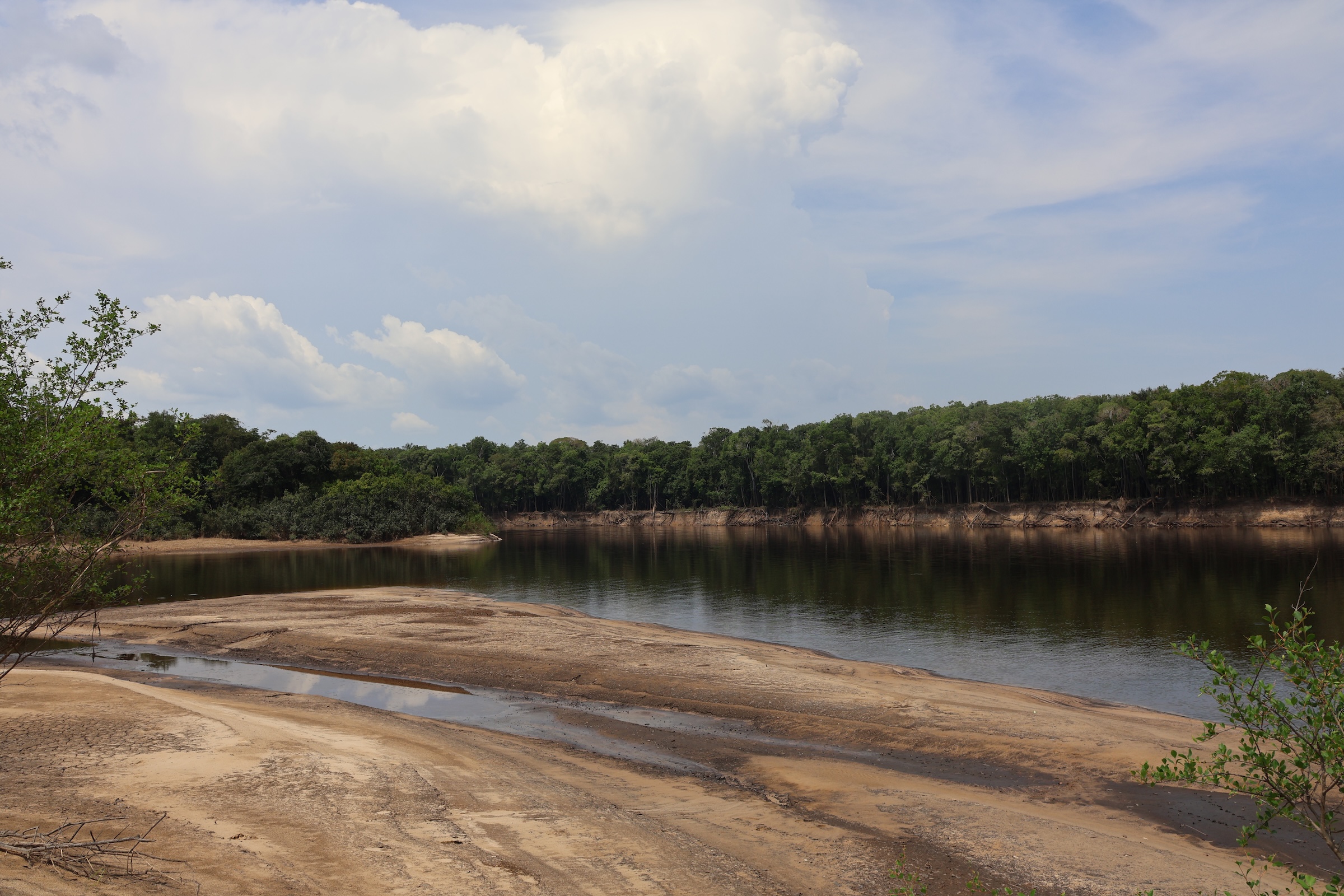
Banner image: Jaú river (Amazonas, Brazil) in September 2024. The Jaú River is a tributary of the Rio Negro, which suffered from the extreme drought of 2024, recording its lowest water level since 1902. Credit: Cássio Alencar Nunes.
Citations:
Barlow, J., Carvalho, N. S., Nunes, C. A., Aguiar, A. P. D., Alencar, A., Anderson, L. O., … Wiederhecker, H. C. (2026). Rapid increase of climate extremes reveals new areas of concern in Amazonia. Communications Earth & Environment, 7(1), 746. doi:10.1038/s43247-026-03975-1
Chang, A., Zhuang, Y., Fu, R., Worden, J. R., Gu, Y., Costa, M. H., … Jiang, J. H. (2026). Rapid increases in heat-driven extreme moisture demand in the Southern Amazon. Geophysical Research Letters, 53(16), e2026GL123139. doi:10.1029/2026GL123139
Guimaraes, A. F., Schietti, J., Querido, L. C. A., Nunes, J., Santos, P., Lagroteria, D., & Gordo, M. (2025). Extreme drought and heat lead to alarming mortality of Amazon fauna. Acta Amazonica, 55, e55bc24405. doi:10.1590/1809-4392202404053
Marengo, J. A., Jimenez, J. C., Espinoza, J.-C., Cunha, A. P., & Aragão, L. E. O. (2022). Increased climate pressure on the agricultural frontier in the Eastern Amazonia–Cerrado transition zone. Scientific Reports, 12, 457. doi:10.1038/s41598-021-04241-4
Souza, C. M., Jr., Marengo, J., Ferreira, B., Ribeiro, J., Schirmbeck, L. W., Schirmbeck, J., … Latuf, M. O. (2024). Amazon severe drought in 2023 triggered surface water loss. Environmental Research: Climate, 3(4), 041002. doi:10.1088/2752-5295/ad7c71
de Souza Tadano, Y., Potgieter-Vermaak, S., Siqueira, H. V., Hoelzemann, J. J., Duarte, E. S. F., Alves, T. A., … Godoi, R. H. M. (2024). Predicting health impacts of wildfire smoke in Amazonas basin, Brazil. Chemosphere, 367, 143688. doi: 10.1016/j.chemosphere.2024.143688
Wolfe, J. D., Luther, D. A., Jirinec, V., Collings, J., Johnson, E. I., Bierregaard, R. O., Jr., & Stouffer, P. C. (2025). Climate change aggravates bird mortality in pristine tropical forests. Science Advances, 11(5), eadq8086. doi:10.1126/sciadv.adq8086
Wunderling, N., Sakschewski, B., Rockström, J., Flores, B. M., Hirota, M., & Staal, A. (2026). Deforestation-induced drying lowers Amazon climate threshold. Nature, 654(8117), 114–120. doi:10.1038/s41586-026-10456-0
Qin, Y., Wang, D., Ziegler, A. D., Fu, B., & Zeng, Z. (2025). Impact of Amazonian deforestation on precipitation reverses between seasons. Nature, 639, 102–108. doi:10.1038/s41586-024-08570-y
FEEDBACK: Use this form to send a message to the author of this post. If you want to post a public comment, you can do that at the bottom of the page.
Cite this article
Daniel Shailer (2026). Central-north Amazonia has experienced an ‘alarming’ increase in temperatures: Study. Mongabay Conservation news. DOI: https://doi.org/10.66709/news-336184

