


Welcome to Foreign Policy’s Africa Brief.
The highlights this week: Economic policies loom over Zambia’s election, Spain comes up with a plan for the more than 1,000 Moroccan children who remain in Ceuta, and Colombia’s new administration recognizes Morocco’s sovereignty over Western Sahara.
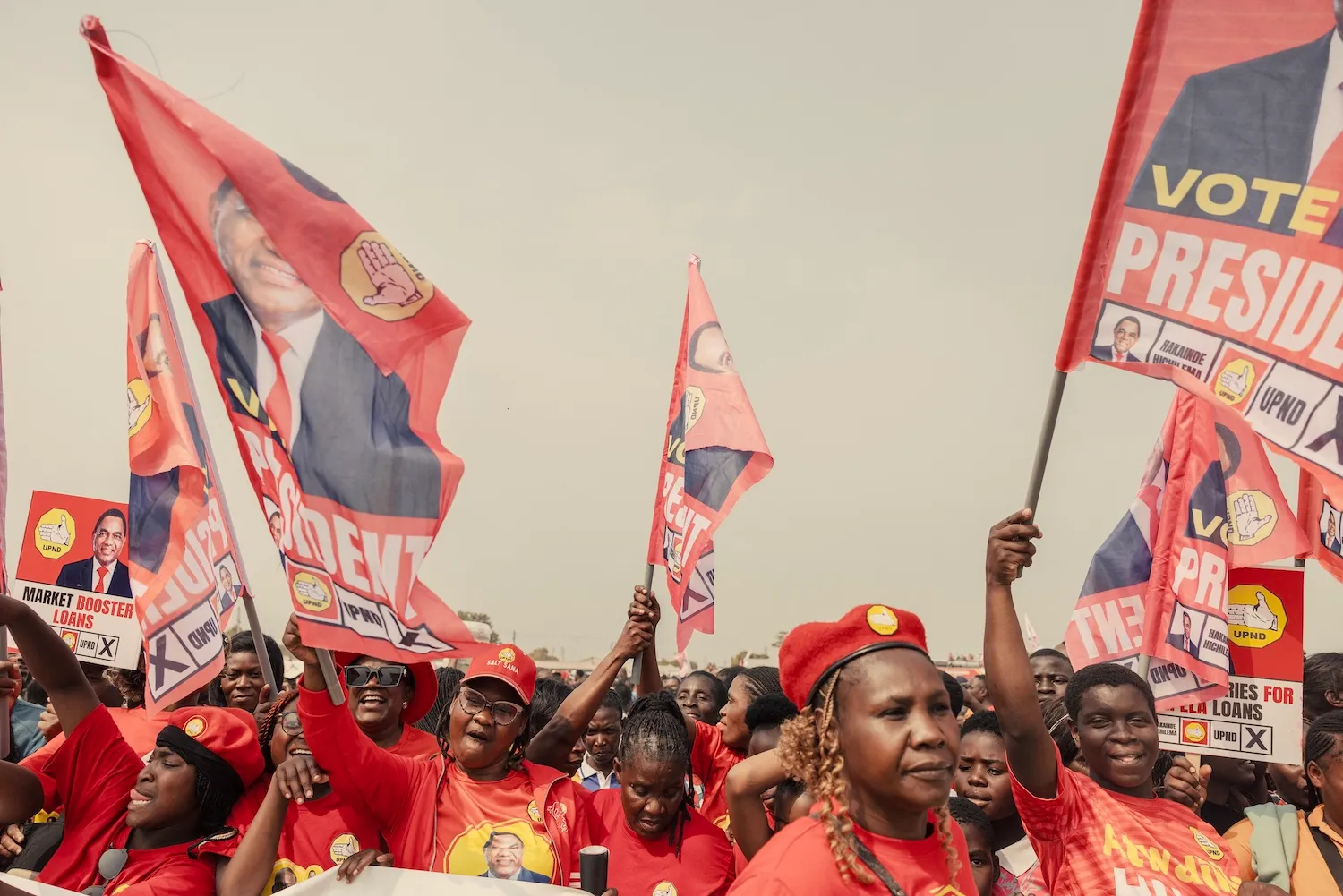
Zambians head to the polls on Aug. 13 for an election that will test President Hakainde Hichilema’s economic policies amid intense rivalry between the United States and China over the country’s critical minerals.
Although analysts initially expected Hichilema to secure a comfortable second-term win, a newly reorganized opposition that emerged out of the Patriotic Front, the former ruling party from 2011 to 2021, has transformed the election into a close contest.
International media coverage of Zambia largely focuses on U.S.-China competition over economic influence in the country, which is Africa’s second-largest copper producer. Zambia is also home to large deposits of other critical minerals including cobalt, lithium, nickel, and graphite.
The U.S.-led Lobito Corridor hopes to upgrade an 810-mile railway connecting Angola’s port of Lobito to Zambia through the mineral-rich Democratic Republic of the Congo. In response, China announced last year that it would modernize the Tazara line connecting the Tanzanian seaport of Dar es Salaam to Zambia’s copper provinces.
Yet while Zambia’s natural resources have put this election under international scrutiny, voter frustrations center on rising food prices and rolling blackouts. As much as they “do acknowledge some of these broader issues,” said Menzi Ndhlovu, a lead analyst at Signal Risk, Zambians care more about how Hichilema’s economic reforms have “translated to a change in people’s living standards.”
Hichilema inherited the first African economy to have defaulted on its sovereign debt during the COVID-19 pandemic in late 2020. After taking office in 2021, Hichilema forged closer ties with the International Monetary Fund, ended fuel and energy subsidies, and introduced free primary and secondary school education. (Lusaka temporarily reimplemented fuel subsidies until September amid an energy crisis.) He also ramped up Zambia’s copper output.
On his campaign trail, Hichilema has pointed to his success in restructuring $6.3 billion of debt with foreign nations through the G20 Common Framework. His government recently bought debt back from private bondholders and plans to invest the saved interest payments in electricity generation. Annual inflation has dropped to 6.5 percent, its lowest in eight years.
But copper extraction has failed to create well-paid jobs. Around 60 percent of the population lives below the World Bank’s poverty line of $3 per day. Although Hichilema promised to reduce food costs when he entered office, the price of some staple foods, such as maize, has doubled since then.
Zambia has also suffered due to the severe drought that began in 2024 linked to the El Niño weather pattern. In recent decades, the country has concentrated more than 80 percent of its electricity generation on hydroelectric power, but the drought led to significantly reduced reservoirs, causing nationwide electricity rationing. Lusaka has quickly attempted to diversify, investing in solar, nuclear, and coal plants, with China, South Africa, and Singapore as partners.
“They set themselves these lofty goals around mining, job creation, and the Lobito Corridor, but they don’t have enough energy to power most of these things,” Ndhlovu said. “In comparison, the whole of Zambia generates as much energy as [the South African city of] Johannesburg.”
Zambia plans to increase electricity generation from 4.5 gigawatts to 10 gigawatts over five years, “which is still very low for a country of Zambia’s size,” Ndhlovu said.
Hichilema’s main challenger, Brian Mundubile, has belittled the government’s economic policies, criticizing its decision to build up a $6.5 billion foreign reserve while the “Zambian people go hungry.” Mundubile leads the National Reconciliation Party for Unity and Prosperity, a new alliance that emerged from the Patriotic Front.
Mundubile has also sought to weaponize Zambia’s ongoing failure to bury former President Edgar Lungu, who was also a Patriotic Front leader, for more than a year after his death. Lungu’s family oppose state funeral arrangements involving Hichilema, who was a bitter rival of Lungu. Mundubile has appealed to former Patriotic Front strongholds by pledging to give the former president a dignified burial.
Still, analysts currently expect Hichilema and his United Party for National Development (UNDP) to secure a narrow victory against Mundubile. This is primarily due to the opposition failing to provide a credible alternative economic plan or field legislative candidates in nearly one-third of parliamentary seats.
Mundubile’s opposition alliance has also suffered from factionalism. “It was a very disorganized and opportunistic campaign,” Ndhlovu said, though he added that “they’ve done well at picking at Hichilema’s shortcomings.”
At the same time, Hichilema has faced serious criticism for his approach on rights. Mundubile has accused the government of using the police to stifle his campaign rallies and having introduced administrative hurdles to make it difficult for his alliance to register in the election. The government has also used recently enacted cyber laws to limit free speech.
Under Hichilema, said Tigere Chagutah, Amnesty International’s regional director for East and Southern Africa, “authorities have resorted to the familiar playbook of using the law to criminalize peaceful dissent and silence independent media.”
Thursday, Aug. 13: Zambia holds general elections.
Sunday, Aug. 16, to Tuesday, Aug. 18: Heads of state within the Southern African Development Community meet in Durban, South Africa.
Ceuta’s child migrants. More than 1,000 unaccompanied Moroccan children remain in Ceuta, a Spanish city in North Africa. Madrid has said that they will be transferred to mainland Spain in the coming weeks, but the move has increased divisions between Madrid and right-wing factions in Europe.
Around 72,000 people entered Ceuta from Morocco between July 30 and 31, while 70,000 soon returned. Morocco has said that it is ready to take back the minors, particularly since Moroccan parents have been searching for their missing children, but Spain cannot easily send them back under international law.
If an adult enters Europe, they must prove that they fear genuine persecution in order to obtain refugee status under the 1951 Refugee Convention. But Article 3 of the United Nations Convention on the Rights of the Child requires authorities to determine what next step is in the best interest of the child, a process that can take months.
In 2024, Spain’s Supreme Court ruled that the government’s immediate return of children after 8,000 Moroccans entered Ceuta in 2021 was illegal. Some of the children who entered Ceuta last month have said that they do not want to go back. The “priority will always be family reunification, but each situation must be analyzed individually,” said Sira Rego, Spain’s youth minister.
Troops in Gaza. Ugandan lawmakers have approved the deployment of troops to Gaza to be part of an international stabilization force, which was part of U.S. President Donald Trump’s 20-point peace plan, to maintain security in the region.
Uganda is one of the largest contributors to peacekeeping in Africa—a role that has helped President Yoweri Museveni’s government evade international criticism over his more than 40-year authoritarian rule. Morocco, Albania, Indonesia, Kazakhstan, and Kosovo have also pledged soldiers to the force.
Colombian recognition. Colombia’s new pro-Trump administration has recognized Morocco’s sovereignty over Western Sahara, reversing the former left-wing government’s support for Sahrawi independence, a position that Bogotá had maintained since the 1980s.
The decision was announced on Friday, the same day as the inauguration of Colombia’s new right-wing president, Abelardo de la Espriella. Washington recognized Morocco’s sovereignty over the territory in 2020, during Trump’s first term.
The U.N. has classified Western Sahara as a non-self-governing territory since 1963. In a 1975 advisory opinion, the International Court of Justice concluded that there was no historical evidence of Moroccan sovereignty over Western Sahara and that Sahrawis should be allowed a referendum to determine their future. However, after Madrid withdrew from the territory in 1976, Morocco moved to occupy 80 percent of the phosphate-rich area.
Today, around 170,000 Sahrawis are refugees in neighboring Algeria.
Nigerian rescue. Last Wednesday, Nigerian security forces rescued more than 300 abducted people held captive by jihadists in the Kainji Lake National Park forest in the northwestern part of the country.
The operation came after President Bola Tinubu recently approved 30 percent salary increases for high-ranking soldiers and up to 80 percent increases for lower-ranked soldiers, effective from Sept. 1, to combat growing insecurity across Nigeria.
Guinea has asked France to return several skulls of Guinean anti-colonial leaders held in the Musée de l’Homme, an anthropology museum in Paris. French troops took the skulls back to Europe as war trophies after beheading the fighters in 1896.
The request includes the skull of Bokar Biro Barry (also known as Boubacar Biro), the last leader of the kingdom of Fouta Djallon, which is located in modern-day central Guinea, as well as Barry’s son, brother, and war chief. Guinea has also asked for personal belongings owned by Samory Touré, a religious leader and anti-French resistance figure.
In 2025, France returned to Madagascar the skulls of a Malagasy king and two others beheaded during a violent conquest in 1897. The repatriations are facilitated by a French law that was passed in December 2023 to aid the return of colonial-era human remains.
One-party politics. A wave of political defections to Nigeria’s ruling All Progressives Congress (APC) has weakened the opposition, pushing the country toward a one-party state. In Africa is a Country, Sada Malumfashi argues that if this trend continues, Nigeria’s 2027 elections could be the most consequential in the country’s history.
“Across the country, many Nigerians increasingly experience the state as an extraction site for the political class,” he writes. “The APC dominates both federal and most state structures, leading to weakened legislative oversight and defections. The result is a system that is structurally concentrated and not fully democratic.”
Toxic state. Emissions from a state-owned phosphate processing plant in the Tunisian port city of Gabès have left children with breathing issues and other diseases, Khadija Ben Salah, Dawn Kikel, and Elisangela Mendonc report for Arab Reporters for Investigative Journalism in collaboration with Mongabay.
The plant’s customers include fertilizer giants EuroChem North America and Koch Fertilizer. The authors’ “analysis of Sentinel-5 satellite imagery found concentrations of air pollutants in the area that may have reached up to nine times the World Health Organization’s recommended limits.”
