


Welcome to Foreign Policy’s South Asia Brief.
The highlights this week: The new security pact among Pakistan, Saudi Arabia, and Turkey delivers Islamabad a boost in the Middle East but not in its own backyard, Bangladesh lashes out at India over an event involving former Bangladeshi Prime Minister Sheikh Hasina, and the Taliban deny detaining an Afghan-U.S. dual citizen who disappeared in Kabul four years ago.
Mecca Pact Is Mixed Blessing for Pakistan
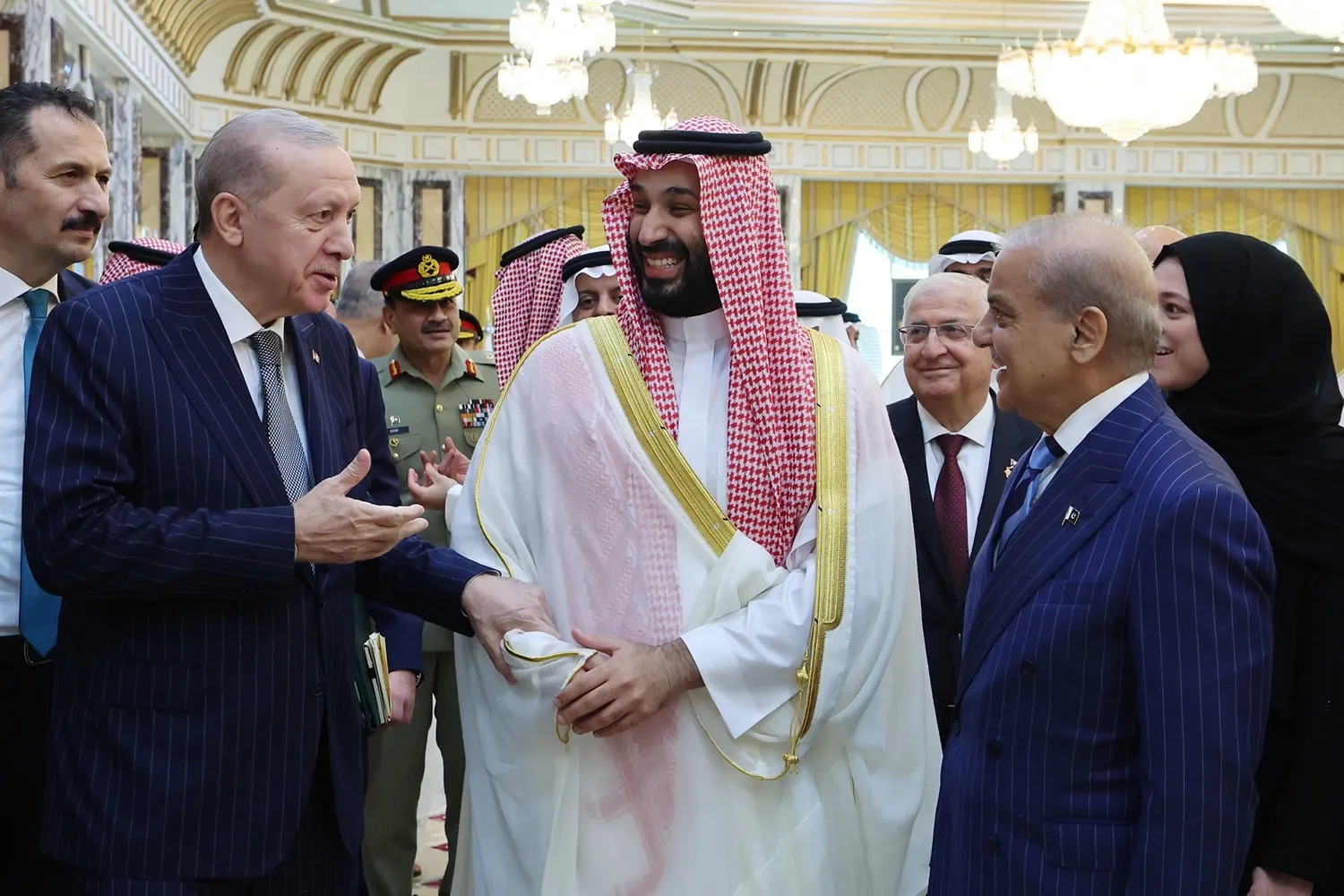
Last week, Pakistan inked a new security pact with Saudi Arabia and Turkey, known as the Mecca Joint Defense Agreement. The deal cements Islamabad’s place in the Middle East’s emerging security architecture and will help advance its interests in the region. But it likely won’t help Pakistan much in its own neighborhood, where it is grappling with hostile neighbors.
The Mecca pact comes less than a year after Pakistan concluded a mutual defense agreement with Saudi Arabia—and as it is taking steps to strengthen security cooperation with other Middle Eastern allies, including Egypt, Jordan, and Kuwait.
A few of those countries might eventually join the Mecca accord; the agreement could also produce bilateral opportunities for Pakistan, such as new arms deals with Turkey.
The pact also brings Muslim-majority Pakistan more influence in the Middle East. This is important: Pakistani leaders want the world to see their country as an impactful global player rather than a risky partner. But the Middle East is also important to Islamabad’s strategic interests: home to many of its top allies, a majority of its hydrocarbon imports, and several million Pakistani expats.
Further, the Mecca pact will help Pakistan’s relationship with the United States. The Trump administration, keen to see more burden-sharing from allies, will likely welcome a deal that advances collective deterrence with an eye toward Iran. In the long term, the agreement will remind Washington of Islamabad’s broader utility in the Middle East, including as a mediator.
However, the accord with Saudi Arabia and Turkey will be less beneficial for Pakistan closer to home. Though the full text hasn’t been released, a joint statement from the signatories asserts that an attack on one member will be viewed as an attack on them all, drawing comparisons to NATO’s Article 5.
In principle, this would be crucial for Pakistan, which has fought multiple wars with India, including a brief conflict last year, and now engages in periodic skirmishes with the Taliban regime in Afghanistan. In reality, Pakistan’s allies likely wouldn’t come to its aid.
If India carried out strikes on Pakistan, it beggars belief that Saudi Arabia would take up arms against India, another of its close partners. When it comes to the Taliban, there are already telling data points. The Afghanistan-Pakistan violence began last October soon after the mutual defense agreement with Saudi Arabia was finalized. At no time since then have the Saudis threatened to invoke the agreement.
Turkey might seem more likely to invoke the pact: It has shaky ties with India and supplied arms to Pakistan that were reportedly used in the conflict between the countries last year. But Ankara has recently pushed to improve relations with New Delhi—not to mention that it would have no interest in getting dragged into a South Asian war between nuclear-armed rivals, given what is going on in its own backyard.
What the Mecca pact may do is make Saudi Arabia and Turkey more likely to take on active mediation roles in Pakistan’s regional conflicts, especially those involving Afghanistan. Riyadh and Ankara have already facilitated talks between Pakistani officials and the Taliban in recent months.
Ultimately, Pakistan will hope that all of this gives it a stronger case to stay out of conflicts involving Saudi Arabia and Turkey, too—despite what the text of the pact says. Like its two allies, Islamabad doesn’t want to get dragged into wars elsewhere, and it aims to maintain a semblance of neutrality as it seeks to establish itself as an Iran war mediator.
What We’re Following
India-Bangladesh blowback. Bangladesh’s foreign ministry has slammed India’s government for allowing former Bangladeshi Prime Minister Sheikh Hasina to participate virtually in an event hosted by the Foreign Correspondents’ Club of South Asia in New Delhi last week, denouncing the affair as an “affront to the sovereignty of Bangladesh.”
Hasina fled Bangladesh for India amid mass protests in 2024; she was sentenced to death in absentia last November on charges of crimes against humanity. Her party is banned from political activity, but in her virtual appearance, she repeated a vow to return home in December. New Delhi distanced itself from the journalists’ event, but from Dhaka’s perspective, Indian officials could have done more.
The foreign ministry statement features some of the strongest language directed at Hasina since she fled Dhaka and comes as Bangladesh-India relations were poised for a comeback. But last week’s event inflamed already significant anti-Hasina sentiment within Bangladesh, which means the government that took office there in February will need to be extra careful about outreach to New Delhi.
A key signpost awaits next month, when Bangladeshi Prime Minister Tarique Rahman is invited to attend the BRICS summit in New Delhi. If he doesn’t attend, that won’t bode well for the bilateral relationship.
Taliban deny holding U.S. citizen. On Tuesday, the Taliban denied detaining Mahmood Shah Habibi, an Afghan American businessman and former head of Afghanistan’s civil aviation authority who disappeared in Kabul four years ago. Taliban spokesperson Zabihullah Mujahid said Habibi is not with the Taliban and that “if he were, this problem would have been resolved long ago.”
Mujahid, responding to an FBI statement marking the four-year anniversary of Habibi’s disappearance, said the Taliban regime knows nothing about his whereabouts. The FBI accused Taliban intelligence agents of abducting Habibi, a dual U.S.-Afghan citizen, from his car and detaining him in August 2022.
This issue won’t go away anytime soon. The Trump administration’s chief priority in Afghanistan is to secure the freedom of the few remaining U.S. hostages in the country. U.S. authorities have held direct talks with the Taliban about captive Americans, including traveling to Kabul for talks on the issue.
The United States has recently signaled a desire to apply more pressure. This year, the Trump administration designated Afghanistan as a “state sponsor of wrongful detention” and accused the Taliban of detaining foreigners for ransom.
Indian official flags ethanol problems. India’s minister of state for petroleum and natural gas, Suresh Gopi, said on Monday that ethanol-blended diesel had failed recent safety tests and wouldn’t be pegged for wider use until the issue was resolved. Gopi’s comments are significant because New Delhi has moved quickly to make ethanol a bigger part of India’s transport fuel mix.
This approach includes ramping up the use of E20 fuel, a mix of petrol containing 20 percent ethanol. The government argues that more ethanol use will decrease India’s reliance on imported crude oil, lower greenhouse gas emissions, and generate income opportunities for farmers through higher demand for sugar cane and maize, which are used to produce ethanol.
However, the E20 experiment is controversial. Drivers report that the mix reduces fuel efficiency and causes vehicles not to function properly—a problem particularly for cars produced before 2023 that are not ethanol-compatible. Opposition politicians have also accused India’s road transport minister, Nitin Gadkari, of a conflict of interest regarding the ethanol business.
The E20 policy has even spawned a copycat of the Cockroach Janta Party, which staged protests over the summer and forced the resignation of India’s education minister last month. The E20 Janta Party is gaining momentum online, railing against ethanol-blended fuel and demanding that Gadkari step down.
Under the Radar
Bhutan’s government has announced the findings of the country’s first aerial geophysical survey, which focused on the possible presence of underground minerals. The results are promising: They include favorable conditions for copper and tungsten and possible indications of rare-earth minerals and other precious metals.
If the presence of these high-demand materials is confirmed, Bhutan—already a strategic space because of its location between India and China—could take on greater geopolitical significance and attract more attention from major global players, including the United States.
The findings also point to a potentially large domestic energy benefit. The assessment suggests the presence of hot water circulating underground and thus the possibility of geothermal energy. Bhutanese Prime Minister Tshering Tobgay said this month that that would give the country a major energy security boost.
In addition to expanding Bhutan’s supply and diversifying its green energy sources, geothermal energy is available year-round. Together with hydropower, it could provide a consistent source of clean power in Bhutan.
FP’s Most Read This Week
Regional Voices
In the Daily Star, public health analyst Sumit Banik asserts that artificial intelligence can help strengthen Bangladesh’s troubled health sector. “By strategically integrating [AI] not as a replacement for human clinicians, but as an interactive public educator and a clinical co-pilot, public health awareness and the knowledge levels of our healthcare workers can be elevated,” he writes.
Writing for South Asian Voices, scholar Portia Conrad describes how the Dalai Lama’s succession will affect geopolitics. “The future recognition of the 15th Dalai Lama will shape the trajectory of Tibet, influence India-China relations, affect the cohesion of the Tibetan diaspora, and become another arena” in China’s geopolitical competition, she writes.
In the Express Tribune, diplomat and author Muhammad Babar Chohan argues that Pakistani policymakers wrongly believe that building more roads always brings economic growth. “The overarching policy belief that new roads inherently promote economic growth and productivity heavily relies on quantitative tools while ignoring the contextual details of roading projects,” he writes.
