


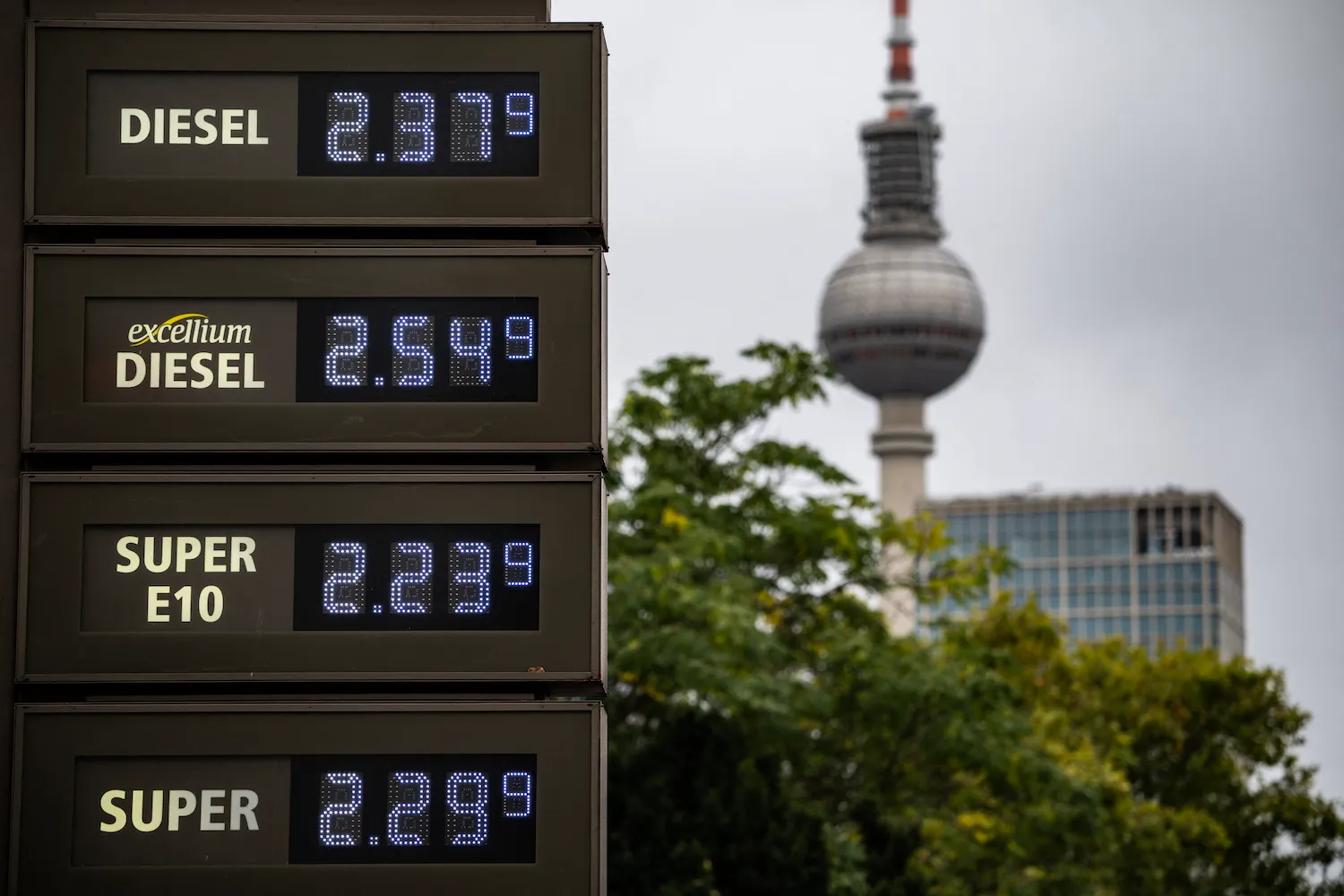
Welcome back to World Brief, where we’re looking at global efforts to rein in high fuel costs, violent student protests across France, and Ebola’s rising death toll in the Democratic Republic of the Congo.
Pain at the Pump
Some of the world’s wealthiest nations agreed on Friday to release 100 million barrels of diesel and crude from their reserve stockpiles over the next four months in an effort to rein in runaway fuel prices. That amounts to around one day’s worth of global oil demand and includes a “frontloaded substantial diesel release” within the next 20 days.
Welcome back to World Brief, where we’re looking at global efforts to rein in high fuel costs, violent student protests across France, and Ebola’s rising death toll in the Democratic Republic of the Congo.
Pain at the Pump
Some of the world’s wealthiest nations agreed on Friday to release 100 million barrels of diesel and crude from their reserve stockpiles over the next four months in an effort to rein in runaway fuel prices. That amounts to around one day’s worth of global oil demand and includes a “frontloaded substantial diesel release” within the next 20 days.
“We condemn Iran’s continued attacks against its regional neighbours and its disruption of international trade, energy security and the global economy,” G-7 leaders said in a statement. The bloc—consisting of Canada, France, Germany, Italy, Japan, the United Kingdom, and the United States—requested that the International Energy Agency (IEA) monitor the release.
In recent days, U.S. President Donald Trump has threatened to impose an export ban on U.S. diesel if European countries—specifically, France and Germany—do not do more to relieve high global energy costs, including by drawing down from their own emergency diesel inventories. Europe imports around 1.5 million barrels of diesel a day, half of which came from the United States in August. Meanwhile, China, another key diesel supplier, has recently begun restricting its own exports.
To avoid further disruption, Europe appears to have acquiesced to Washington’s demands. A coordinated G-7 release will cause fuel prices to “drop at the pump as quickly as possible,” French President Emmanuel Macron said on Friday. European Union trade chief Maros Sefcovic similarly stressed that “we have every interest in working together on lowering the prices, be it on diesel or also other products from oil and gas supplies.”
Timing matters for the White House. Analysts believe that Trump is hoping to lower domestic fuel prices before the November midterm elections, which could see Democrats win a majority of seats in Congress. According to a new Associated Press poll, only 17 percent of U.S. adults approve of Trump’s handling of the cost-of-living crisis, and barely 26 percent support his overall economic strategy.
“Prices are way down from what Biden and the Dumocrats left us,” Trump wrote on Truth Social on Thursday. “It’s why I won the Election, and now prices are coming down, RAPIDLY. It’s the Dumocrats’ fault, not the fault of the Republicans — But we are fixing it!” According to AAA, the average price for gas across the United States is above $4 a gallon, and the average price for diesel nationwide is above $6.
It is unclear whether 100 million barrels over four months will be enough to soothe market concerns and bring costs down. “We will convene in the context of the IEA in the coming days to discuss the possibility of additional diesel releases as necessary,” the G-7 said.
Today’s Most Read
What We’re Following
Violent student unrest. French riot police clashed with hundreds of student protesters on Friday, as young people demand greater state investment in education to address staffing shortages, overcrowded classrooms, and dilapidated school buildings. The demonstrations—which began last week and have only worsened with the recent unveiling of a controversial 2027 budget proposal—have forced around 400 high schools to close. Although education is typically France’s largest budget item, debt-servicing costs are expected to take the No. 1 spot next year.
Violent unrest, including the setting of fires near several French schools, has led to around 3,000 arrests. Meanwhile, nearly 400 police officers and more than 230 students and school employees have been injured. Demonstrators have accused security forces of using heavy-handed tactics, including tear gas, to disperse crowds. Teachers’ unions have also joined the movement, calling on educators to go on strike.
French authorities have blamed the hard-left France Unbowed party for fomenting domestic unrest for political purposes ahead of next year’s general election. “The duty of a republic’s elected official is to protect young people and call for calm,” Prime Minister Sébastien Lecornu wrote on X. “Exploiting their anger for partisan purposes is a fault.” France Unbowed has denied those allegations.
Ebola’s death toll. Ebola deaths in the Democratic Republic of the Congo surpassed 4,000 on Thursday, marking a grim milestone for the African country’s fastest-growing outbreak to date. It now comes second only to the 2014-2016 West African Ebola outbreak, which killed more than 11,000 people across Guinea, Liberia, and Sierra Leone.
According to Congolese health officials, around 8,300 Ebola cases have been confirmed since the epidemic was announced on May 15, and more than 2,000 people have recovered from the disease. Although Kinshasa and the United Nations reported last month that transmission may be slowing in parts of the Ituri province, where the outbreak began, much of Congo continues to suffer from high infection rates, particularly as there remains no known vaccine or treatment for the rare Bundibugyo strand of the virus that is responsible for this outbreak.
Efforts to combat Ebola became even harder this week, after a key patient transit center in Ituri burned down. “It’s been a huge struggle to create Ebola transit centers [and] Ebola treatment centers; it’s required money, bringing in staff, and it’s been a struggle all across the east,” senior Ebola coordinator Julien Harneis told U.N. News. “So, when we lose a center, that means we lose capacity, we lose investment, and we have to start again.”
Three key votes. Foreign Policy is keeping an eye on critical elections in Latvia, Brazil, and Bosnia and Herzegovina. Here’s what you need to know:
Latvia. Parliamentary elections in Latvia on Saturday are likely to keep incumbent Prime Minister Andris Kulbergs in power in what would be a big win for Europe’s pro-Ukraine camp. Kulbergs took office in May after the country’s previous coalition government collapsed due to its inadequate handling of stray drones that had entered Latvian territory. Although the populist Latvia First party, which has ties to Russian oligarchs, has attracted enough support to raise it to third in opinion polls, analysts believe that repeated Russian hybrid attacks on NATO’s Baltic members will convince voters to side with Kulbergs’s centrist United List.
Brazil. The first round of Brazil’s general election on Sunday will almost certainly be a close race between incumbent left-wing President Luiz Inácio Lula da Silva and right-wing Sen. Flávio Bolsonaro, the son of convicted former President Jair Bolsonaro. Lula’s campaign has focused on social welfare reforms, bolstered defense spending, and diversification of the country’s trading partners. Flávio, meanwhile, seeks to extend privatization, slash the country’s deficit, and maintain close ties with Trump. If none of Brazil’s 12 presidential candidates wins more than 50 percent of the vote, then a runoff will be held on Oct. 25.
Bosnia and Herzegovina. Ethnic tensions are once again expected to dominate Bosnia and Herzegovina’s general election on Sunday, threatening to further derail the country’s EU membership ambitions. Bosnia became an EU candidate in 2022, but accession talks have stalled due to its failure to implement any of the EU’s 113 required reforms. Emigration of young people remains a top concern, corruption continues to plague local politics, and around 11 percent of the country’s population is unemployed.
What in the World?
According to a report published on Tuesday, generative artificial intelligence adoption in China in the first half of 2026 exceeded what notable benchmark?
A. 20 percent
B. 35 percent
C. 50 percent
D. 75 percent
Odds and Ends
It’s a bird. It’s a plane. It’s … a man on a tightrope! Estonian aerial athlete Jaan Roose tiptoed across a roughly 525-foot slackline above Seoul’s city center on Thursday, completing his first of two attempts. Suspended nearly 400 feet above the ground, Roose’s feat marked South Korea’s first high-altitude slackline performance. The 34-year-old daredevil has previously made headlines by becoming the first person to slackline the Strait of Messina between Sicily and mainland Italy, as well as the space between Qatar’s Katara Towers more than 600 feet in the air.
And the Answer Is…
C. 50 percent
There is greater trust in AI in China than in the United States, FP’s James Palmer writes in China Brief.
To take the rest of FP’s weekly international news quiz, click here, or sign up to be alerted when a new one is published.
