


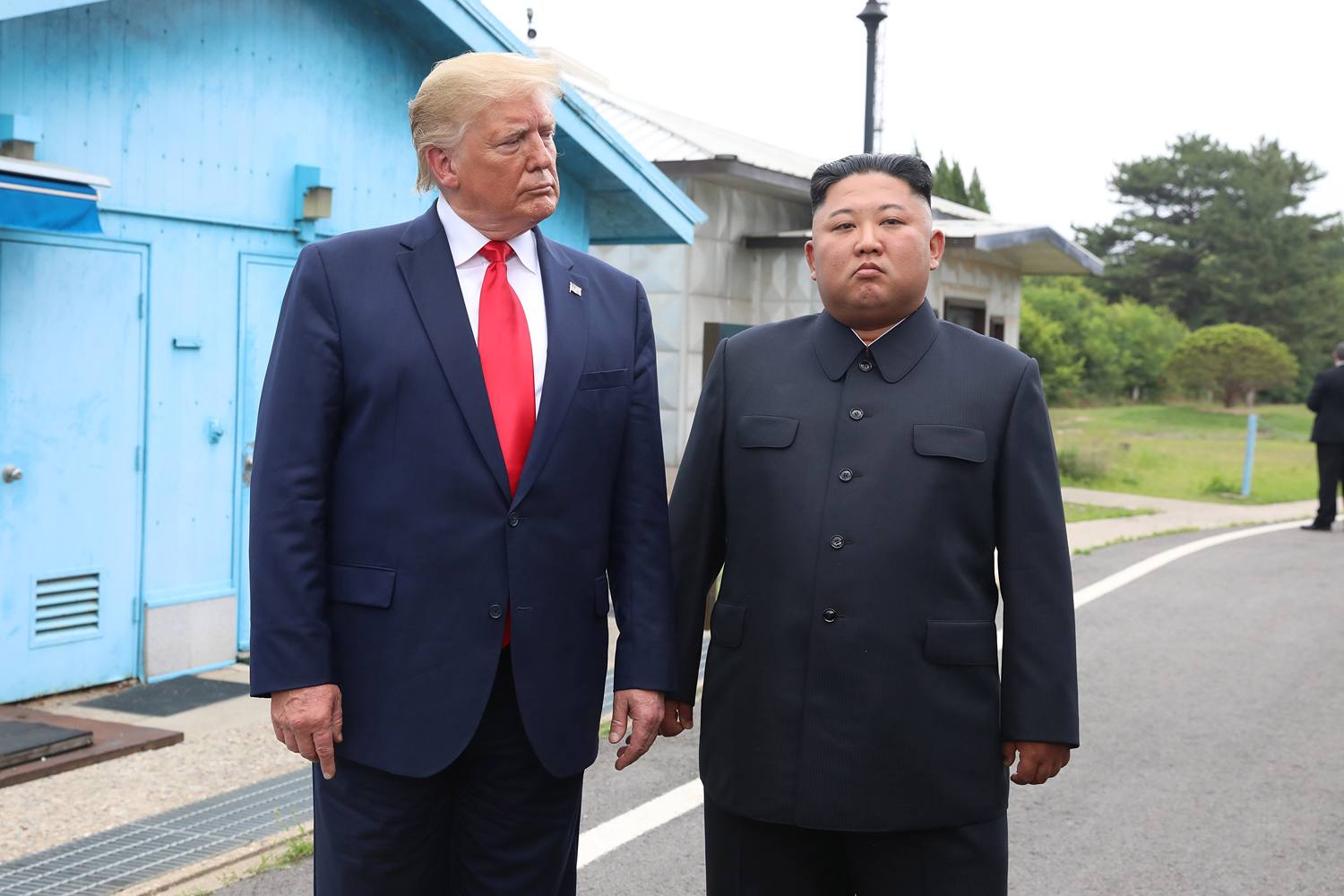
U.S. President Donald Trump has been pushing for a meeting with North Korean leader Kim Jong Un by the end of the year, but the rogue state has thrown cold water on his overtures so far.
Trump in mid-August abruptly ordered the Pentagon to scale back joint military exercises with South Korea (and has since canceled another joint exercise), criticizing the drills as “hostile” toward Pyongyang while citing his “very good relationship” with Kim. Though North Korea has decried such drills as rehearsals for war, Kim’s powerful sister, Kim Yo Jong, effectively dismissed Trump’s conciliatory move as meaningless despite characterizing the relationship between her brother and Trump as “excellent.”
“If the U.S. side attempts to promote the measures they have taken this time as some kind of ‘goodwill gesture,’ they will not get the answer they desire,” Kim Yo Jong said in a statement.
Trump held historic summits with Kim Jong Un during his first term in an effort to convince North Korea to denuclearize. During those meetings—which took place in Singapore in June 2018; Hanoi, Vietnam, in February 2019; and the Korean demilitarized zone in June 2019—North Korea sought sanctions relief and security guarantees from the United States.
Ultimately, though, the talks broke down without a deal. No high-level talks between Washington and Pyongyang have happened since, with North Korea rebuffing all attempts by the Biden administration to reach out.
Trump’s more recent efforts to meet with Kim come as North Korea continues to conduct provocative missile tests and aid Russia in its war against Ukraine. Critics have accused Trump of reaching out to Pyongyang in desperation for a win on the global stage as he struggles to end the war with Iran on favorable terms for the United States. But whether or not Trump would have much to gain from meeting with Kim is another question.
For insights on what’s guiding Kim’s thinking at the moment—and his apparent lack of interest in another meeting with Trump—Foreign Policy spoke with Sydney Seiler, a former national intelligence officer for North Korea at the U.S. National Intelligence Council. Seiler, one of the top experts on North Korea in the United States, spent over 40 years focusing on the Korean Peninsula in various roles across the U.S. government.
This conversation has been edited for length and clarity.
Foreign Policy: Why doesn’t North Korea seem particularly interested in meeting with Trump?
Sydney Seiler: A larger diplomatic goal was set [by Pyongyang] back at the end of 2019, implemented and publicized on Jan. 1, 2020, and overlaid with the [country’s] COVID-19 border shutdown. But basically, the objective was to walk away from diplomacy, to no longer pursue sanctions relief, aid, or assistance from the outside. Through self-reliance and austerity, and a commitment to the principle that the world will one day see things our way, [North Korea decided] to simply go down a path of refusing to talk to those countries who are insistent on talking about denuclearization, and staying within the boundaries defined by sanctions as far as acceptable exchange and cooperation. So, until countries are willing to walk away from the nuclear issue and walk away from sanctions, there’s simply no need to talk to them.
It looked like a mini-temper tantrum at the end of 2019 after the failure to achieve what Kim had been hoping for in Trump’s first term. In both Singapore and Hanoi, the same goals were in play—to get the United States to accept North Korea as a nuclear power. It was not about denuclearization, at least from Kim’s perspective.
Kim’s longer-term diplomatic strategy is to just wait out countries until they come to the realization that we have to live with a nuclear North Korea. Russia in 2022 became the first symbol of this new approach and an ability to succeed at it. Kim is getting everything he wants in terms of being able to sit down with the Russians, to not be pressured on denuclearization, to get needed materials, and to engage in commerce, both military and economic, that are all proscribed by sanctions, without anybody in either Moscow or Pyongyang worrying about sanctions.
Any type of engagement with the United States at this time that doesn’t look like a near-total capitulation by the United States to that logic is actually detrimental to North Korea’s interests. As North Korea says: You have to accept us on our terms; we’re a nuclear power, we are no longer interested in talking about denuclearization.
China is part of the way there. China has disengaged from actively promoting, pursuing, and insisting on denuclearization. But it also hasn’t gone as far as Russia, in terms of Foreign Minister [Sergey] Lavrov’s statements that we understand, we respect North Korea’s going down the nuclear route considering their security situation.
Amid this, since [Trump] taking office [for his second term], there’s been regular signaling [from Washington] messages sent. I think the [U.S.] president is smart here and is trying to preemptively either goad Kim into responding or at least establish to whatever audiences—everybody from [Trump’s] base and China to South Korea and Russia—that he’s reaching out and that Kim’s the bad actor here and the one not responding. Trump is throwing out proposals that I think he’s relatively certain will not succeed in the near term, but that have their own value.
FP: So, you think Trump expected North Korea to reject these overtures but is warming them up for something they could accept later on?
SS: I think that’s the case. In terms of, for example, the military exercise cessation, what value does North Korea really see in that? The response by Kim Jong Un’s sister, Kim Yo Jong, was about what I expected. I’ve played this game before—what concession on the hostile policy list is going to make North Korea happy? I was involved in lifting it from the state sponsors of terrorism lists, and I was asked at the time: “What good is this going to do, and is North Korea going to reciprocate?” I said: “Probably not, but it’s one less irritant.”
The military exercise is a little different, because military exercises are crucial to both readiness and deterrence. What [Pyongyang] see[s] right now is a fissure in the alliance, a weakening of U.S.-South Korea cooperation. But North Korea’s long-term goal is bringing an end to all these exercises and all of these nuclear umbrella extended-deterrent signaling operations, like B-52 flights, aircraft carrier deployments, submarine launches, and eventually getting the United States off the Korean Peninsula altogether. They could care less about a single exercise being canceled. What they want to see is all of them being canceled.
Did the president really believe that calling off this exercise would bring Kim to the table? He probably thought it through and said: “This is a win-win. If he does, great. He’s responded. I’m making the calls. And if he doesn’t, you know, at least going on record is trying. Plus, what’s an exercise cycle? No big deal.”
FP: Why is being accepted as a nuclear power currently more important for North Korea than sanctions relief or other potential concessions from the United States?
SS: North Korea has reportedly netted about $22 billion in benefits from its relationship with Russia. And it’s reportedly earning billions of dollars from cybercrime. I’m one of those guys who’s said there’s still value in pressure and sanctions. There’s still a value in stigmatizing North Korea’s nuclear status as a deterrent to potential other aspirants to nuclear capability. They have to look and see that you pay a price if you go down this road. But as far as the value in halting or slowing the growth of the [country’s] nuclear missile programs, [sanctions are] simply not as important as they were before. And Kim has publicly stated that he doesn’t want sanctions relief anymore.
Through COVID, it became a necessity [for North Korea] to find ways to survive without external inputs because the country was completely shut down, and it actually gave the authorities an ability to test the hypothesis of “How long do we survive shut down like this?” The result was that they can [survive].
And [there’s also the] new relationship within the CRINK—China, Russia, Iran, North Korea—and the benefits North Korea is acquiring because of the war in Ukraine. And particularly if [Russian President] Vladimir Putin is warning [Kim] against talking to Donald Trump, I don’t see why you would risk the relationship with Moscow right now and everything you’re getting from that just to chase after something. He knows at the end of the day Donald Trump has little to offer him.
Kim walked away from the negotiations after Hanoi because the goal he wanted was to lock in a nuclear status and maybe engage in something that could be called arms control talks, while keeping the highly enriched uranium program off the table. North Korea just has repeatedly said it’s not going to talk about this program. So, there’s no urgency to talk to Donald Trump right now.
FP: If North Korea is definitely not going to denuclearize, what benefit would there be, if at all, to Trump meeting with Kim at this time?
SS: So, that’s a good point. On the Korean Peninsula, there is no urgency, no sense of imminent hostilities, no lethal kinetic provocations driving up tensions. People are trying to pitch the value of an end-of-war declaration or a peace agreement to replace the armistice, at a time where the evidence would suggest [that] either one of those would actually bring inherent danger and risk to the peninsula, because they would weaken the U.S.-South Korea deterrent while not touching the key elements of North Korea’s military strength—particularly its nuclear program. There’s no urgent need to talk.
If I were the president’s spokesperson and allowed to freelance on this, I would put it like this: Nuclear weapons are dangerous. This is why what the president had to do in Iran is so crucial, because Iran was getting these capabilities that would fundamentally destabilize the world, but mostly, of course, the Middle East. He had to take action on it.
With North Korea, the president inherited this threat, this danger. Northeast Asia is volatile. We don’t see bombs being dropped or drones flying all over the place, but we need to act now to make sure that day doesn’t come. And there’s some formidable adversaries in the region. The president has focused on trying to develop a relationship with [Chinese President] Xi Jinping, our biggest adversary in that area. And Kim Jong Un is another person with whom we need to have a relationship. If we’re going to have a mechanism by which to deter unintended escalations of tensions or to resolve them should they occur, there needs to be a relationship. Our president needs to have a relationship with our adversaries—it’s just common sense.
That sets up the stage for a summit that would not at all mention the nuclear issue in any of the preparatory paperwork or any of the press readouts and could be easily criticized for doing little to tackle the fundamental core issues of instability on the peninsula. But nevertheless, he could credibly say: “Hey, listen, in times of trouble I need to have somebody to reach out to, and I do now. And we’ve advanced the relationship, and we’ve agreed to work on this moving forward.”
FP: What is most important to understand about where the North Korean regime’s mindset is right now in terms of its goals and priorities—particularly vis-à-vis the broader geopolitical landscape and Pyongyang’s dynamic with the United States and Trump?
SS: In the 2023 National Intelligence Estimate, we demonstrated that there may be scenarios in which North Korea could credibly use or threaten to use nuclear weapons in pursuit of strategic revisionist objectives. Maybe short of reunification of the peninsula, 1950s-style, but in ways that could lead to a calamity in the region. And that Kim seeks a return on investment.
Kim’s program has grown so far beyond [what is] necessary for mere defense. First of all, you can make the argument that Kim has never felt militarily threatened. He feels concerned about color revolutions—internal forces that would bring down the North Korean regime like so many of his other fellow socialist bloc countries did at the end of the Cold War.
But Kim, his father, and his grandfather have spent decades watching the United States and South Korea maintain peace under armistice. He is clearly pursuing a quality and quantity of weapons capable of, from a revisionist perspective, transforming the balance of power on the peninsula. It’s clearly not defensive. It’s coercive, at the very least, and much less likely an offensive capability.
But there’s a lot of zone between coercive, de-escalatable provocations to annoy and bully the South and revisionist actions that would seek to establish dominance on the Korean Peninsula. I believe that’s sufficient in possibility that we need to challenge it head-on right now.
He watched what Vladimir Putin attempted and got away with. And, you know, it’s interesting that after the Ukraine conflict broke out, analysts started to come around to the possibility that maybe this is an option Kim Jong Un would see as well. And of course, this all is against the backdrop of Xi Jinping threatening the same type of revisionist actions to unify Taiwan.
Right now, though, deterrence is working. And essentially what’s taken place under [former President Barack] Obama, Trump, [former President Joe] Biden, and now Trump again, is strategic patience. We maintain deterrence. We leave the door open for dialogue. We take seriously the threat posed, but we don’t let it dictate how or when we capitulate to North Korea. That’s going to be the key going forward: maintaining that deterrence.
Over the past couple of weeks, we’ve seen the debates over the curtailment of the exercises and an appeasement-like policy. Other than the derogatory, pejorative nature of the term, we need to leave room for us to go through periods of appeasements. There’s a credibility, particularly of our hard-line, muscle-flexing strategy. And if we ever go to conflict on the peninsula, the justification for the actions we take will depend upon us having tried engagement, having tried appeasement.
