


Welcome back to World Brief, where we’re looking at a growing protest movement in India, alleged Russian drone strikes in the Black Sea, and Houthi attacks on Saudi infrastructure.
Modi’s Cockroach Infestation
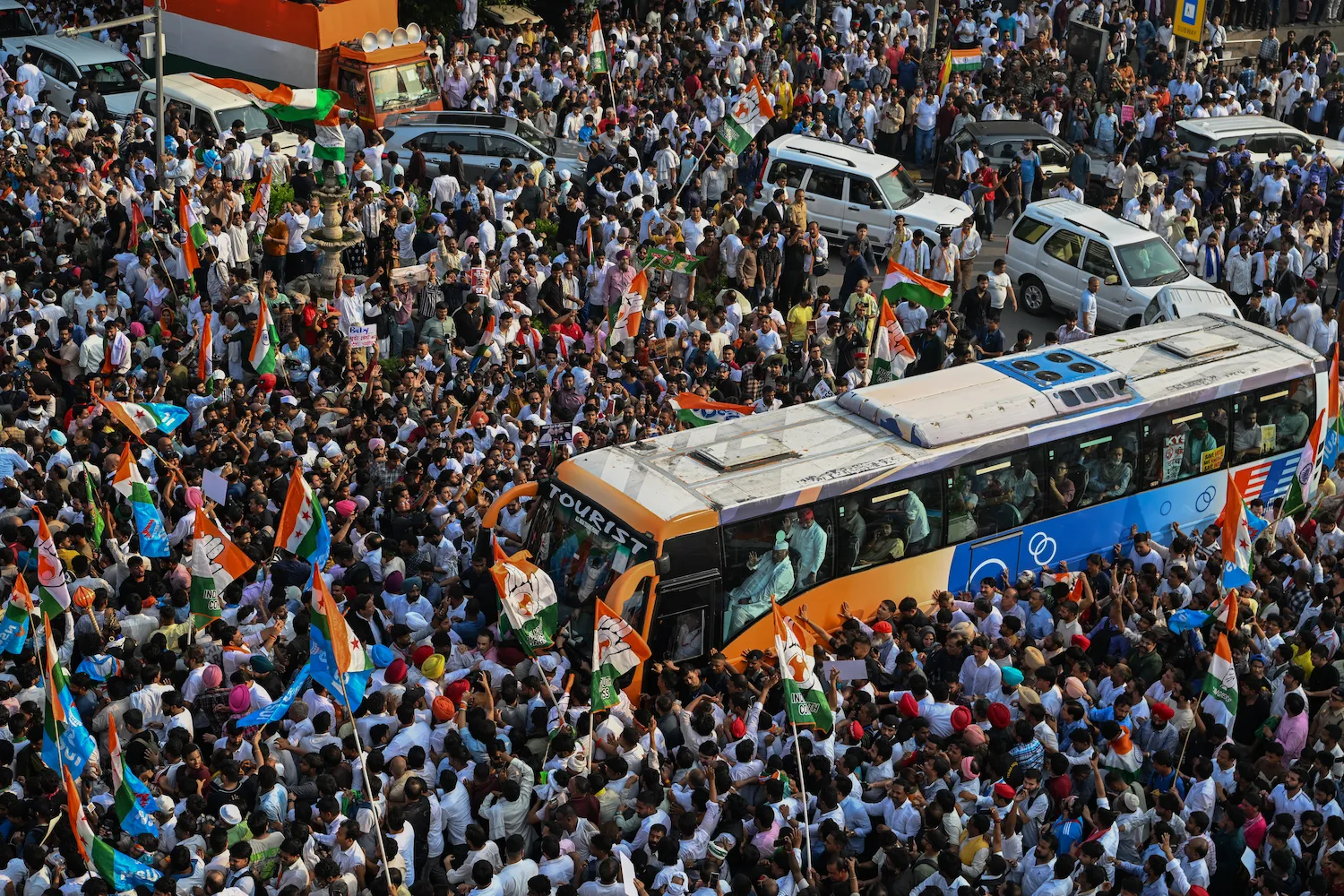
Indian police detained several leaders of the so-called Cockroach movement on Tuesday after they defied a police order prohibiting them from entering a historic protest site. The arrests came the same day that embattled Prime Minister Narendra Modi addressed delegates at a Bloomberg summit in the nation’s capital and described India as a “mother of democracy.”
Welcome back to World Brief, where we’re looking at a growing protest movement in India, alleged Russian drone strikes in the Black Sea, and Houthi attacks on Saudi infrastructure.
Modi’s Cockroach Infestation
Indian police detained several leaders of the so-called Cockroach movement on Tuesday after they defied a police order prohibiting them from entering a historic protest site. The arrests came the same day that embattled Prime Minister Narendra Modi addressed delegates at a Bloomberg summit in the nation’s capital and described India as a “mother of democracy.”
The Cockroach Janta Party (CJP), satirically named after Modi’s Bharatiya Janata Party (BJP), emerged in May after Indian Chief Justice Surya Kant likened the country’s unemployed youth to “cockroaches” and “parasites of society.” Denouncing lackluster job creation and poor education policy, including leaked medical exam results, the youth-led Cockroach movement has transformed into one of Modi’s most significant political challenges in years.
Protests took on a new sense of urgency this month after an investigation by the Indian Express revealed that two members of India’s three-person Election Commission had raised serious questions about a national program to clean up the country’s electoral rolls. Last year, ahead of critical state elections, the commission began removing more than 130 million names from voter lists, which the BJP says includes 30 million people who could not be traced and 28 million people who had died. However, critics of the government maintain that the deletions disproportionately affected minority communities that might have been less likely to vote for the BJP. The CJP and its supporters have called for the resignation of Chief Election Commissioner Gyanesh Kumar.
Last weekend, Indian authorities cracked down on thousands of anti-government protesters, prompting the United Nations human rights office to demand that New Delhi ensure the right to peaceful assembly. In response, India’s Ministry of External Affairs condemned the U.N.’s statement as “unwarranted” and an “unacceptable interference in the internal affairs of India.”
The government had also declared that protests could no longer be held at Jantar Mantar observatory, an 18th-century monument located less than a mile from India’s Parliament. But on Monday, CJP supporters and opposition-led allies, including Indian National Congress leader Rahul Gandhi, found other streets to make their case, showing up in numbers estimated to top several thousand. Tuesday’s arrests of CJP leaders came after some members of the group snuck into Jantar Mantar to “reclaim” it from Modi’s control, suggesting that the protest movement will continue even amid government crackdowns on dissent.
“Delhi is once again flooded with people standing up to save democracy,” wrote CJP founder Abhijeet Dipke on X. “If Modi thinks taking away Jantar Mantar will put an end to protests, he is mistaken. Jantar Mantar is not just a location but a spirit of resistance that nobody can ever take away.”
Today’s Most Read
What We’re Following
Black Sea shipping risks. Bulgaria condemned drone strikes that hit two ships off the country’s coast in the Black Sea on Tuesday—the latest attacks to imperil shipping in the critical body of water amid the Russia-Ukraine war. Eleven out of 16 crew members aboard one of the cargo ships, the Guinea-Bissau-flagged Dignity, are still missing; all 15 crew aboard the other ship, the Ukrainian-owned Chelsea-3, were rescued.
Although Bulgarian Prime Minister Rumen Radev stopped short of explicitly blaming Moscow, he stressed that the attack’s outcome “benefits the Russian Federation,” and he summoned Eleonora Mitrofanova, Russia’s ambassador in Sofia, in response. Following that meeting, Mitrofanova maintained that she had no information about the attacks from the Russian Defense Ministry and that a third party could be responsible for the strikes.
Ukraine, however, went further than Bulgaria, directly accusing Russia. “The Black Sea is a lifeline for global food security,” Ukrainian Foreign Minister Andrii Sybiha wrote on X on Tuesday. “Russia is attacking it to weaponize hunger and hold the world hostage,” he said, adding that the strikes demonstrate Moscow’s “deliberate disregard for civilian lives.”
Bulgaria’s Security Council convened an emergency meeting on Tuesday to address the strikes as the country called for assistance from NATO and the European Union.
Targeting Riyadh’s airport. Saudi forces intercepted more missile and drone strikes by Yemen’s Houthi rebels on Tuesday, including two ballistic missiles targeting the southern Saudi city of Khamis Mushait and three drones near the capital of Riyadh. The attacks came after a series of deadly Houthi assaults on Saudi civilian infrastructure, including a recent devastating strike on the kingdom’s second-busiest airport.
Over the weekend, Houthi forces targeted King Khalid International Airport in Riyadh, killing at least 13 people and injuring more than 300 others. Despite the attack’s severity, the country did not issue any public warnings in the days leading up to it. Its failure to do so has raised concerns that Saudi Arabia is more vulnerable than initially thought, prompting King Khalid International Airport to suspend all flights until next Saturday. Saudi Arabia’s civil defense authority issued its first emergency alert since Sept. 29 on Monday.
An initial Saudi investigation into how that attack made it past the country’s defenses reportedly indicates that the Houthis first sent several drones in to pave the way for cruise and ballistic missiles to reach King Khalid.
IMF warnings. Wealth disparities between rich and poor countries are likely to widen as prolonged regional conflicts continue to upend global energy markets, the International Monetary Fund (IMF) warned on Tuesday. Low-income economies that are dependent on oil imports are at a greater risk of income gaps, due in part to high fuel prices exacerbated by the Iran war.
Economists are particularly concerned about government bond yields. According to the IMF’s Global Financial Stability Report, high debt and rollover risks make the bond market “susceptible to more frequent fiscal and inflation shocks.” Last week’s global bond sell-off saw long-term borrowing costs hit some of their highest levels in decades, particularly in the United States, where 30-year U.S. Treasurys climbed to 5.73 percent for the first time since 2002. Such yields have prompted investors to inject nearly $14 billion into U.S. bond funds since the start of October, the Financial Times reported on Monday.
Increased borrowing from artificial intelligence firms has further strained these yields, even as the CEOs of several major AI companies call for a drawdown or pause in the development of the most advanced AI models amid demands for greater guardrails. The IMF specifically warned against a web of recent “circular” AI financial deals that include $1.4 trillion in “future revenue commitments.”
Odds and Ends
The 2026 Nobel Prize in economic sciences went to Robert E. Hall and Michael Woodford on Monday for developing models that help “smooth out” economic cycles. The two U.S. economists restructured a classic Keynesian formula to better explain the 1970s oil crisis, building their models on the total mass of households and businesses rather than macroeconomic variables, such as inflation and consumption.
