


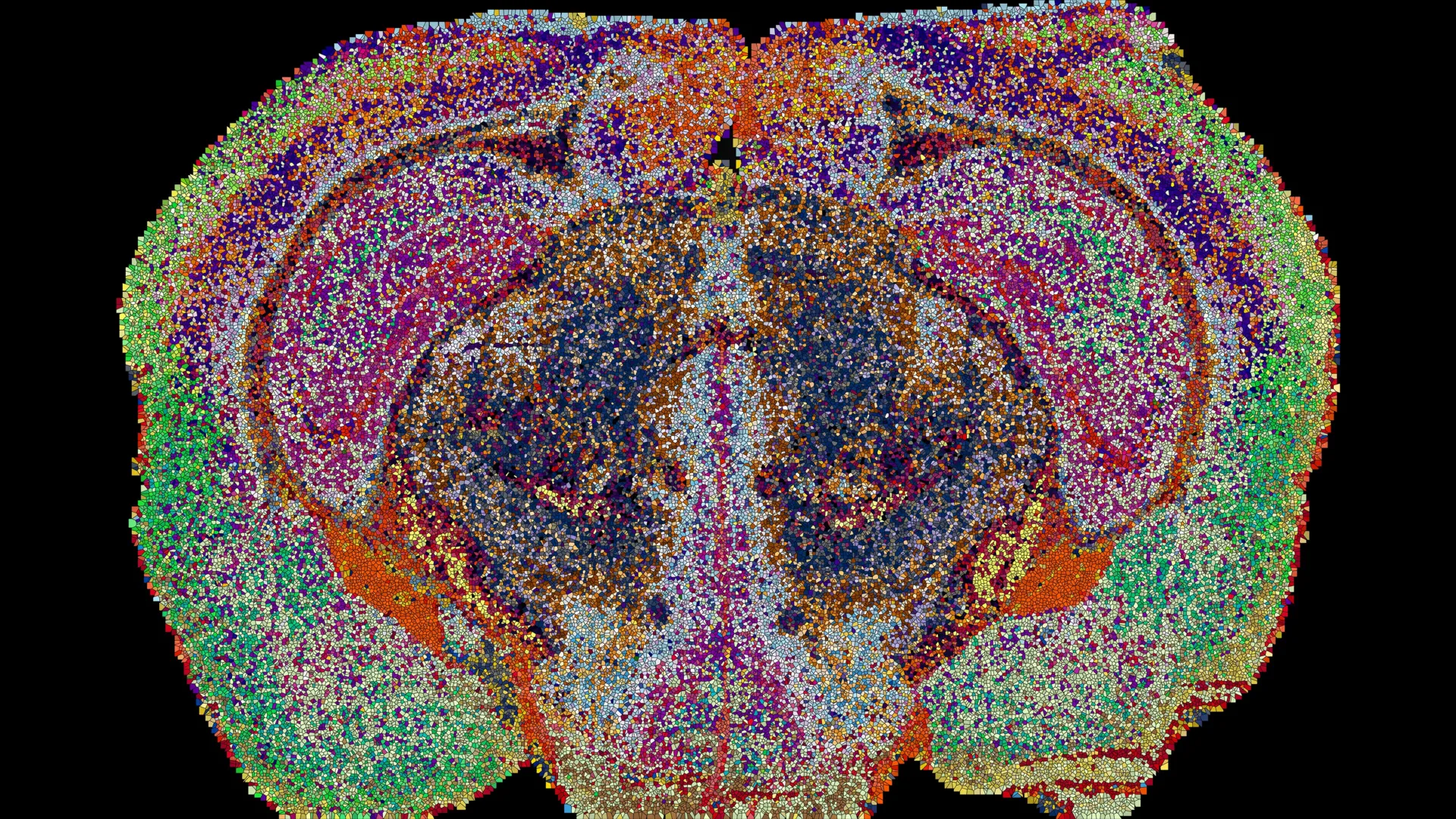
Scientists have spent decades studying the brain’s cells, connections, genes, and proteins. Yet another essential part of brain biology has received far less attention: lipids. These fatty molecules make up the membranes surrounding neurons, contribute to the myelin insulation that protects nerve fibers, and play important roles in communication between brain cells.
Although lipids are fundamental to brain function, scientists have struggled to map where different types are located. Conventional imaging techniques cannot easily distinguish individual lipid molecules, leaving a major gap in our understanding of the brain’s chemical organization.
“So scientists have had only a blurry picture of how lipids differ from one part of the brain to another,” says Giovanni D’Angelo, professor at The Kristian Gerhard Jebsen Foundation Chair in Nutrition and Metabolism at EPFL. “That gap matters, because changes in brain lipids are increasingly linked to conditions from depression to Alzheimer’s disease.”
Researchers at EPFL have now taken a major step toward filling that gap. A team led by D’Angelo, Luca Fusar Bassini, and Gioele La Manno has created a detailed map showing how lipids are distributed throughout the mouse brain.
Their Lipid Brain Atlas reveals that these molecules are arranged in highly organized patterns. Some match familiar anatomical structures, while others expose chemical boundaries that previous approaches had overlooked. The patterns are so distinctive that researchers could identify where a brain tissue sample originated simply by examining its lipid composition.
The findings were published in Nature.
Scientists Identify 539 Distinct Chemical Zones in the Brain
To construct the atlas, researchers used mass spectrometry imaging, a technique that allows them to identify lipid molecules across thin sections of brain tissue. A laser scans each slice one location at a time, producing detailed information about which lipids are present and where they are found.
The team examined 172 different lipids in 109 brain slices collected from 11 mice. This generated approximately 7 million measurements, which scientists combined into a comprehensive 3D reconstruction using machine learning tools developed specifically for the project.
The resulting atlas revealed 539 chemically distinct territories, which the researchers named “lipizones.” Each has a characteristic combination of lipids, creating a recognizable chemical signature.
Many of these regions correspond to established brain structures and cell types. Others reveal unexpected relationships between groups of nerve cell bodies and distant regions connected by their fibers. Such connections have often been difficult to detect using maps based on gene activity.
“In effect, lipids work like postal codes, giving distant but related parts of the brain the same chemical address,” says D’Angelo.
Hidden Chemical Patterns Challenge Previous Brain Maps
The new atlas also uncovered surprising differences within parts of the brain that scientists previously considered relatively uniform.
One striking example is white matter, the tissue containing nerve fibers that connect different brain regions. Rather than having a largely consistent chemical composition, white matter contains numerous distinct lipid zones.
“This shows that the cells which make myelin are far more varied in their chemistry than their genes alone would suggest,” says Luca Fusar Bassini.
The researchers also detected previously unrecognized chemical boundaries in the choroid plexus, the structure responsible for producing cerebrospinal fluid, as well as in the tissues lining the brain’s internal cavities.
Together, these findings show that lipid mapping can reveal important features of brain organization that are not apparent from anatomy or genetic information alone.
Pregnancy Triggers Widespread Changes in Brain Lipids
Beyond identifying the brain’s chemical structure, the atlas offered new insight into how that structure changes during pregnancy.
When researchers examined pregnant mice, they found substantial shifts in lipid composition across numerous brain regions. Overall, these changes were more pronounced than the typical lipid differences observed between male and female mice.
The cortex, which forms the brain’s outer layer, showed particularly extensive changes. Meanwhile, levels of galactosyl ceramide, an important component of myelin, increased sharply throughout much of the brain’s white matter.
These findings suggest that pregnancy involves significant changes in the brain’s chemical makeup, potentially helping its neural connections adapt to the body’s changing demands.
“Together, these shifts suggest the brain retunes its own wiring to meet the demands of pregnancy,” says Gioele La Manno. “The Atlas reveals that the brain constantly adjusts its lipids to meet the body’s changing needs.”
A New Tool for Understanding Brain Aging and Disease
The Lipid Brain Atlas is freely available online, allowing scientists worldwide to explore this previously difficult-to-study aspect of brain biology.
By combining lipid information with existing genetic and cellular maps, researchers can gain a more complete understanding of how the brain is organized and how its chemistry changes over time.
The atlas also establishes a detailed reference for healthy mouse brain tissue. Scientists can use it to investigate how disruptions in lipid distribution might contribute to brain development, aging, and disorders such as Alzheimer’s disease and depression.
Although the specific mouse brain map cannot be directly applied to humans, the approach used to create it could help researchers uncover comparable patterns in the human brain.
“What transfers to humans isn’t the map, it’s the method, and the fact that we now know that a healthy brain has a very organized lipid map at all,” says Luca Fusar Bassini.
